Tuesday, 14 January 2025: 4:45 PM
334 (New Orleans Ernest N. Morial Convention Center)
Peiyuan Li, Discovery Partners Institute, University of Illinois System, Chicago, IL; and A. Sharma and R. Kotamarthi
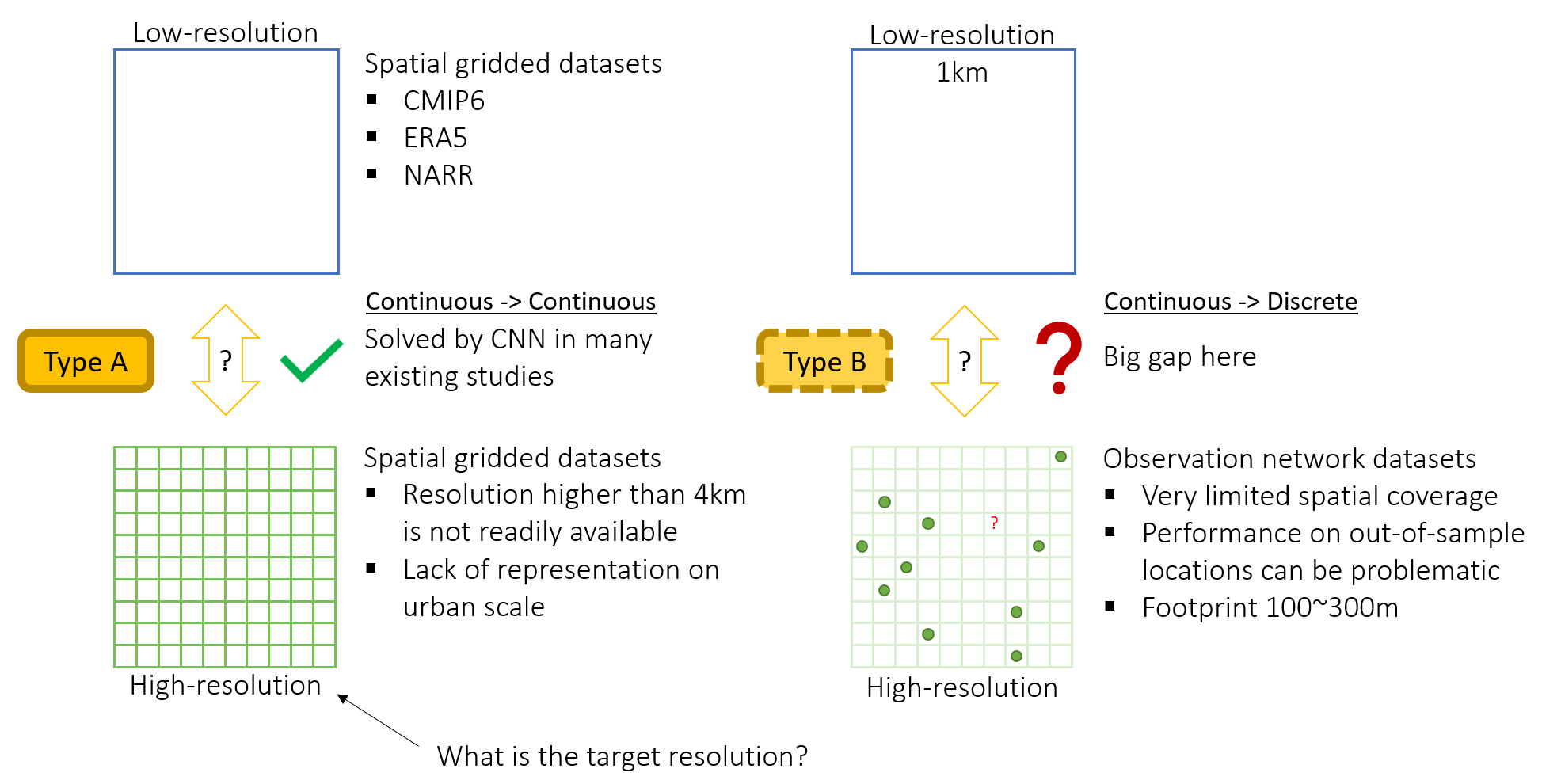
Accurately simulating climate in urban areas requires the effective integration of urban processes into climate models. This task, however, is complicated by the "resolution-coverage dilemma," where the necessity of incorporating detailed urban features must be balanced against the challenge of maintaining broad geographic coverage due to computational limits. While advances in observational tools and computational capabilities have refined models such as Global Climate Models (GCMs), Regional Climate Models (RCMs), and Urban Canopy Models (UCMs), the trade-off between high resolution and domain coverage continues to limit their utility in real-time applications. In recent years, data-driven methods, particularly those powered by machine learning (ML), have emerged as promising solutions to these challenges. These approaches leverage high-precision data sources like remote sensing, LiDAR, distributed sensors, and mobile measurements to deliver detailed spatial analyses without the heavy computational demands typically associated with traditional models. These advancements have significantly contributed to improving predictions related to temperature, air quality, and flood risks in urban environments. However, the current landscape of ML applications in urban climate research has been largely characterized by a "bottom-up" approach. While this approach has been valuable in the early stages of the field, allowing for the exploration of diverse methodologies and case-specific studies, it now presents significant limitations. The proliferation of similar studies, often isolated in their focus and methodology, has led to a fragmented research environment. This will further hinder the ability to fully leverage existing resources and integrate knowledge across different scales and disciplines, resulting in inefficiencies and redundancies.
Given the maturity of the field and the volume of research being published, there is an urgent need for a structured blueprint that can guide future studies in a more cohesive and collaborative direction. This study aims to address this critical gap by developing a hybrid ML framework that integrates diverse modeling and observational efforts across the scale spectrum. The proposed framework is designed to outline key components, ensure alignment between data and models, and establish an outcome-driven pipeline. This approach will provide urban climate researchers and practitioners with a streamlined and efficient workflow, enabling them to build on existing work rather than duplicating efforts. Moreover, the framework will enhance the strategic deployment of urban observation tools by identifying the most critical types of measurements needed and optimizing their placement from an ML perspective. By doing so, this structured approach to ML integration will not only advance the field of urban climate research but also foster greater collaboration and innovation. It will enable the research community to move beyond the limitations of the "bottom-up" approach, creating a more integrated and systematic pathway for future studies.

- Indicates paper has been withdrawn from meeting

- Indicates an Award Winner
