Monday, 13 January 2025
New Orleans Ernest N. Morial Convention Center
Harish Uppu, Louisiana State University, Baton Rouge, LA; and H. Huang
Handout
(692.6 kB)
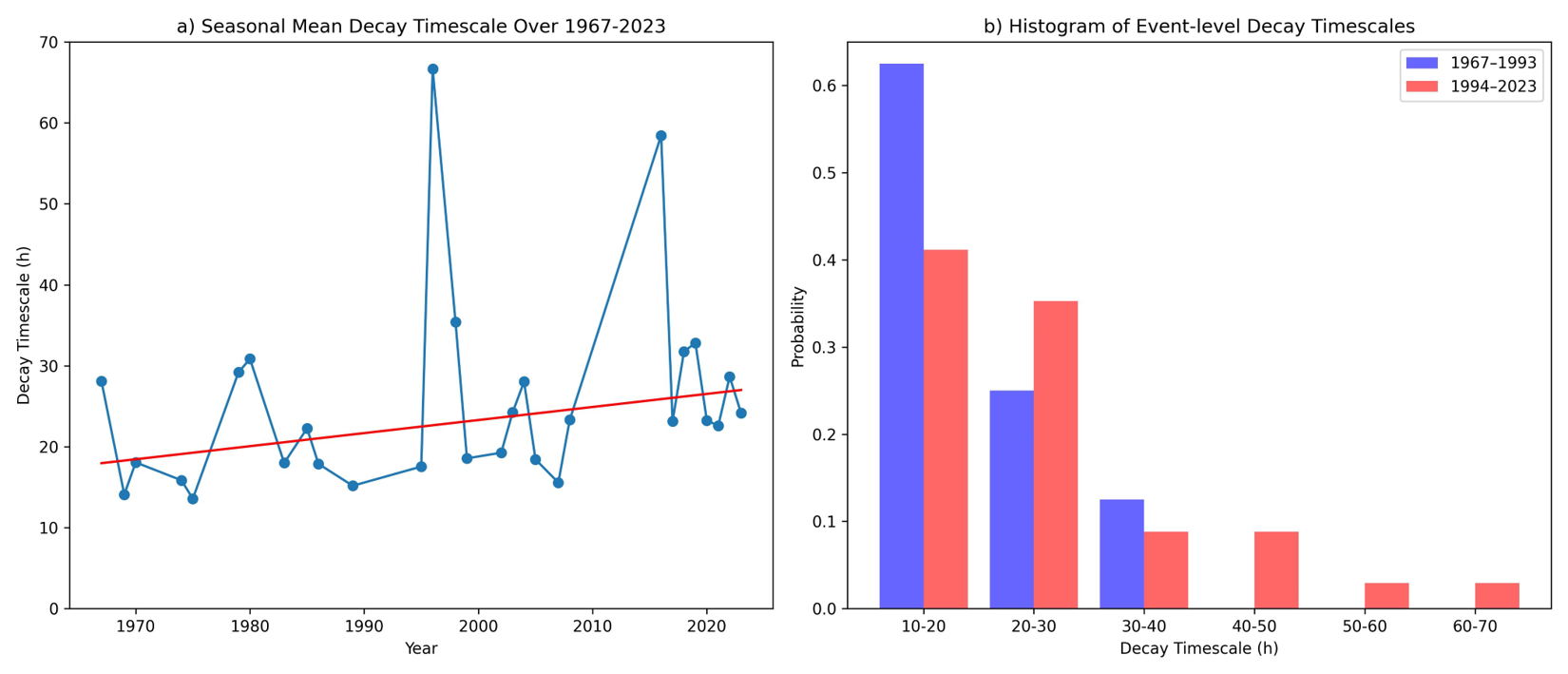
Landfalling tropical cyclones (TCs) consistently pose severe threats to the United States and cause extensive damages to natural and human systems. Understanding and predicting how inland TCs intensity (i.e., maximum sustained wind speeds) has changed is important to mitigate hurricane hazards. Decay timescale is a commonly used indicator of how fast TC intensity decays. The longer decay timescale, the slower intensity decay and stronger TC. Earlier studies show that there are uncertainties in the change of TC intensity decay over the North Atlantic basin. It remains unknown whether or not US landfalling TCs have decayed differently. Using the HURDAT2 dataset, we discovered a discernible linear trend towards longer decay timescales in the US over in the period 1967–2023. Figure 1a shows that seasonal average decay timescale has increased significantly at a rate of 1.6 hour per decade (p<0.05). This increasing trend is particularly evident post-1994. Figure 1b presents the distribution of event-level decay timescales for two periods, 1967-1993 and 1994-2023. Most US landfalling TCs between 1967 and 1993 exhibited decay timescales of 10–30 hours. During the period 1994-2023, there is a significant increase in the frequency of events with decay timescales extending into the 40-70 hour range, a pattern that was largely absent in the earlier period.
To understand the implications of the lengthening decay timescale on existing TC prediction models, this study further evaluates the performance of a widely used TC decay model developed by Kaplan and DeMaria in 1995 (hereafter referred to as the KD95 model). The model, based on a fixed decay timescale of 10.5 hours, accounted for 91% of the variation in US landfalling hurricane wind speeds from 1967 to 1993. However, the slower decay rates in recent decades raises the question on the model's capability in predicting inland TC wind speeds in the current climate state. This research seeks to refine the KD95 model’s decay parameters to better capture observed wind speed changes from 1967 to 2023. We find that incorporating time-varying decay parameters can significantly improve the model’s predictive skills. This work has important implications on TC forecasting and hazard mitigation. The updated empirical model, grounded in the latest observational data, would provide more reliable predictions of inland TC intensity, particularly in the context of a changing climate. The information can inform future improvement of TC forecasting models which would benefit hurricane warnings and hazard mitigation.

- Indicates paper has been withdrawn from meeting

- Indicates an Award Winner
