
We sampled airmasses as they moved 2km inland from the coast, switching between an aerosol observing system inlet and a ground-based counterflow virtual impactor to sample the activated particles during cloud events. Cloud droplet residuals were analyzed to compare the activated to the non-activated particles. We focus on chemical composition using aerosol mass spectrometry to determine the organic and inorganic fractions for the in-cloud and out-of-cloud periods. We utilized a soot-particle aerosol mass spectrometer (SP-AMS) and a single particle soot photometer (SP2). We also measured the water uptake of particles at relative humidity levels below and above 100% using our custom humidified cavity attenuated phase shift particulate matter single scattering albedo (SSA) and a cloud condensation nuclei (CCN) counter.
The initial results from the aerosol measurements on the GCVI inlet illustrated differences in chemical composition between the cloud residuals and out-of-cloud aerosols observed during the periods just prior and after the cloud event. We compared properties of interstitial (non-activated) particles and particles observed during cloud-free periods and found that the inorganic nitrate fraction increased 2-fold and chloride fraction increased 3-fold in the cloud droplet residuals relative to the interstitial aerosol. However, composition varied between different cloud events from different airmasses that include urban, remote/clean, marine/coastal etc., potentially due to sources, aging and transport as well as the level of cloud processing. Preliminary analysis also indicated that the cloud residuals were larger in size than the non-activated particles. Reasons for this may hint at physical changes in the aerosol due to cloud processing that would impact both aerosol and cloud lifecycles. Our direct observations of natural marine and anthropogenic urban aerosol processing can be used to constrain the current understanding and model parameterizations of aerosol-cloud interactions for marine and coastal boundary layer clouds that are important to reduce uncertainties for climate.
Figure Caption: In-cloud sampling location at EPCAPE-PT-LANL: (a) main inlet and ground-based counterflow virtual impactor (GCVI) for in-cloud sampling; (b) measurement site on Mt. Soledad. Non-refractory aerosol chemical composition in-cloud and out-of-cloud during: (c) time series of temperature (T), relative humidity (RH), and the fraction of non-refractory aerosol chemical composition; (d) mass fractions and concentrations.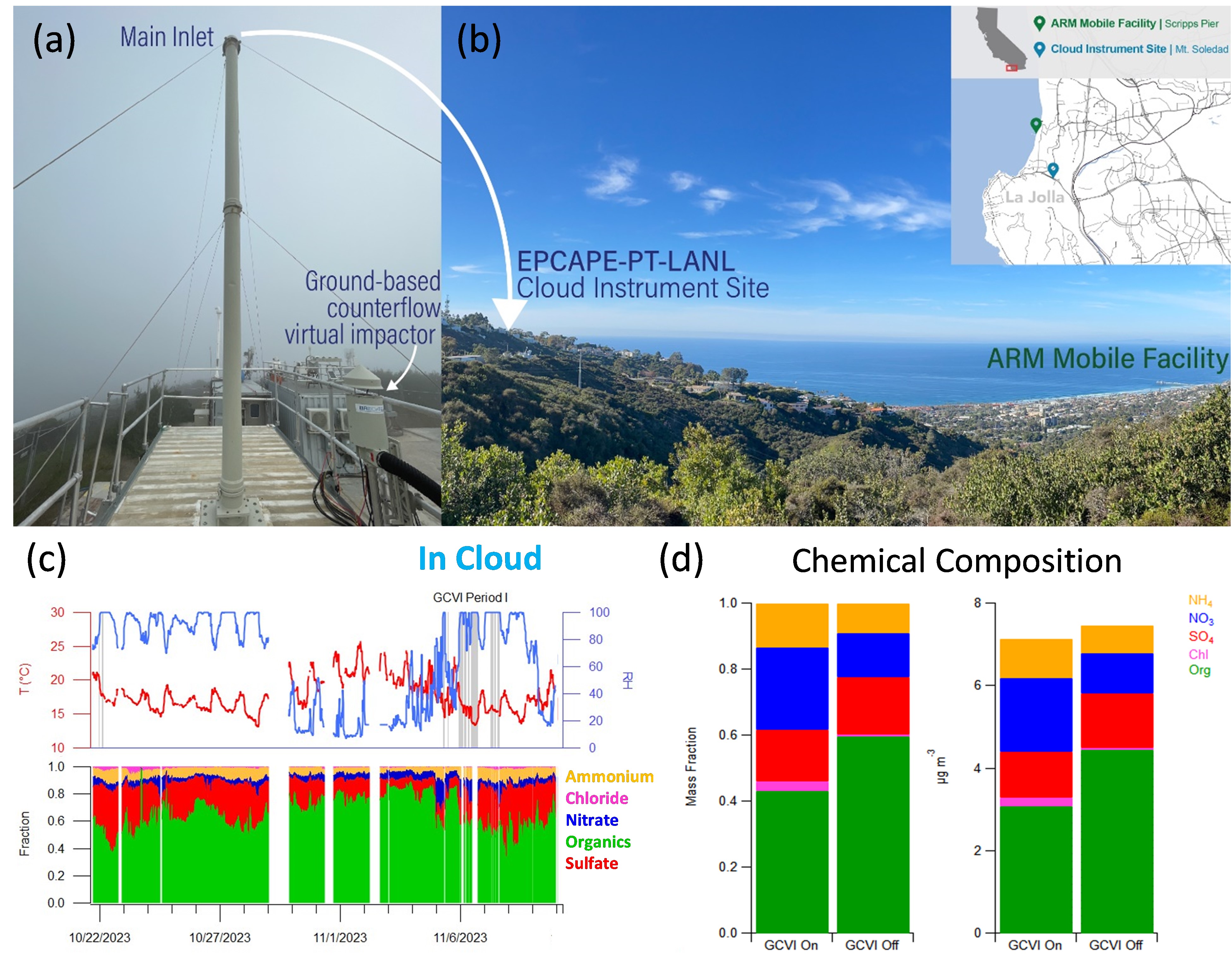
 - Indicates paper has been withdrawn from meeting
 - Indicates an Award Winner