
AR Recon was also the core of one of the recommendations in NOAA/Science Advisory Boards’ “Priorities for Weather Research” (PWR Report) created in 2021 in response to direction from Congress for the NOAA SAB to make recommendations spanning a decade. More recently, in late 2023, The Atmospheric Rivers Observations and Warnings Act (ARROW Act) was signed into law as part of the National Defense Authorization Act after approval by the US Senate, House and President Biden. It specifies AR Recon be conducted “...over the eastern, central and western north Pacific Ocean, the Gulf of Mexico and the western Atlantic Ocean...,” and that is “Participate in the research and operations partnership that guides flight planning and uses research methods to improve and expand the capabilities of weather reconnaissance over time...” In 2024, for the first time, AR Recon missions were conducted as a demonstration in the western Pacific, from Guam.
The schematic Figure (from Lavers et al. BAMS, 2024) illustrates the broad array of observations used by AR Recon. The foundational observations within AR Recon are dropsondes, which provide atmospheric vertical profiles of temperature, moisture, winds, and pressure at targeted locations over the northeast Pacific, but AR Recon includes many other data streams via robust partnerships. Partners include the Scripps Lagrangian Drifter Laboratory-based NOAA funded Global Drifter Program, prototype data streams for airborne radio occultation based at Scripps, targeted radiosonde releases by CW3E after AR landfall, and others. CW3E partners closely with NCEP Environmental Modeling Center to carry out near real-time data denial experiments to examine the data impact on the Global Forecast System. Data denial efforts are also conducted in partnership with other global operational modeling centers in the off-season. This presentation will cover the accomplishments of the AR Recon RAOP with a focus on results from data impact studies, program evolution, and future plans to continue to advance national weather services in partnership with NOAA based on accomplishments to date.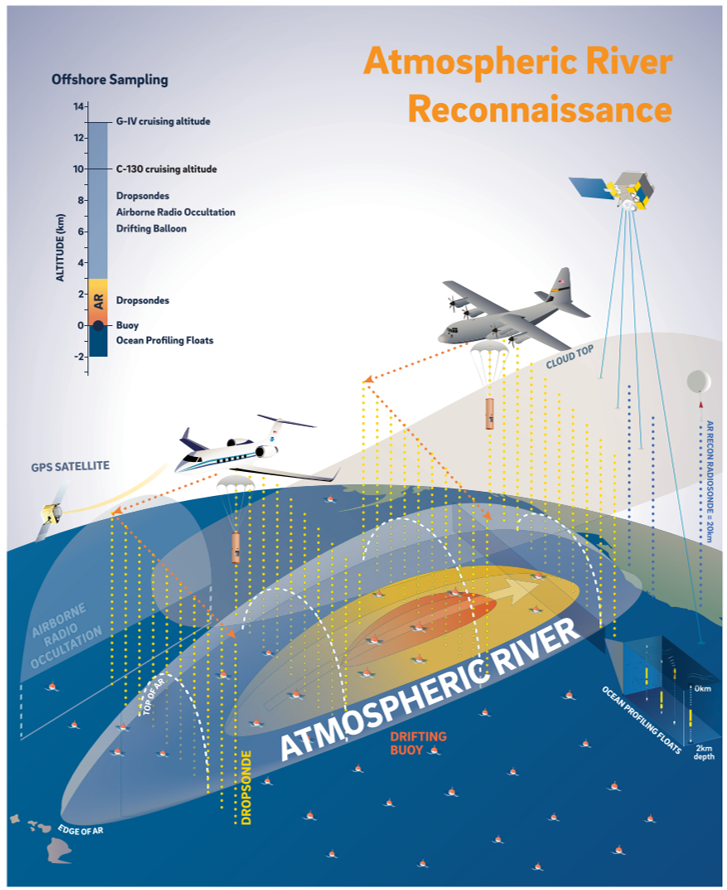
 - Indicates paper has been withdrawn from meeting
 - Indicates an Award Winner