
Wednesday, 15 January 2025: 11:45 AM
217 (New Orleans Ernest N. Morial Convention Center)
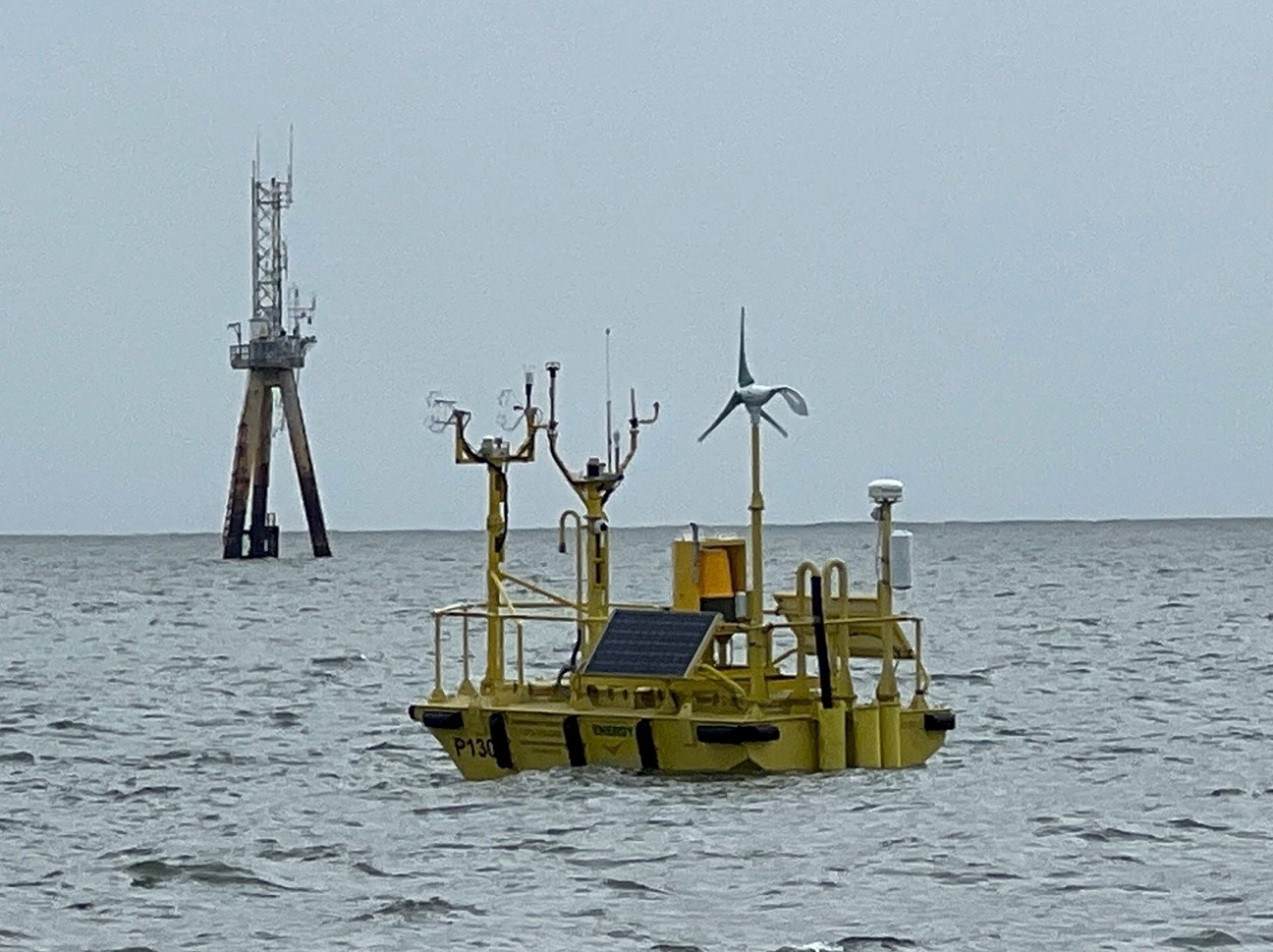
Wind resource forecast models have potential to improve the efficiency of offshore wind turbine operations and the integration of generated electricity into the power grid. The forecast models require accurate representation of marine atmospheric boundary layer (MABL) physics and surface layer parameterization schemes that may be site specific. To assess and improve these “flux-profile relationships”, we equipped a Pacific Northwest National Laboratory (PNNL) floating lidar buoy with an automated eddy covariance (EC) package to measure air-sea fluxes of momentum and sensible and latent heat. In May 2024, the buoy was deployed within the Wind Forecasting Improvement Project (WFIP3) zone, approximately 50 miles southeast of the eastern tip of Long Island. The EC system was designed to be robust, with dual 3D ultrasonic anemometers, both open- and closed-path InfraRed Gas Analyzers (IRGAs), and a liquid water rejection system. Platform motion corrections of the 10 Hz 3D wind vector are computed in real time by a commercial datalogger, enabling onboard calculations of motion-corrected 10-minute turbulent air-sea fluxes that are transmitted to shore-based servers each hour. An evaluation deployment of the “Flux-Lidar Buoy” conducted between Jan–May 2024 near the Martha’s Vineyard Coastal Observatory’s Air-Sea Interaction Tower (ASIT) included more than 8000 10-minute intervals. Preliminary estimates of the drag coefficient from both the ASIT and WFIP3 deployments, calculated using onboard-computed momentum fluxes, show close agreement with a simple bulk drag parameterization (Garratt 1977) without additional corrections or quality control measures beyond what is performed onboard. Ongoing work includes validating the buoy-based fluxes using fixed EC sensors on the ASIT tower, and comparing the fluxes with the NOAA COARE bulk air-sea flux algorithm. Future work includes integrating the EC fluxes with the collocated lidar-measured vertical wind profiles to assess flux-profile relationships over the open ocean. We aim to characterize the fluxes, turbulence, and wind profiles in near real-time, enabling efficient evaluation and potential improvement of wind resource forecast models and their underlying marine surface and boundary layer parameterization schemes.
 - Indicates paper has been withdrawn from meeting
 - Indicates an Award Winner