
In 2016, NASA launched the Cyclone GNSS (CYGNSS) mission, deploying eight equatorial-orbiting GNSS-R satellites. The onboard CYGNSS system integrates observations over a 0.5-second period, resulting in a spatial resolution of approximately 3.5 km along-track and 0.5 km across-track. The GNSS-R instrument provides delay-Doppler maps (DDMs) of reflected power, which can be used to estimate soil moisture through reflectivity measurements (Chew et al., 2016). More recently, Spire Global has developed GNSS-R satellites capable of delivering up to 32 simultaneous DDM reflection measurements. These constellations capture reflections at near-nadir elevations (20-90 degrees). The Spire GNSS-R receiver enhances coverage by processing signals from multiple GNSS systems, including Galileo, GPS, Beidou, QZSS, and GLONASS (Jales et al., 2023).
Accurate simulation of reflectivity is essential for interpreting GNSS-R signals and retrieving soil moisture. A critical component of these simulations is the soil permittivity, which relates the soil dielectric constant to soil moisture (Edokossi et al., 2020). Two widely used soil permittivity models are the generalized refractive mixing dielectric (GRMD) model (Mironov et al., 2004) and the semi-empirical mixing dielectric (SMD) model (Dobson et al., 1985, 1995). The GRMD model is valued for its accurate estimation for the given soil type, though it requires soil permittivity measurements for the specific soil type being studied to estimate soil permittivity at moisture levels different from the input data. In contrast, the SMD model, developed through precise experiments on soil permittivity across five soil types at a temperature of 22°C, provides a more detailed account of soil texture and water content, offering semi-empirical predictions of soil permittivity for a range of soil textures.
Recent experiments have demonstrated that soil dielectric properties are significantly influenced by temperature variations across a broad range, from 0 to 50°C (Wraith et al., 1999; Zhou et al., 2021). Neglecting the effect of soil temperature in modeling soil permittivity can introduce substantial uncertainty in soil moisture retrieval from remote sensing data. To address this issue, a temperature-dependent soil permittivity (SMD-T) model has been proposed and successfully applied in simulating radiometer responses at P- and L-band frequencies (Li et al., 2024).
This research explores the application of the SMD-T model for simulating reflectivity by incorporating temperature effects into the traditional SMD model. The SMD-T model accounts for temperature impacts on the relaxation time and the permittivity of free water, using recent laboratory measurement data from George Washington University (Lang et al., 2023). The SMD-T model has been evaluated against the SMD model across various temperatures for five soil types at 1.4 GHz and 0.75 GHz, relevant for radiometer applications. This paper extends the comparison to 1.575 GHz for GNSS-R retrieval. An example using sandy loam soil is presented in Fig. 1 (refer to the extended abstract). As expected, at 22°C, the SMD-T model aligns with the SMD model, reflecting only soil moisture changes. However, soil permittivity decreases as temperature increases for a given soil moisture level. The percentage difference between the SMD-T and SMD models is evaluated, showing that temperature has a nonnegligible effect on the soil dielectric constant for moist soil. At a soil moisture level of 0.50 cm³/cm³, the real part of the dielectric constant changes by +7.66% at 0°C and -8.71% at 50°C, while the imaginary part varies by +87.98% at 0°C and -47.53% at 50°C.
This research incorporates temperature modifications into the forward model for soil moisture retrieval from reflectivity, addressing the potential uncertainty introduced by soil temperature variations. By retrieving soil moisture from reflectivity, the relationship between soil permittivity, soil moisture, and temperature is established, as illustrated in Fig.3. For example, the estimated soil moisture could vary between ~0.2 to 0.5 cm³/cm³ if soil temperature is not considered, resulting with a real part of 14 and an imaginary part of 2.0 (as highlighted in Fig. 3). This highlights the importance of applying the SMD-T model in soil moisture retrieval to reduce uncertainty. A comparative study of soil moisture estimation using CYGNSS and Spire GNSS-R data is currently underway, covering diverse landscapes with varying soil temperatures. The soil temperature data will be extracted from Global Modelling and Assimilation Office (GMAO). The differences in soil moisture retrievals from CYGNSS and Spire GNSS-R data will also be analyzed in this study.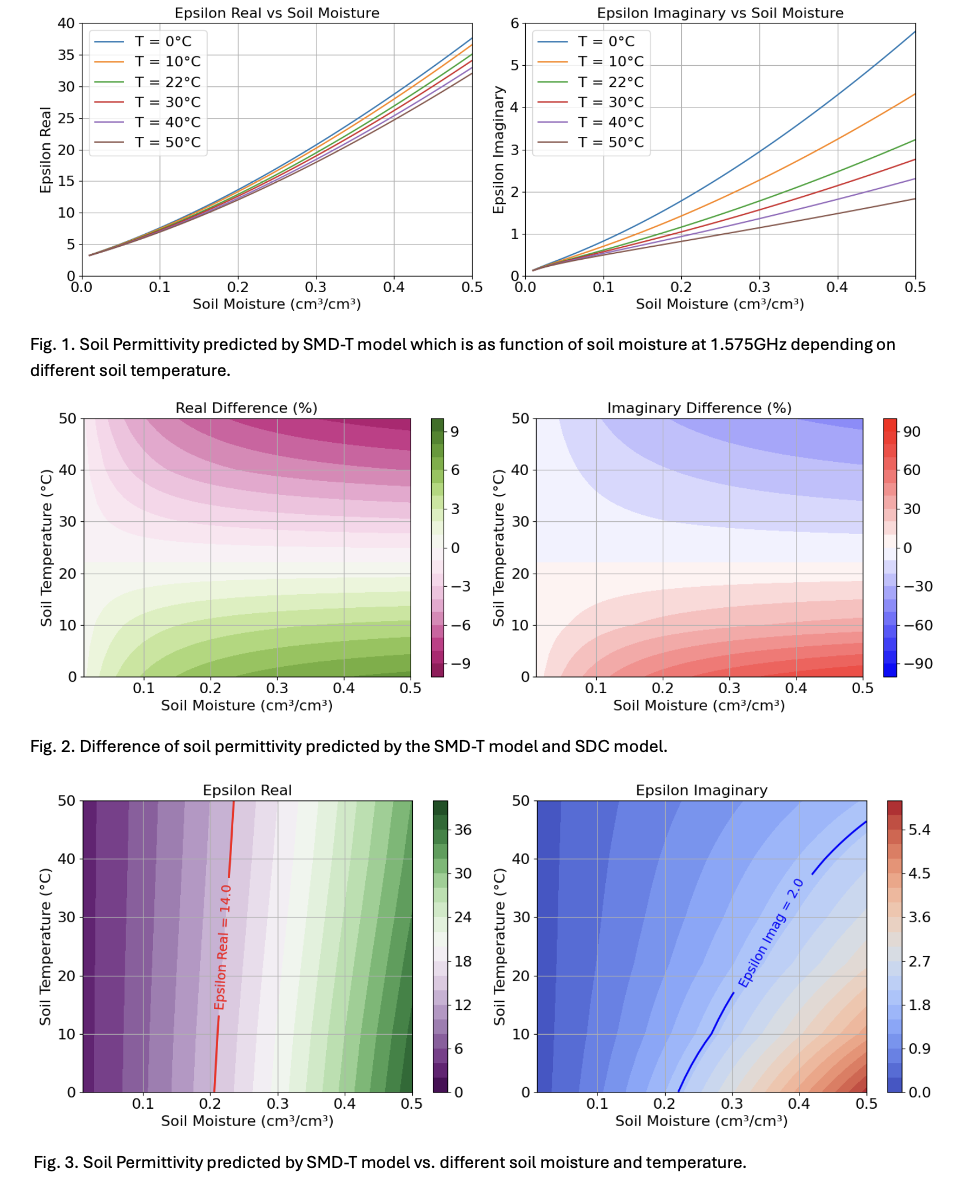
 - Indicates paper has been withdrawn from meeting
 - Indicates an Award Winner