
This work presents a framework to project new energy demands for the New York Metro Region under a transition to full electrification, considering a changing climate toward 2050. In this region, buildings account for 70% of the total energy consumption and carbon emissions. The focus is on an electrified winter for buildings and EVs, evaluating the energy infrastructure and environmental impacts of such major shifts, particularly the adoption of air source heat pumps replacing natural gas boilers for buildings at a constant annual adoption rate towards 2050. The framework quantifies baseline and climate-dependent energy loads separately, with baselines constructed from historical data evolving with EV adoption rates. For future climate forcing we consider two possible Socio-Economic Pathways (SSPs) climate scenarios from the Sixth Assessment of the Coupled Model Intercomparison Project (CMIP6), SSP2-4.5 and SSP5-8.5, representing low and high greenhouse gas scenarios, respectively. The specific future climate ensemble used is the downscaled 12 km resolution IM3/HyperFACETS Thermodynamic Global Warming (TGW) Simulation Dataset for the Continental US. The Weather Research and Forecasting model coupled with a multi-layer building environment parameterization and building energy model (uWRF), is used to perform the climate and energy analysis. uWRF is forced by the global climate ensemble to produce future local climates and energy demand projections at 1.33-km spatial resolution.
Model results are calibrated with regional weather records for a benchmark period (2010-2020) and with Zonal Energy demand from New York Independent System Operator (NYISO) with excellent approximation. Preliminary results indicate a baseline load (demand without building) with peak of 7GW for New York City, and future projections of winter peak increase of two-fold factor (from 8GW to 16 GW) for the City, with significant reduction of the winter UHI. The presentation will outline context, methods, results, and challenges to meet these goals such as adoption rates and generation from renewables to meet these new demands.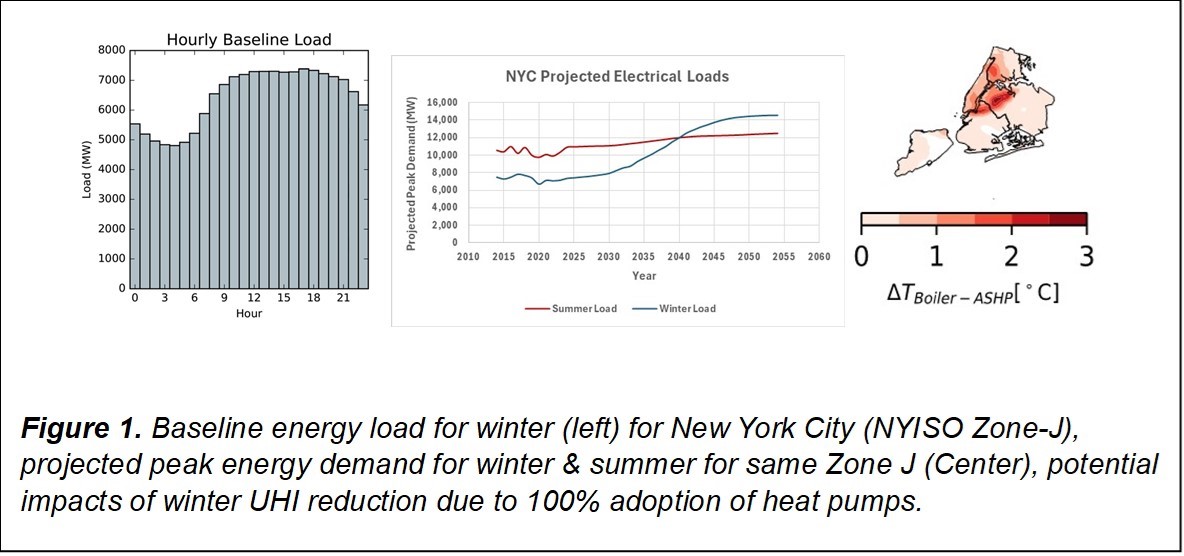
 - Indicates paper has been withdrawn from meeting
 - Indicates an Award Winner