
Wednesday, 15 January 2025
Hall C (New Orleans Ernest N. Morial Convention Center)
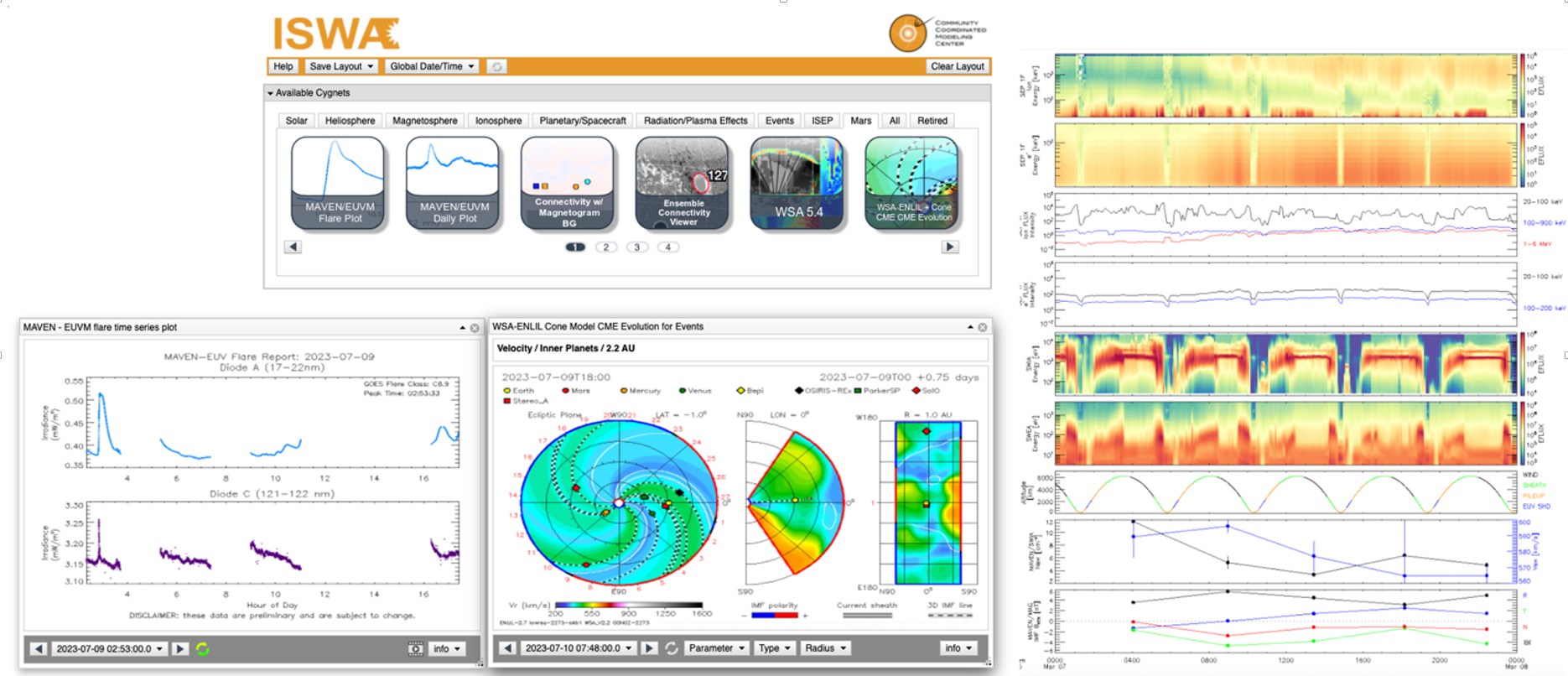
Space Weather science has traditionally explored the Sun’s immediate influence on the Earth system and its technology, including the direct impact on humans. With increasing missions leaving Earth, as well as plans to send humans to Mars, space weather studies have recently expanded to include not only Mars, but also the entire heliosphere. Two critical assets that have made studying space weather at Mars possible are NASA’s Mars Atmosphere and Volatile Evolution mission (MAVEN) and the Mars Science Laboratory Radiation Assessment Detector (MSL/RAD). MAVEN has instruments on board to not only study the solar irradiance, solar wind, and energetic particles, but also the in-situ and remote sensing instruments to directly measure the Sun’s impact, and its variability, on the Martian environment. MSL/RAD directly measures the radiation on the surface of Mars. Additionally, the well-established personnel, tools, and methods of the Community Coordinated Modeling Center (CCMC) and Moon to Mars Space Weather Analysis Office (M2M SWAO) at NASA Goddard Space Flight Center (GSFC) make a perfect pairing to provide the assets capable of real-time space weather monitoring and data serving of the space weather at Mars. At its initial stage, the Mars Space Weather Collaboration is focusing on proof-of-concepts to explore what planetary data are available, and if it is possible to implement these data as near real-time space weather information at Mars. Additionally, we are demonstrating these abilities as a call for accommodations and acceptance of Space Weather instruments and real-time data streams on future interplanetary missions. The ultimate goal of the team is to understand the gaps in space weather research and monitoring at Mars and beyond with emphasis on open collaboration with others to fill in those gaps. This presentation will provide an overview of the current efforts of the Mars Space Weather Collaboration, as well as present some of the open-access tools developed for the community to monitor space weather at Mars.
 - Indicates paper has been withdrawn from meeting
 - Indicates an Award Winner