
Wednesday, 15 January 2025: 2:00 PM
220 (New Orleans Ernest N. Morial Convention Center)
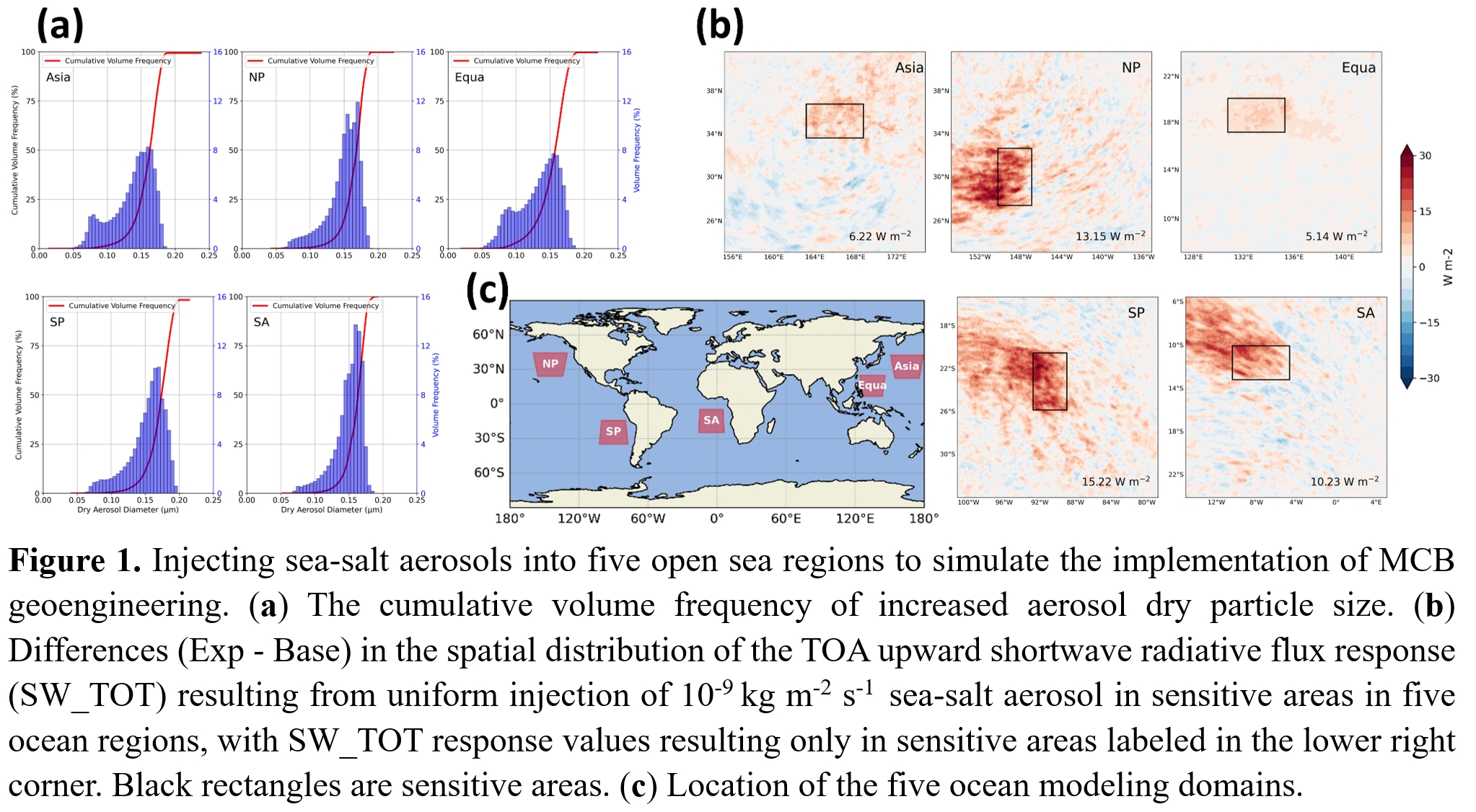
Marine Cloud Brightening (MCB) geoengineering aims to inject aerosols over oceans to brighten clouds and reflect more sunlight to offset the impacts of global warming or to achieve localized climate cooling. There is still controversy about the contributions of direct and indirect effects of aerosols in implementing MCB and the lack of quantitative assessments of both. Here, we conducted experiments with injected sea-salt aerosols in the same framework for five open oceans around the globe. Our results show that injecting sea-salt aerosols uniformly over the five ocean regions at 10-9 kg m-2 s-1 resulted in a change of 10.96–24.50 W m-2 shortwave radiation flux at the top-of-atmosphere (TOA) and increased the regional average cloud albedo by 0.13–0.20. The uniform injection strategy that did not depend on wind speed captured the sensitive areas of the regions that produced the largest radiative perturbations during the implementation of MCB. When the injection amounts were low, the sea-salt aerosols dominated the shortwave radiation mainly through the indirect effects of brightening clouds, showing obvious spatial heterogeneity. As the indirect effects of aerosols saturated with increasing injection rates, the direct effects still increased linearly and exceeded the indirect effects, producing a consistent increase in the spatial distributions of TOA upward shortwave radiation. The shortwave flux changes caused by clouds after injecting sea-salt aerosols are mainly driven by increases in cloud droplet number concentration (CDNC) and liquid water path (LWP, each accounting for about 40%–50%), with a small contribution from cloud fraction changes (less than 10%). Our research emphasizes that MCB was best implemented in areas with extensive cloud cover, while the aerosol direct scattering effects remained dominant when clouds were scarce.
 - Indicates paper has been withdrawn from meeting
 - Indicates an Award Winner