
Currently, only conventional PRO products (e.g., bending angle) are assimilated into Numerical Weather Prediction (NWP) forecast models. Methods to simulate the polarimetric RO profile are being developed by operational weather agencies, for eventual implementation into a data assimilation system. While the comparisons between PRO forward operator simulations and observed PRO profiles is promising, further assessment is needed to identify which types of weather systems one could expect a future PRO assimilation to yield the most impact.
However, the fact that the ΔΦ signal is not currently assimilated allows its use as an independent diagnostic. This knowledge of the presence of heavy precipitation and its associated vertical extent is useful for the evaluation and diagnosis of precipitation as revealed by forecast, climate and reanalysis data products. Furthermore, the polarimetric profile can be independently compared to the precipitation structure as revealed by near-coincident complementary satellite data, such as the large suite of passive microwave (MW) data (e.g., ATMS, GPM).
This presentation will highlight selected science topics that emerged at the recent (November 2023) 2nd Polarimetric Radio Occultations User Workshop. For example, polarimetric RO data will be highlighted as one means to evaluate the different precipitation vs water vapor relationships that arise when conditioning these same data on different pressure level layers in the lower free troposphere (LFT), thereby evaluating sensitivity of convection to the moisture structure and the entrainment of environmental air. Cluster classification analyses will be described for different types of vertical ΔΦ and refractivity profiles that can occur during precipitation scenarios. 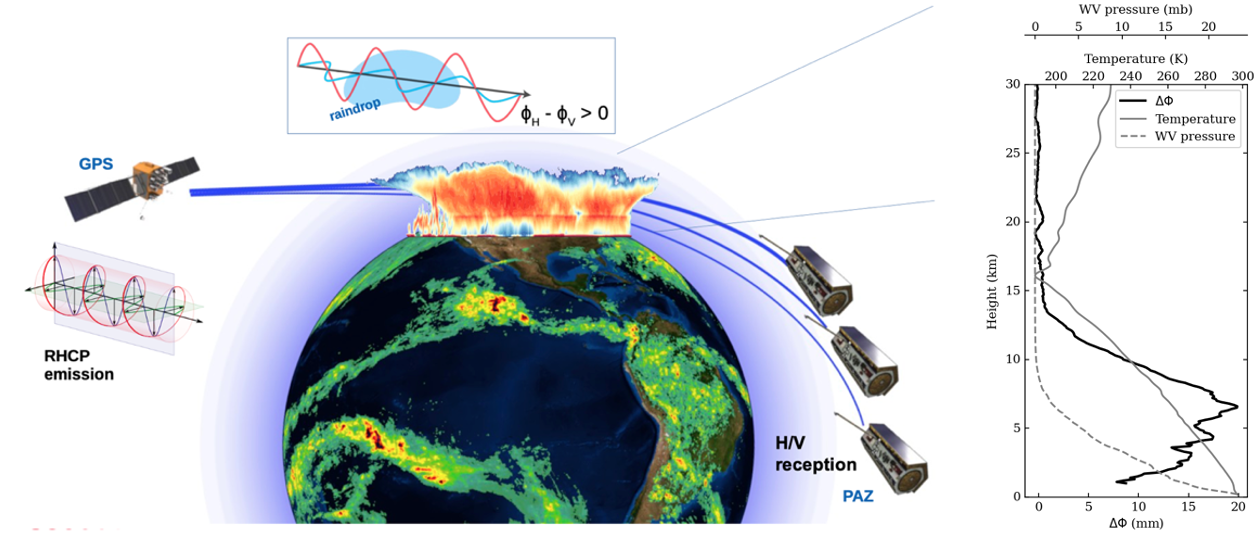
 - Indicates paper has been withdrawn from meeting
 - Indicates an Award Winner