V1A 17AEROSOL A Case Study of Observations and WRF Simulations of the Impact of Airborne Glaciogenic Seeding on Orographic Clouds and Precipitation over the Payette River Basin.

Tuesday, 7 January 2025
Zhixing Xie, Univ. of Colorado Bol, Boulder, CO; and K. Friedrich, S. A. Tessendorf, J. R. French, L. Xue, PhD, S. Chen, and C. Hohman

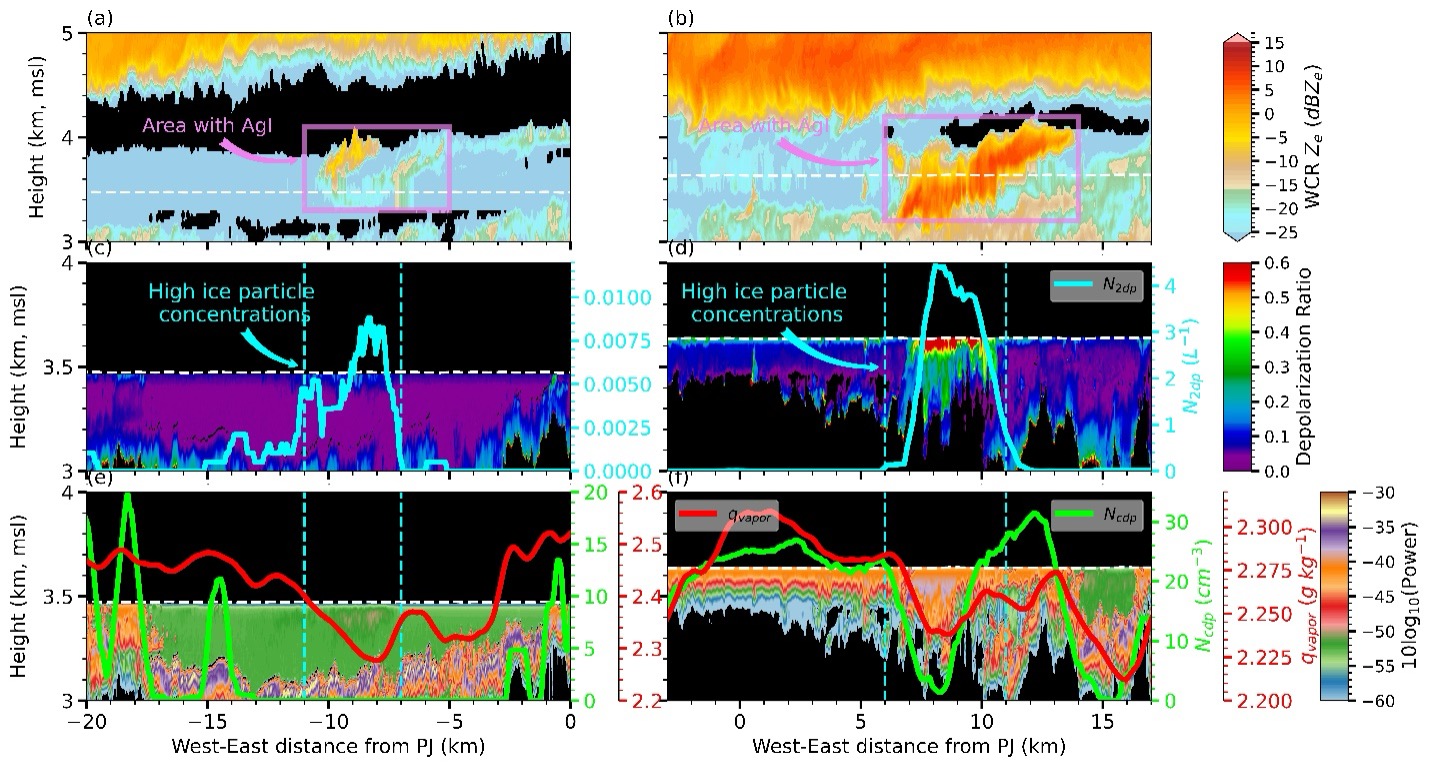
Cloud seeding with silver iodide (AgI) during winter is a widely used solution for enhancing precipitation in regions suffering from water management issues. This method has been utilized for several decades in arid and semiarid areas worldwide (Rauber et al., 2019). Addressing the challenge of assessing the impact of cloud seeding remains a complex task. However, recent advancements in observational and computational capabilities offer promising evidence that the research community is making significant progress (e.g., French et al. 2018; Tessendorf et al. 2019; Friedrich et al. 2020,2021; Xue et al. 2022). The Seeded and Natural Orographic Wintertime Clouds: Idaho Experiment (SNOWIE) conducted 21 seeding experiments with state-of-art observation instruments, including in-situ and remote sensing measurements from ground and airborne, provided an opportunity to investigate the detailed physical evolution of cloud seeding. In this study, we suggest conducting an in-depth, comprehensive analysis, utilizing observations and well-constrained numerical simulations to investigate the cloud seeding effects. We utilized radars with different wavelengths (X-band, Ka-band, and W-band) and lidar to study an airborne seeding case of SNOWIE where seeding materials were released on the top of orographic clouds and investigate cloud seeding effects on microphysical processes. The observational results indicated the snow fell out within 30-40 min after seeding operations. The high reflectivity pockets (> 15 dBZe) captured by airborne lidar and w-band cloud radar demonstrated that the high concentration of ice particles (> 4 L-1) were observed within the clouds with AgI. The in-situ probe measured the reduction of water vapor and supercooled liquid water content while large ice particle was growing (> 400 μm). In addition, we compared WRF simulations with observations and validated their performance in simulating cloud structures. We will further conduct ensemble simulations for the seeding case using the seeding parameterization developed by Xue et al. (2013 a, b) to assess cloud seeding impact. The analysis of simulation data indicated the model had a good performance in simulating the locations of seeding lines, which were reflected as zig-zag patterns 25-50 km downwind in the radar PPI map.

Reference:

French, J. R., and Coauthors, 2018: Precipitation formation from orographic cloud seeding. Proc. Natl. Acad. Sci. USA, 115, 1168–1173, https://doi.org/10.1073/pnas.1716995115.

Friedrich, K., and Coauthors, 2021: Microphysical Characteristics and Evolution of Seeded Orographic Clouds. J. Appl. Meteor. Climatol., 60, 909–934, https://doi.org/10.1175/JAMC-D-20-0206.1.

Rauber, R. M., and Coauthors, 2019: Wintertime orographic cloud seeding—Areview. J. Appl. Meteor. Climatol., 58, 2117–2140, https://doi.org/10.1175/JAMC-D-18-0341.1.

Tessendorf, S. A., and Coauthors, 2019: A Transformational Approach to Winter Orographic Weather Modification Research: The SNOWIE Project. Bull. Amer. Meteor. Soc., 100, 71–92, https://doi.org/10.1175/BAMS-D-17-0152.1.

Xue L. and Coauthors, 2022: Comparison between Observed and Simulated AGI Seeding Impacts in a Well-Observed Case from the SNOWIE Field Program. J Appl Meteorol Climatol, 61, 345-367, https://doi.org/10.1175/JAMC-D-21-0103.1

Xue, L., and Coauthors, 2013: Implementation of a silver iodide cloud seedingparameterization in WRF. Part I: Model description and idealized 2Dsensitivity tests. J. Appl. Meteor. Climatol., 52, 1433–1457, https://doi.org/10.1175/JAMC-D-12-0148.1.
- Indicates paper has been withdrawn from meeting
- Indicates an Award Winner