
This presentation details how a new-generation of low-light visible satellite sensors—the Day/Night Band (DNB) on NOAA's Visible Infrared Imaging Radiometer Suite (VIIRS)—is able to detect and quantify milky seas for the first time. Nightly DNB imagery sequences reveal contiguous swaths of luminous waters drifting with the currents and persisting for days up to weeks on end in the historically-reported milky sea hot-zones of the Northwest Indian Ocean and the Maritime Continent. Characteristics of the satellite-retrieved sea surface temperature, oceanic biomass, and analyses of surface current dynamics in milky sea environments have inspired a ‘Natural Flask’ hypothesis, wherein natural processes serve to isolate and incubate a uniquely cultured body of water. These satellite observations have also opened the possibility of deploying to an active milky sea for in situ sampling.
We highlight a milky sea event spotted in mid-2019—a massive glowing sea spanning over 100,000 km2 (the same size as Iceland) that persisted in a region south of Java for at least 40 days. The case was later confirmed by a yacht crew, yielding the first known surface-based photos of a milky sea. We explore possible connections to the Indian Ocean Dipole and the Indian Monsoonal modes, and consider the air-sea-biosphere interactions at the forefront of Earth System science. Understanding the nuances of milky seas can shed light how primary production may respond to a changing climate, including extreme behaviors of the microbial carbon pump response, and how coupled-system processes communicate and indeed connect across scales from microscopic to global. Arriving at solutions to this scientific mystery will require breaking down the traditional silos of atmospheric science, oceanography, and marine biology / microbial ecology.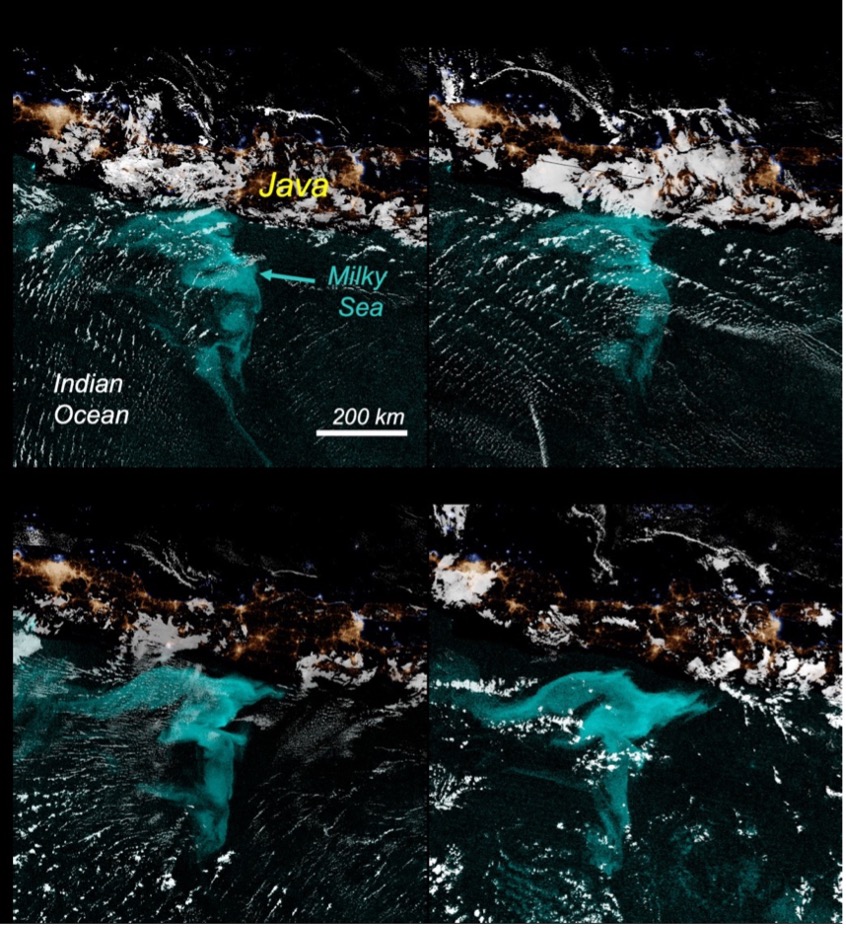
Supplementary URL: https://www.nature.com/articles/s41598-021-94823-z
 - Indicates paper has been withdrawn from meeting
 - Indicates an Award Winner