
Monday, 13 January 2025: 11:15 AM
245 (New Orleans Ernest N. Morial Convention Center)
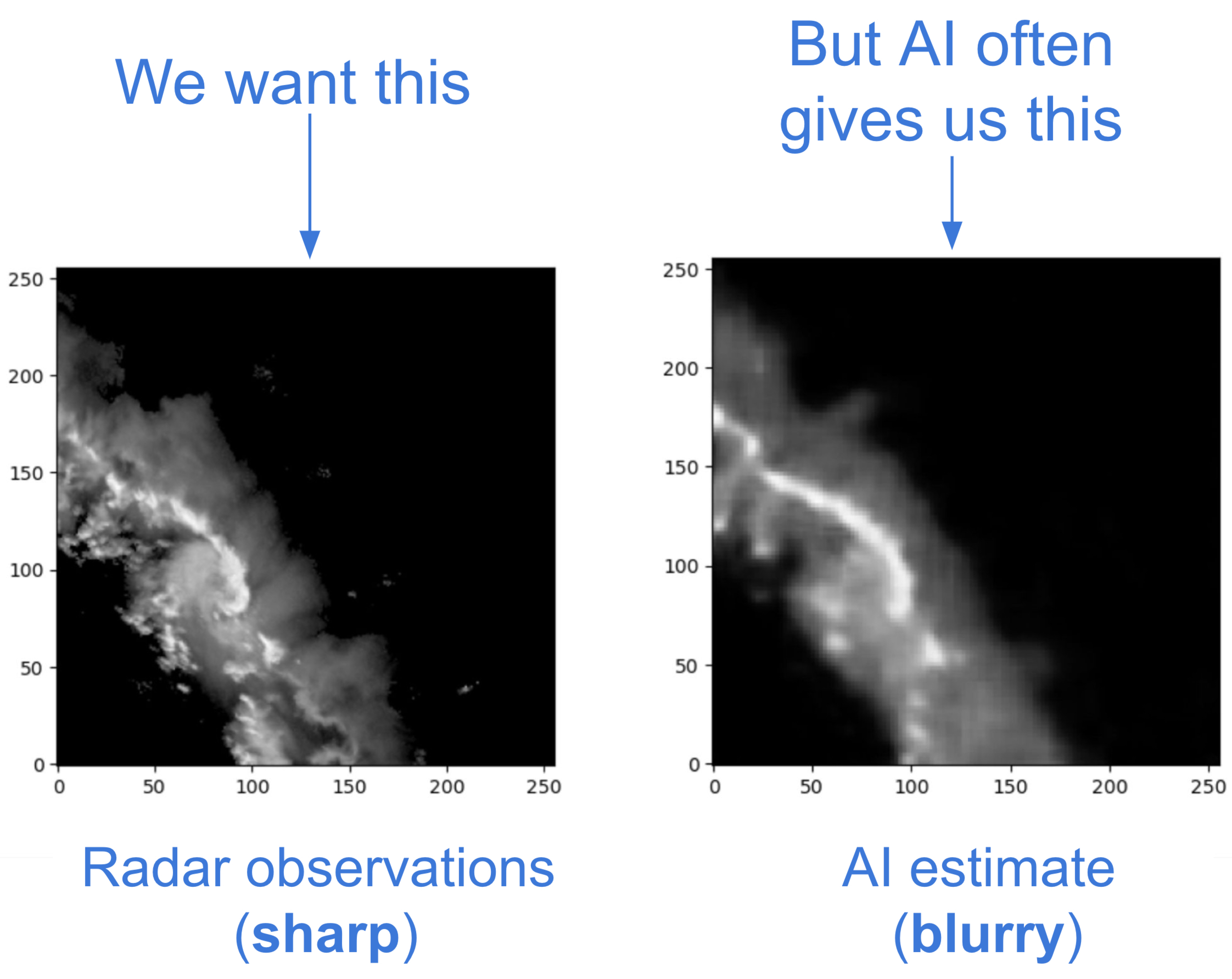
AI-based algorithms are emerging in many meteorological applications that produce imagery as output, including for global weather forecasting models. However, the imagery produced by AI algorithms, especially by convolutional neural networks (CNNs), is often described as too blurry to look realistic, partly because CNNs tend to represent uncertainty as blurriness. This blurriness is undesirable since it might obscure important meteorological features. More complex AI models, such as generative adversarial networks (GANs) and diffusion models, generate images that appear to be sharper. In order to evaluate image sharpness of any of these algorithms we need to assess the sharpness of the output images, but there are no established sharpness metrics for meteorological imagery. Furthermore, improved sharpness may come at the expense of a decline in other performance criteria, such as accuracy. To choose a good trade-off between sharpness and accuracy for a specific task it is important to quantitatively assess both accuracy and sharpness. While there are numerous well-established measures for accuracy there is a lack of well-established measures for sharpness in meteorological imagery. This paper seeks to fill this gap by 1) exploring a variety of sharpness metrics from other fields, 2) evaluating properties of these metrics, 3) developing tools for their interpretation, such as the Gaussian Blur Equivalent introduced here, and 4) demonstrating their use for sample meteorological applications, including a case study comparing the sharpness of a few sample images generated by an AI-based global weather forecasting model (GraphCast) versus the corresponding output of a traditional numerical weather prediction model (GFS).
 - Indicates paper has been withdrawn from meeting
 - Indicates an Award Winner