Monday, 13 January 2025: 2:30 PM
224 (New Orleans Ernest N. Morial Convention Center)
Pratapaditya Ghosh, Carnegie Mellon Univ., Pittsburgh, PA; and K. J. Evans, D. Grosvenor, H. G. Kang, S. Mahajan, M. Xu, W. Zhang, and H. Gordon
Aerosol activation is critical for indirect aerosol effects on global radiative balance. The Abdul-Razzak and Ghan (ARG) activation parameterization is used with modal aerosol microphysics to represent this process in many climate models. Performance of this parameterization is sensitive to the geometric standard deviations (mode widths) of the lognormal aerosol modes. Moreover, the parameterization does not account for kinetic limitations on water uptake during activation. Here, we recommend adjustments to the parameterization that improve its performance for small mode widths and across a wider range of updrafts, and extend its range of validity to more polluted conditions where kinetic limitations on water uptake are important.
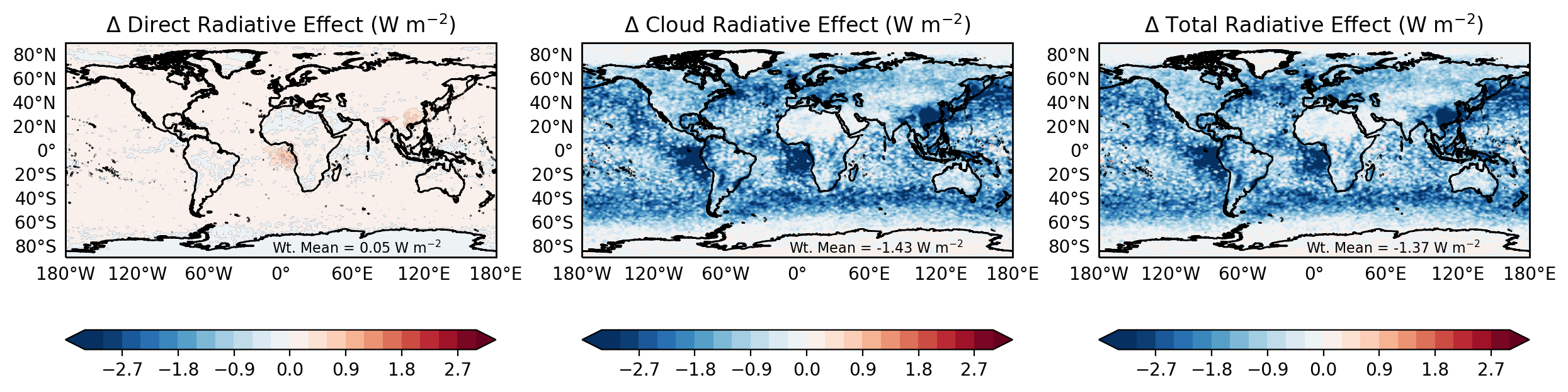
The ARG scheme is semi-empirical and calculates the maximum supersaturation and activation fraction based on two empirical constants. We optimize them by comparing with a cloud parcel model and provide better estimates of these constants. Unlike the default ARG, here we recommend that these constants should depend only on the aerosol mode width of the accumulation mode, and not on other soluble modes. For the accumulation mode width of 1.4 used in the Met Office Unified Model (UM), our modifications decrease the mean bias in activation fraction compared to a cloud parcel model from -6.6 % to 1.2 %. We implemented our improvements in the UM and compared simulated global cloud droplet concentrations with satellite observations. The simulated cloud radiative effect changes by -1.43 Wm2 and aerosol indirect radiative forcing over the industrial period changes by -0.10 Wm2.

- Indicates paper has been withdrawn from meeting

- Indicates an Award Winner
