
Tuesday, 14 January 2025: 2:15 PM
239 (New Orleans Ernest N. Morial Convention Center)
Every year, wildfires burn an average of 7.5 million acres of land and threaten life and property across the United States (NIFC, 2023). As in-situ measurements and observations of fires are often limited, remote sensing systems, like weather radars and satellites, are the most effective options to monitor fires and their evolution continuously. The National Weather Service uses the NEXRAD system to continuously monitor weather across the country at about 160 sites, and thus provides opportunities to monitor fires and smoke around the clock, year-round. NEXRAD S-band radars use a fuzzy logic hydrometeor classification algorithm (HCA) to determine the hydrometeor type within a resolution volume at each range location. To build on the current platform, we add a new smoke (SMK) class to the preexisting HCA to further improve its accuracy of classification, as smoke is currently classified as “biological scatter” (BS). Statistical analysis of radar variables in the smoke plume shows that there are significant enough differences, suggesting that a new smoke class could be added. Smoke plumes typically present very low correlation coefficient values from 0.2-0.6, which enabled smoke to be easily grouped in the non-meteorological scatterers category. Differential reflectivity (ZDR) exhibits an interesting pattern. ZDR is typically close to or below 0 dB which indicates randomly oriented scatterers and is most likely caused by the turbulent updraft above the fire. The value of ZDR increased with distance away from the fire, tending towards 5 dB, indicating horizontally oriented scatterers. This information is used to make new membership functions for the current fuzzy logic HCA. Nevertheless, the HCA is ineffective where BS and SMK values are similar, or where the underlying membership functions for the two classes overlap leading to misclassification. To address this issue, we explore a new method that involves using set radar variable parameters to detect a smoke plume on the base NEXRAD data. An example of this detection algorithm is shown below for the Smokehouse Creek fire in Texas and the Snake Trail fire in Minnesota (Figure 1). We are exploring machine learning techniques to classify smoke and active fires to provide a full scope of options for classification and detection using the NEXRAD system.
References:
NIFC, 2023: Wildfires and Acres. National Interagency Fire Center. https://www.nifc.gov/fire-information/statistics/wildfires.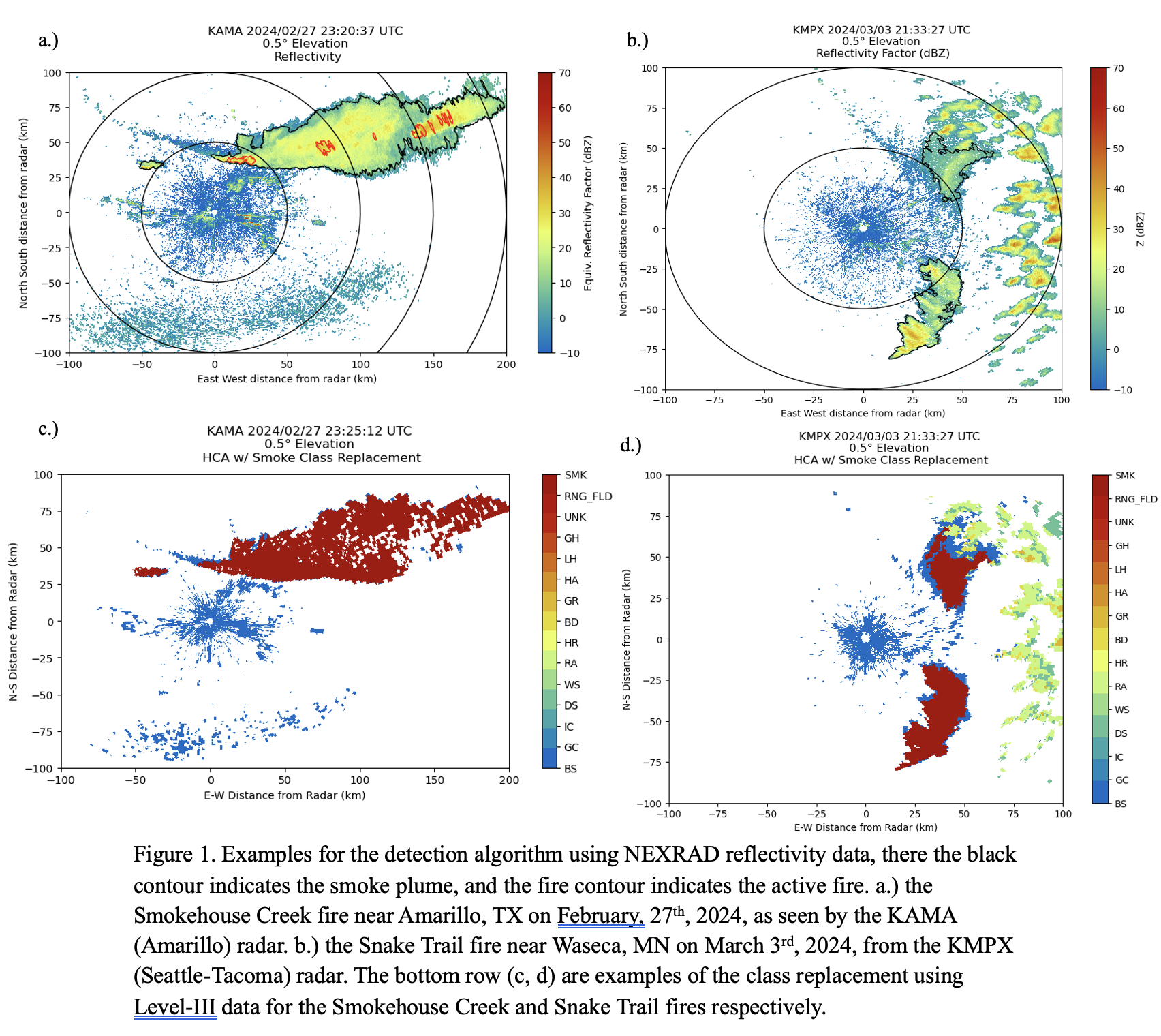
 - Indicates paper has been withdrawn from meeting
 - Indicates an Award Winner