
We use AIRS observations as a case study. Specifically, AIRS observations over the tropical oceans in 2004 are used with collocated CERES-MODIS cloud flags serving as the target labels. An equal number of cloudy and clear-sky satellite footprints are used in the study. The brightness temperatures from selected AIRS 1551 mid-infrared channels and monthly sea surface temperature are used as the original input features to the machine-learning algorithms. Three feature selection and extraction methods are assessed here, namely, forward selection, principal component analysis (PCA), and autoencoders. Four machine-learning algorithms are used in the study, i.e., random forest, linear support vector classifier, gradient boosting classifier, and 5-layer artificial feed-forward neural network (ANN). We compare the accuracy on the test dataset of these models to determine the impact of dimensionality reduction on cloud detection accuracy.
Our study showed that, as far as the classification accuracy is concerned, different combinations of dimensionality reduction methods and machine learning algorithms can either outperform or underperform compared to the same algorithms applied to the original input features. Specifically, ANN models trained on 20-80 reduced features by PCA or autoencoders outperform those trained on original data by ~0.21%-2.18%. While ANN models trained with reduced features derived from the forward selection methods show a reduction of overfitting, they do not surpass the original model regarding classification accuracy.
For linear support vector classifiers and gradient boosting classifiers, dimension reduction always leads to worse performance, suggesting a loss of useful information for cloud detection in the process of dimensional reduction. The performance of random forest models has no clear relation with respect to different dimensional reduction algorithms. Our study suggests that the PCA is a more robust choice for dimension reduction than the other two methods for the ANN model. The findings also underscore the importance of selecting appropriate dimensionality reduction techniques and the number of features tailored to specific classifiers to optimize model performance.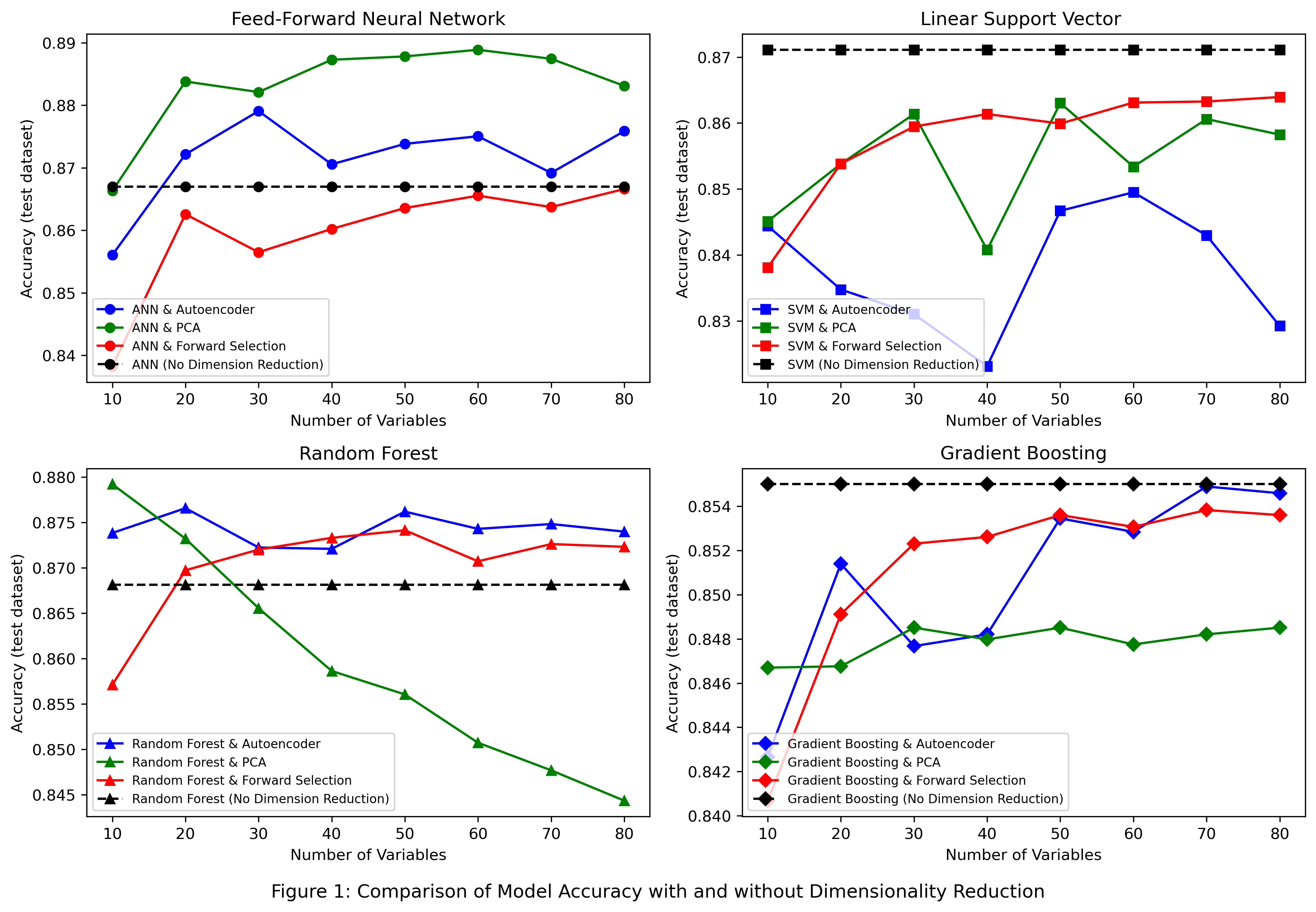
 - Indicates paper has been withdrawn from meeting
 - Indicates an Award Winner