
Handout (7.3 MB)
In the uncertainty analysis, simulated BTs were compared with observed BTs from the GPM microwave imager (GMI) across microwave frequency channels. For the 3-hour forecast, three bulk microphysics schemes were used: WSM6, Thompson, and NSSL. These three schemes have differences in their parameterized equations for prognosing rain, snow, and graupel mixing ratios, and the sensitivity of the BTs to these differences was one point of investigation. To simulate BTs from cloud-affected regions in the simulation output, the CRTM model requires look up tables (LUTs) that specify the bulk scattering properties (i.e., mass extinction cross section, single scattering albedo, asymmetry parameter, and phase function) of hydrometeors as a function of effective radius. The effective radius, in turn, is a factor in determining hydrometeor number concentration as a function of particle size, which in turn influences the scattering properties of the particle size distribution set by the bulk microphysics scheme. To improve the accuracy of the computed BTs, LUTs that are consistent with the hydrometeors in each of the three microphysics schemes were developed. For the computation of BTs using nonspherical snow particle scattering properties, two previously published methods of attaching nonspherical snow particle masses and sizes to spherical particle distributions produced by the microphysics schemes were used. The nonspherical snow particle masses, sizes, and associated microwave scattering properties were from the Liu (2008), Ren et al. (2022), and the ARTS (Eriksson et al., 2018) databases, all of which provide microwave scattering properties of snow aggregates.
Our results indicate that the choice of snow aggregate physical and scattering properties leads to significant differences in both the simulated BTs and their comparisons to GMI BTs. This is particularly true at the microwave frequency of 183+/-7 GHz, one that is sensitive to scattering by snow particles. That said, simulations incorporating the Liu sector plate and the Tyynela dendrite aggregate from the ARTS database produced realistic BTs for the WSM6 and NSSL microphysics schemes. However, the attachment of nonspherical snow particles to these schemes in the current simulations introduced some uncertainty into the BTs below 110 K when compared to GMI observation at 183+/-7 GHz.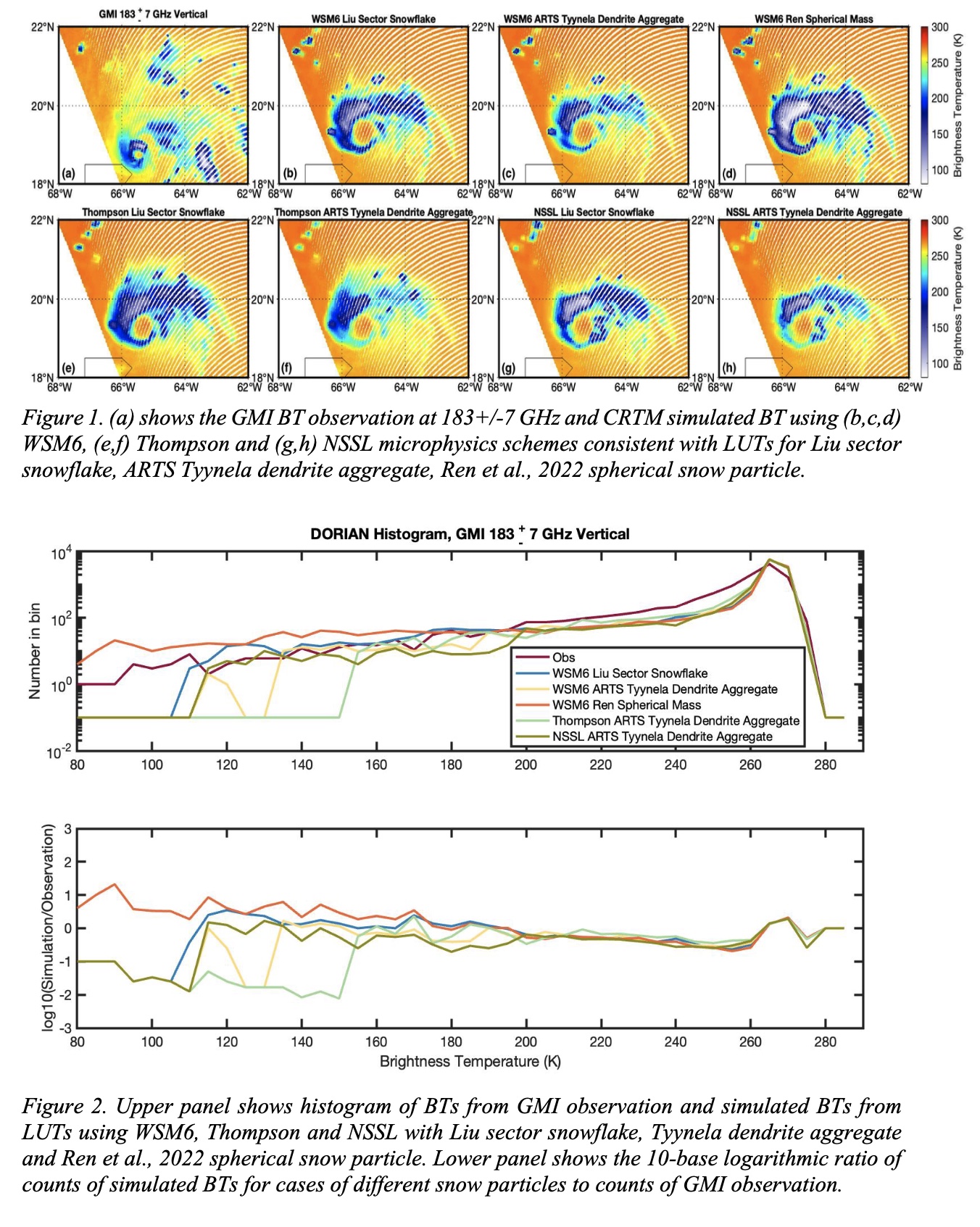
 - Indicates paper has been withdrawn from meeting
 - Indicates an Award Winner