Under the rapidly warming climate of 21
st century, heat-related illnesses account for the most weather-related deaths per year in the US. Numerical weather prediction (NWP) of extreme heat remains a concern for various stakeholders including public health, regional health and environment agencies, municipalities, the Red Cross, elderly and homecare organizations, hospitals, fire departments, and overarching childcare center networks. According to the US National Weather Service, in 2021, 375 people died of heat-related illnesses compared to the second leading cause flooding (146 deaths). Nicknamed “The Silent Killer” by NOAA, heat is typically disregarded as a danger because “
it doesn’t topple trees or rip roofs off houses like tornadoes and hurricanes.” Heat has been shown to govern the spatial and temporal variability of pollutants and gases within and above the atmospheric boundary layer (ABL). These pollutants can have an adverse effect on human health, especially in the summer months. Varying wind patterns are believed to modify the urban heat island (UHI) via urban heat advection (UHA), impacting nearby surrounding rural areas disrupting crops and increasing heat-related illnesses, in areas that do not typically experience these effects. Previous studies in cities ranging from Moscow, Russia to Paris, France have shown that UHI intensity (UHII) evolves with varying wind speeds and direction affecting not only city centers but also the surrounding urban-rural areas. However, little emphasis has been given to investigate the impact of UHI in smaller-sized cities with populations between 100 and 900 thousand. Past work has shown little—to—no regard for how UHI affects impact smaller cities. The heat-related dangers can be enhanced by UHI for cities such as Lubbock (population of 260,993), located in western Texas.
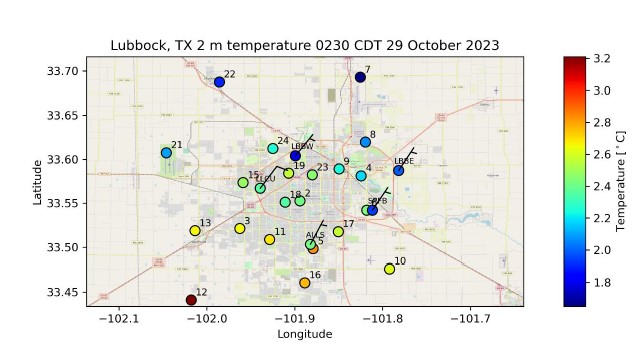
Within this work, we aim to study the variability of the UHI under varying wind regimes utilizing a newly deployed localized micronet along with the existing West Texas Mesonet Network in and around Lubbock (Texas), located in a semi-arid region. The Urban Heat Experiment Around Lubbock, Texas (U-HEAT) project employs temperature and humidity sensors (HOBO sensor from Onset Inc.) at 2-m above ground level at 23 micronet sites, spanning across the urban core, sub-urban region, and adjacent rural areas, and two sensors mounted on mobile platforms for intensive observations during nighttime hours only. We found that the traditional UHII differed from UHII considering measurements collected upwind of the urban core by up to 2.5°C. Furthermore, UHII in the upwind and downwind regimes varied by 0.6°C. We found strong evidence of the presence of UHA for multiple cases under moderate wind speed regimes (2-6 ms-1). Based on recent findings from mobile deployments across a 640 km2 domain centered around the city, it was possible to observe up to 4°C temperature increase downwind due to UHA. In addition to the micronet sensors, overnight 2-m mobile temperature heat maps, statistics, and bulk time series were analyzed. This work will help facilitate better forecasts of extreme heat hazard events via forecasting regions most conducive for UHA, within and around the city, and provide better information for planning outdoor events, helping the public avoid excessive heat-related hazards, heat stress, or any other heat related illness.

 - Indicates paper has been withdrawn from meeting
 - Indicates an Award Winner