Sunday, 12 January 2025
Hall C (New Orleans Ernest N. Morial Convention Center)
Sean Tyler Barnier, ERAU (Embry-Riddle Aeronautical University), Daytona Beach, FL; WHOI, Woods Hole, MA; and L. Yu and Y. Chen
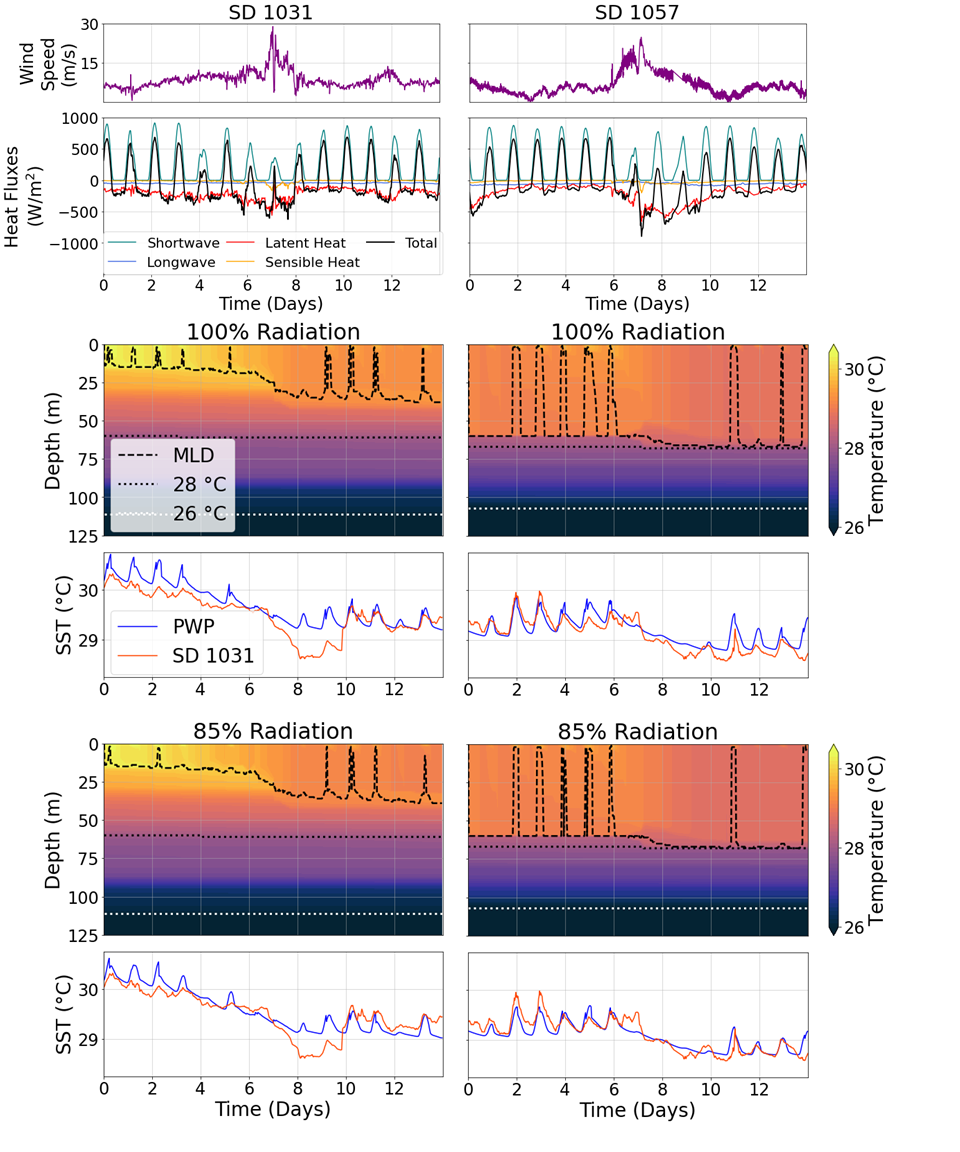
Tropical cyclones (TCs) rank alongside floods as the world’s deadliest natural disasters. Sea surface temperature (SST) above 26℃ is necessary for TC formation and is a key determinant of their intensities (Emanuel, 2003). TCs themselves cool the sea surface, primarily through turbulent heat flux, vertical mixing, and upwelling (Price, 1981). This study attempts to characterize cases of TC-induced upper ocean cooling and identify which physical processes dominate cooling in each case. First, observations are gathered from Saildrone unmanned surface vehicles which measure the atmosphere and ocean surface, Argo floats which measure vertical ocean profiles, and satellite observations of radiation and precipitation. With these observations, two cases were chosen to compare: hurricane Fiona in 2022, and tropical storm Idalia in 2023. Then, the Coupled Ocean Atmosphere Response Experiment (COARE) algorithm is used to calculate turbulent heat and momentum fluxes during these storms. These data are used to initialize and drive the Price-Weller-Pinkel (PWP) model to simulate the 1-dimensional ocean response to observed hurricane forcings. Our initial results of the model showed that it was able to capture general tendencies in ocean response after we applied a wind-wave parameterization to the COARE algorithm and reduced the satellite radiation inputs.
We found that the model showed varying degrees of success in simulating surface cooling induced by hurricanes. The model underestimated the observed ~2°C SST drop during Fiona, leading us to conclude that upper ocean cooling in that storm was enhanced by a 3-dimensional process, such as upwelling, which brought subsurface cooler water to the surface, cooling and deepening the mixed layer. By contrast, the model successfully simulated the ~1.5°C SST drop during Idalia, where surface cooling was due mostly to significant turbulent heat loss, with little change to the mixed layer depth. The PWP model is a useful tool for identifying physical processes behind upper ocean cooling wherever there are adequate observations and applying it to more cases is a foremost area of interest.
References
Emanuel, K., 2003: Tropical cyclones. Annual Review of Earth and Planetary Sciences, 31, 75–104, https://doi.org/10.1146/annurev.earth.31.100901.141259.
Price, J. F., 1981: Upper Ocean Response to a Hurricane. J. Phys. Oceanogr., 11, 153–175, https://doi.org/10.1175/1520-0485(1981)011<0153:UORTAH>2.0.CO;2.

- Indicates paper has been withdrawn from meeting

- Indicates an Award Winner
