
Machine learning (ML) offers a solution by emulating the detailed process model results in a computationally efficient manner. In this presentation, we will present our work in developing and incorporating emulators for liquid drop collision processes and aerosol mixing state to E3SM. The ML emulator for liquid drop collision processes is built with XGBoost based on detailed calculations with the bin approach (size-resolving). This emulator uniquely unifies four processes: autoconversion to form rain, rain accretion, droplet and rain self-collections and are applicable to both 2-moment and 3-moment bulk microphysics schemes. We apply this emulator to the Particle Predicted Properties (P3) scheme in E3SM v3 and present notable findings. To address the overly simplistic aerosol mixing state assumption in E3SM, we have implemented a pre-trained XGBoost ML model, developed using the PartMC-MOSAIC particle-resolved model, to predict aerosol mixing states. This approach results in more realistic aerosol properties, including hygroscopicity, which have significant implications for both direct and indirect aerosol forcing.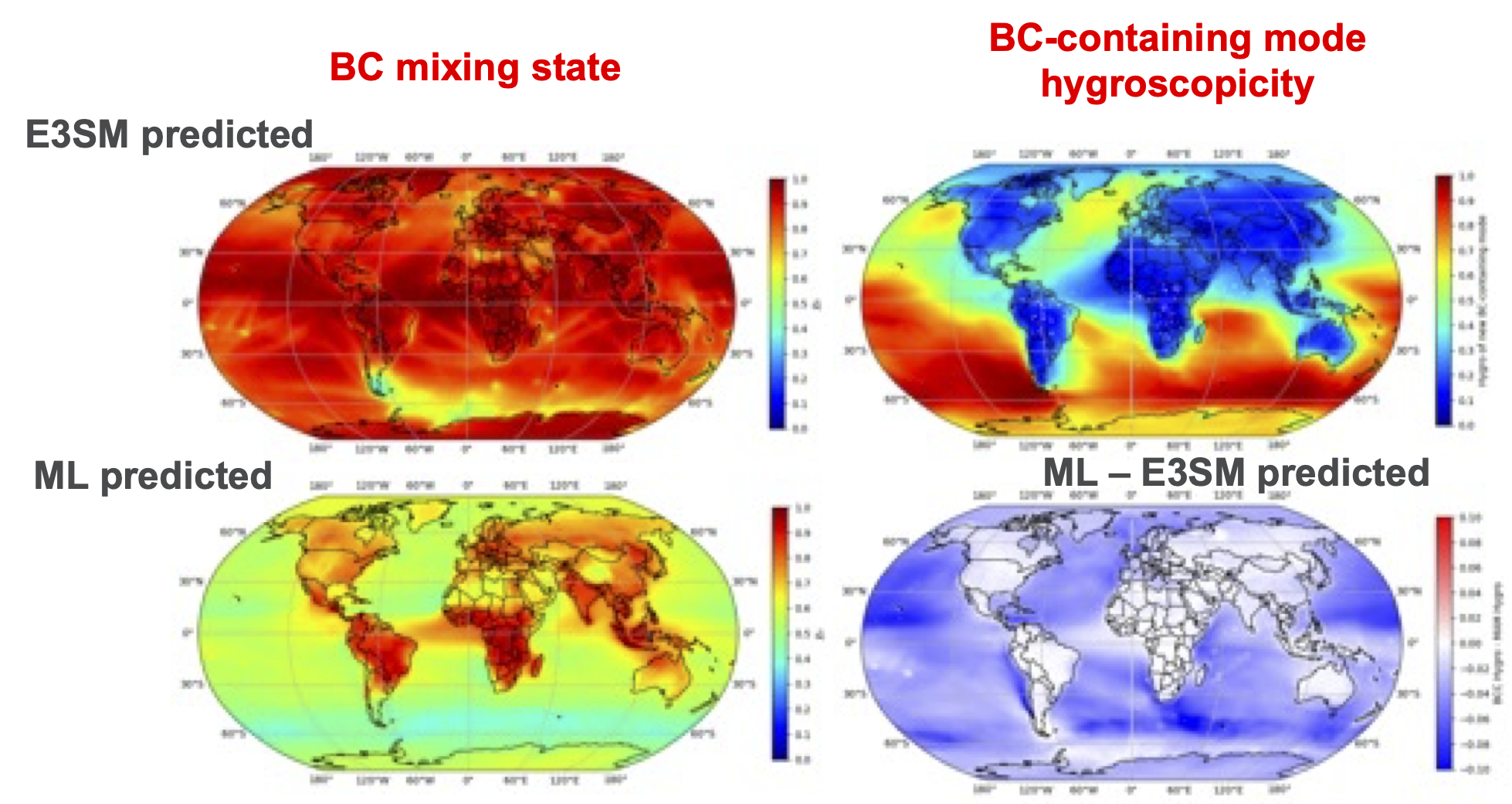
 - Indicates paper has been withdrawn from meeting
 - Indicates an Award Winner