
The model’s climatology from the 1000-year rollout is compared to ERA5 reanalysis data and ISCCP observations to assess its low-frequency variability, with particular emphasis on the northern and southern annular modes, tropical cyclones (TC), and the south Asian monsoon. The performance of our Deep Learning Earth System Model (DLESM) in these comparisons equals or exceeds that of much more computationally intensive Earth-system models from the 6th Climate Model Intercomparison Project (CMIP6) at similar spatial resolution.
It is sometimes erroneously assumed that auto-regressively generated machine learning forecasts inevitably smooth with time. Our DLESM maintains sharp representations of the atmospheric structure indefinitely, and spontaneously generates strong tropical cyclones. The climatology of western north Pacific TCs over years 70-100 of our 1000-year rollout is reasonably close to that in the ERA5 reanalysis over the 30-year period 1985-2014 (see figure). This performance is better than that in historical runs of several leading CIMP6 models.
Figure caption: 30-year average frequency of TCs in storms per day from ERA5 from 1985-2014 (left), or from the last 30 years of our DLESM rollout (right). Presence of a TC is determined from low low Z1000 heights together with warm-core structure aloft.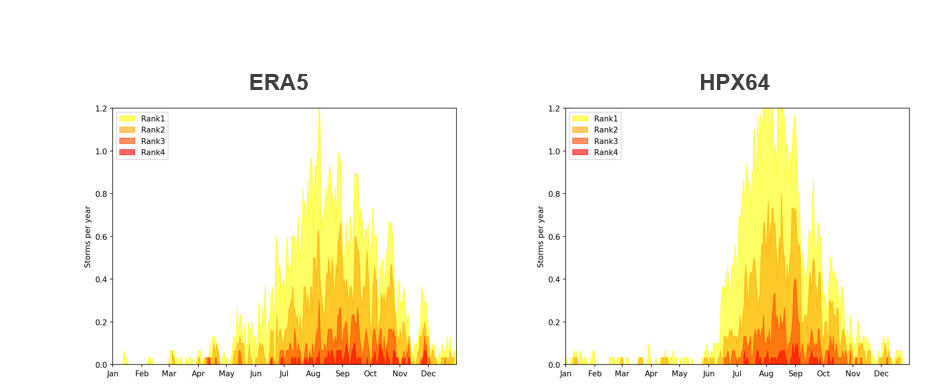
 - Indicates paper has been withdrawn from meeting
 - Indicates an Award Winner