
Thursday, 16 January 2025: 11:45 AM
212 (New Orleans Ernest N. Morial Convention Center)
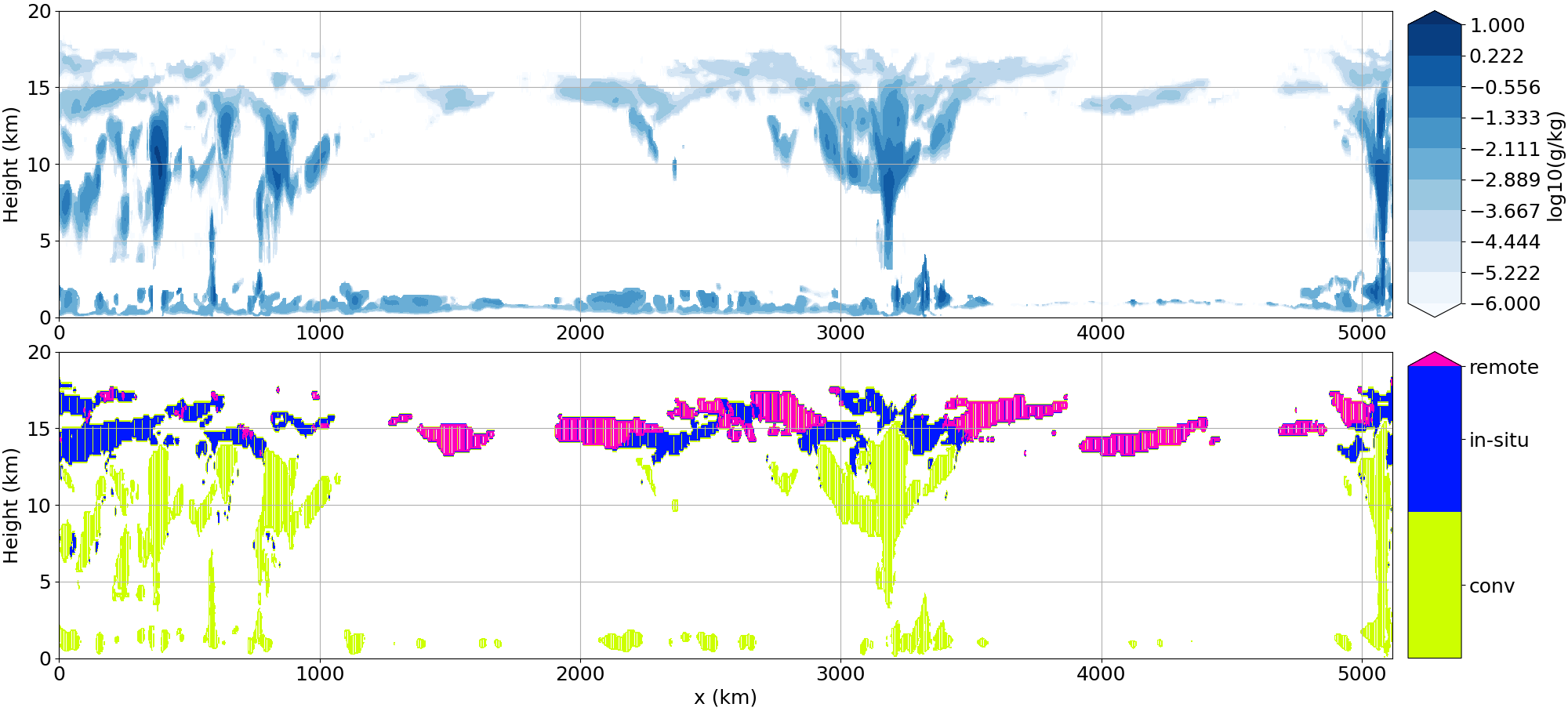
The origins of cirrus have been a source of debate for decades and this work provides valuable insight into the role of convection in cirrus cloud formation. While convection is a key source of cirrus and water vapor in the upper-troposphere, there are many in-situ formed cirrus that persist far from convection. We introduce passive tracers to the model in order to investigate the origin and life cycle of cirrus clouds. The attached figure shows the vertical cross section of cloud ice and liquid in the top panel and cloud type diagnosed from the tracers of time since convection and time since nucleation to label cirrus as in-situ (more than 5 hours detrained from convection) or remote (more than one day detrained from convection). Furthermore, we explore how the ice nucleation scheme and the presence of large-scale ascent impacts cirrus clouds in simulations with convective organization. The structure and degree of convective organization seems to play a key role in the amount of in-situ cirrus in these simulations. While the response of anvil clouds is similar to other RCE models when the SST is increased by 4K, the response of in-situ cirrus is uncertain; they decrease in frequency of occurrence in two of three simulations. Nonetheless, all simulations show a warming of in-situ cirrus clouds when the SST is increased by 4K.
 - Indicates paper has been withdrawn from meeting
 - Indicates an Award Winner