
Wednesday, 15 January 2025: 9:45 AM
339 (New Orleans Ernest N. Morial Convention Center)
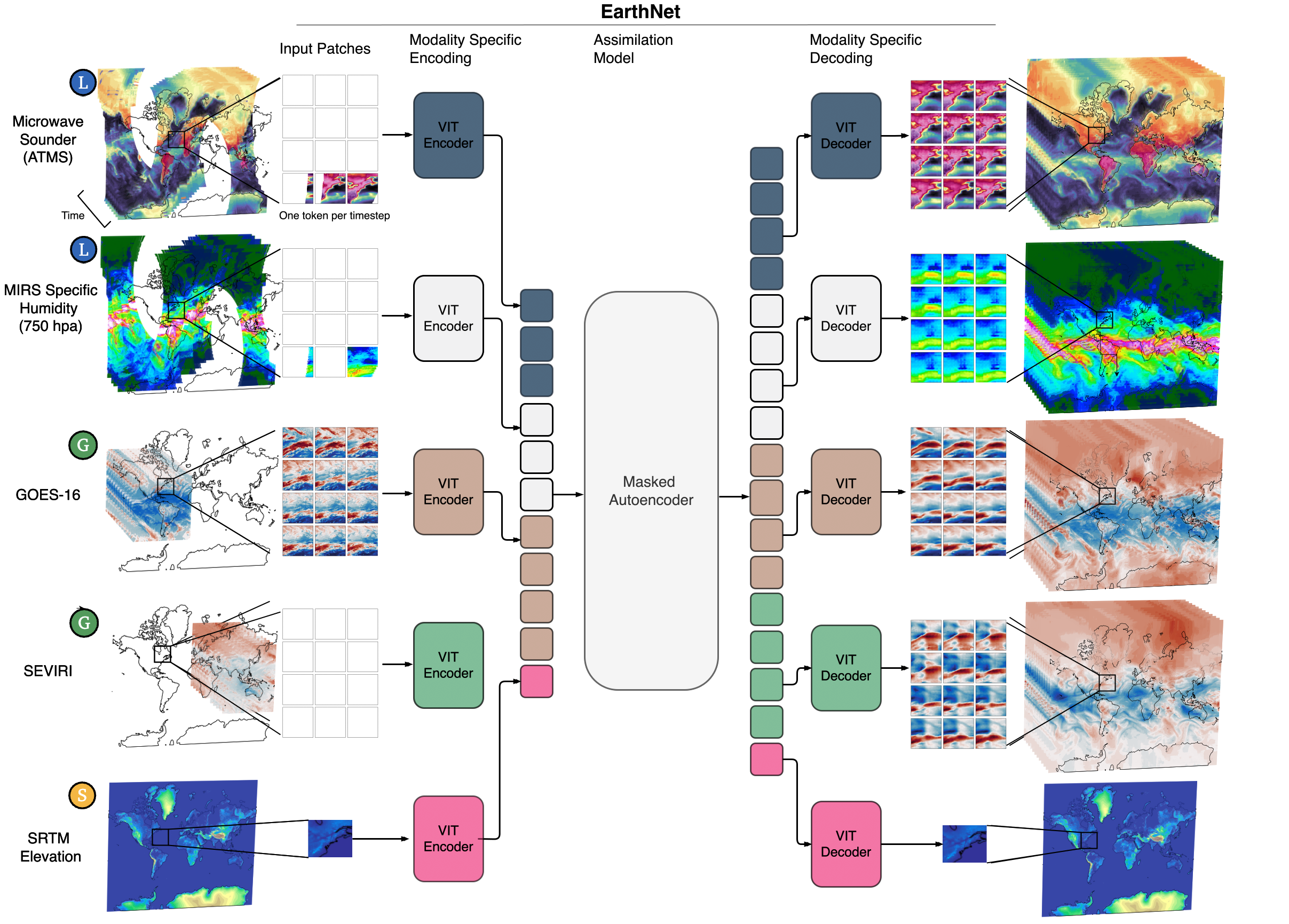
Global data assimilation enables weather forecasting at all scales and provides valuable data for studying the Earth system. However, the computational demands of physics-based algorithms used in operational systems limits the volume and diversity of observations that are assimilated. Here we present a multi-modal foundation model for data assimilation that learns to predict a global gap-filled atmospheric state solely from satellite and in-situ observations. The model is trained as a multi-modal masked autoencoder that ingests a 12 hour sequence of observations and learns to fill missing data from other sensors. We show that the masked autoencoders are powerful tools for gap-filling missing satellite observations. The results show that our model performs a form of data assimilation producing a global 0.16 degree reanalysis dataset of 3D atmospheric temperature and humidity at a fraction of the time compared to operational systems. It is shown that the resulting reanalysis dataset reproduces climatology by evaluating a 1 hour forecast background state against observations. We also show that our 3D humidity predictions outperform MERRA-2 and ERA5 reanalyses by 10% to 60% between the middle troposphere and lower stratosphere (5 to 20 km altitude) and our 3D temperature and humidity are statistically equivalent to the Microwave integrated Retrieval System (MiRS) observations at nearly every level of the atmosphere. Our results indicate significant promise in using multi-modal modeling for high-frequency data assimilation and global weather forecasting.
 - Indicates paper has been withdrawn from meeting
 - Indicates an Award Winner