
The IMERG satellite product provides a more observationally based representation of precipitation compared to ERA5, which relies heavily on parameterizations and approximates key physical processes. Given the shorter observational record of IMERG, the model is initially trained on ERA5 data with the weights subsequently fine-tuned through retraining on IMERG data. Using only ten input variables, this approach allows the diagnostic model to be easily applied to forecasts from other models, facilitating and improving the generation of precipitation forecasts. The precipitation field produced by this model is compared to the ERA5 field by scoring both against IMERG.
The diagnostic model successfully reproduces a precipitation field from the limited number of larger scale variables. When compared to ERA5, this field more closely matches the IMERG satellite product, improving on both the weak and heavy precipitation (see figure). This provides a more realistic representation of precipitation using only the ten input variables and no parameterizations. The diagnostic model skill at extreme event thresholds is assessed through a categorical RMSE analysis as well as an extreme event case study.
Figure caption: 24-hour precipitation (mm) over the Maritime Continent on June 30th, 2017. The deep learning diagnostic model on the left, IMERG in the center, and ERA5 on the right.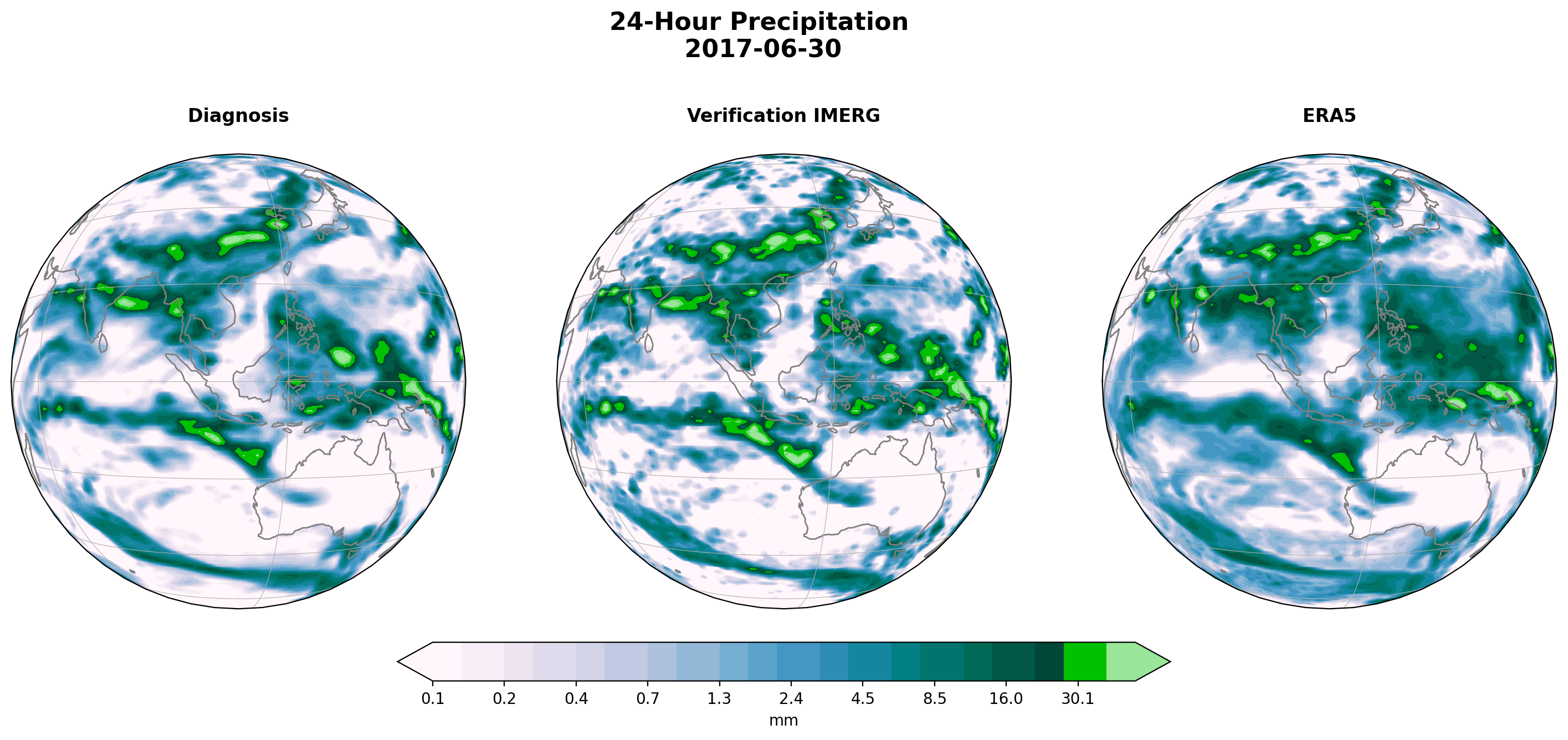
 - Indicates paper has been withdrawn from meeting
 - Indicates an Award Winner