
Again, to understand the influence of cold-water coastal upwelling, we rely on NWP as offshore SST measurements are limited and satellite datasets often have difficulty detecting shallow, narrow regions of cold water. Initializing model SSTs with the Operational Sea Surface Temperature and Ice Analysis (OSTIA) provides the best resolution near the coastlines and the most accurate SST values (Figure 1; Stark et al. 2007). OSTIA's SST, specifically at buoys further offshore, such as 44065 and 44091, compares well to observations—upwelling is detected at buoys 44065 and 44091 (Figure 1).
Using the optimized WRF model set up as the control experiment, we performed three additional experiments to isolate the impact of cold-water upwelling along the NJ coastline on the sea breeze and LLJ. This is done by adjusting the gridded OSTIA satellite data along the NJ coastline and within the area covering three reoccurring upwelling centers, including Barnegat Inlet, Mullica River Estuary, and the Townsend/Hereford Inlets (Figure 1). The initial comparison of these WRF models experiments show that upwelling along the NJ coastline amplifies the strength of the LLJ and results in a sea breeze that penetrates slightly further inland. While the strongest effects of coastal upwelling remains downwind from the planned offshore wind energy areas and will likely have a modest effect on energy generation, it is effective in reducing the heat index in high-demand areas such as NYC and Long Island, thereby reducing energy loads.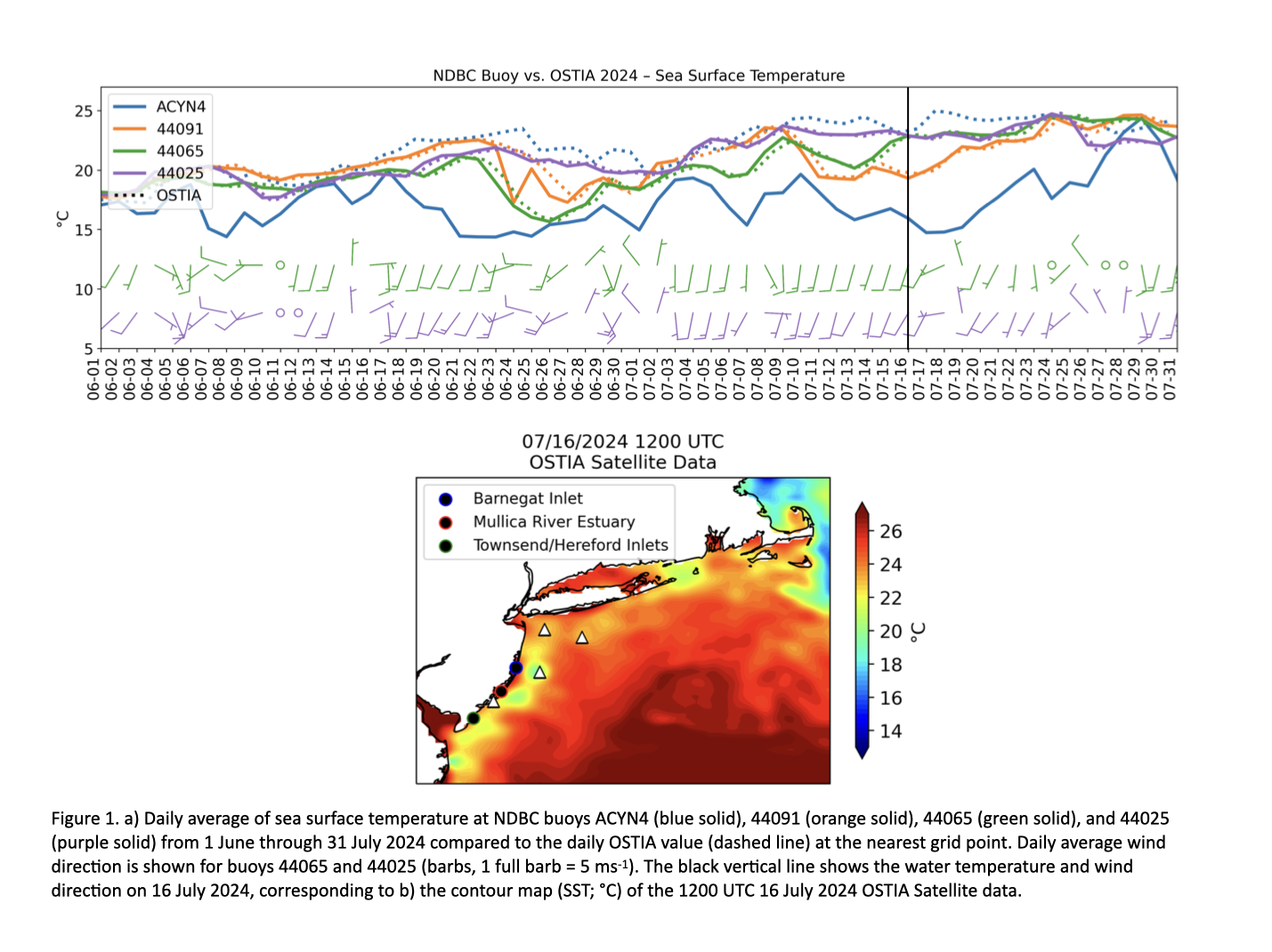
 - Indicates paper has been withdrawn from meeting
 - Indicates an Award Winner