
Thursday, 16 January 2025: 11:30 AM
344 (New Orleans Ernest N. Morial Convention Center)
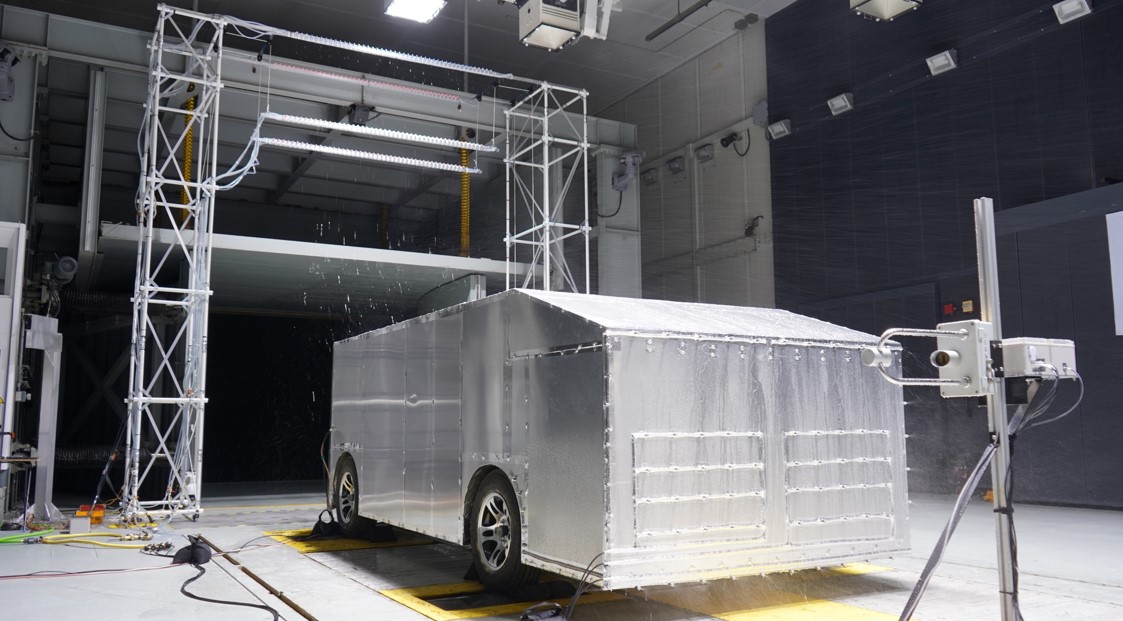
The advancement of automated driving technologies has been recognized to greatly reduce road accidents and improve public safety. As further research and development of Advanced Driver Assistance Systems (ADAS) and autonomous vehicles (AVs) continue, maintaining sensor perception in adverse weather conditions remains a challenge partly due to testing difficulty. Despite outdoor testing is realistic, it fails to allow fundamental investigations on the causes of sensor performance degradation due to having uncontrolled variables, for which the understanding is crucial to deploying effective soiling mitigation strategies. Therefore, indoor chamber testing is proposed. It provides the opportunity to evaluate sensor perceptions in different conditions conveniently, such as varying temperature, humidity, type of precipitation, and precipitation intensity. A hybrid digital twin wind tunnel testing methodology is developed to perform rapid weather testing designed for ADAS/AV applications. The methodology is demonstrated with a novel rain simulation system paired with custom detection targets and digital road scene displays implemented at the ACE Climatic Aerodynamic Wind Tunnel (CAWT) at Ontario Tech University. The methodology also allows considerations of the entire soiling phenomenon by incorporating vehicle kinematics, aerodynamics, optics, and material properties into the tests. This dynamic sensor perception in rain presents a milestone in the advancement of vehicle soiling testing in wind tunnels for automated driving applications. Objective evaluations relevant to real life driving are quantified for optical cameras and LiDAR sensors via image quality metrics, object detection accuracy, visibility, and signal strengths. The presented work is envisioned to advance the development of vehicle ADAS with the ultimate goal to achieve full vehicle autonomy.
 - Indicates paper has been withdrawn from meeting
 - Indicates an Award Winner