Monday, 13 January 2025
Hall C (New Orleans Ernest N. Morial Convention Center)
Jennifer D. Small Griswold, University of Hawai at Manoa, Honolulu, HI; and C. S. McCluskey
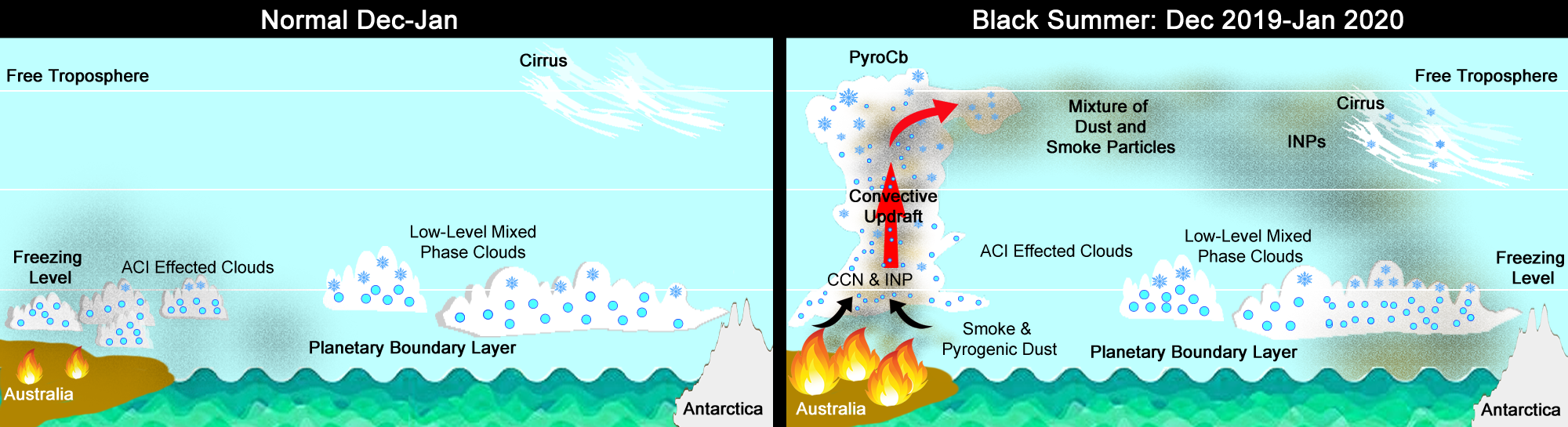
The Southern Ocean (SO) region has impressive cloud cover (>80%) composed mostly of low-level clouds (up to 80%) that tend to be mixed-phase (up to 50%). Given the importance of these SO clouds on the climate system and the complex nature of the aerosol-cloud-precipitation processes active in low-level SO clouds, process-oriented studies are needed to better understand this important region. Here, we propose that the extreme fire event during the 2019-2020 Australian fire season (Black Summer) provides a natural perturbation experiment, where aerosols were injected into the pristine SO atmosphere and perturbed cloud processes in a measurable manner. Aerosol-Cloud Interactions (ACI) are the largest source of uncertainty in global climate models and reducing uncertainty in ACI is critical for constraining the forcing and feedbacks that combine to change the earth’s climate. By isolating a natural aerosol perturbation event, “Black Summer” we will be able to integrate observations, simulated aerosol emissions, and transport patterns over the Southern High Latitudes. Thus, the scientific motivator of this work is to improve the understanding and numerical representations of ACI that determine SO cloud occurrence and phase using constraints observed during the Black Summer natural perturbation experiment.
The proposed study brings together high-resolution satellite remote sensing of biomass burning and dust aerosol and clouds (liquid, ice, and mixed-phase) in combination with global modeling to determine the aerosol-cloud microphysical process active in SO clouds. This initial work presented here focuses on the characterization of the clouds and meteorological environment since local meteorology and dynamics, including available precipitable water, relative humidity, and updraft velocities, are theorized to modify aerosol effects on clouds and precipitation and need to be taken into consideration. To prevent contamination by meteorological factors in our analyses, spatial and temporal averaging or specific sorting and filtering criteria are applied to cancel out or limit their effects. Data sorting has been performed on data from the Black Summer period and baseline condition year(s) selected based on minimal biomass burning influence. This initial data sorting will allow for comparisons between model and observations during BBA-influenced and baseline conditions in specific cloud regimes and boundary layer conditions. Here we show early results of satellite observation categorized by meteorological context (using gridded reanalysis data (MERRA)) as well as by cloud properties for the Black Summer event and a complementary baseline season.

- Indicates paper has been withdrawn from meeting

- Indicates an Award Winner
