
The Southern California Interactions of Low cloud and Land Aerosol (SCILLA) airborne experiment was undertaken in June 2023 to characterize aerosol and cloud properties over the Bight and evaluate aerosol transport hypotheses. SCILLA flights repeatedly sampled upwind (to the west) and downwind (to the east) of San Clemente Island (SCI) to characterize “clean marine” and “polluted” cloudy airmasses, respectively, with a comprehensive suite of instrumentation measuring aerosols, clouds, radiation, turbulence and trace gases. A sustained, multi-day Catalina eddy event occurred during the final week of the experiment and is the focus of the analysis presented here.
Enhanced concentrations of both fine and accumulation mode aerosols were observed above the boundary layer throughout the week, and there was frequently a large gradient in Nd of a few hundred drops per unit volume between upwind and downwind sampling modules. Analysis of sawtooth flight legs traversing cloud top and the overlying free troposphere during wake-impacted downwind modules show enhanced turbulence across the inversion and localized areas of Nd exceeding 600 cm-3 (versus a typical “background” concentration of ~200 cm-3). This suggests that turbulence induced by vertical shear in the island wake promotes mixing across a statically stable interface. In some cases, enhanced Nd is highly correlated with above-cloud accumulation mode aerosol concentration while in others it appears to vary more closely with above-cloud fine mode concentration. We speculate that day-to-day variability in aerosol-cloud interactions is due to differences in both aerosol source region and local meteorology/boundary layer properties, which are likely covarying factors. Overall, our results highlight an underappreciated vertical transport mechanism that may be important at global scale for understanding boundary layer aerosol-cloud interactions in the vicinity of islands with even moderate topography.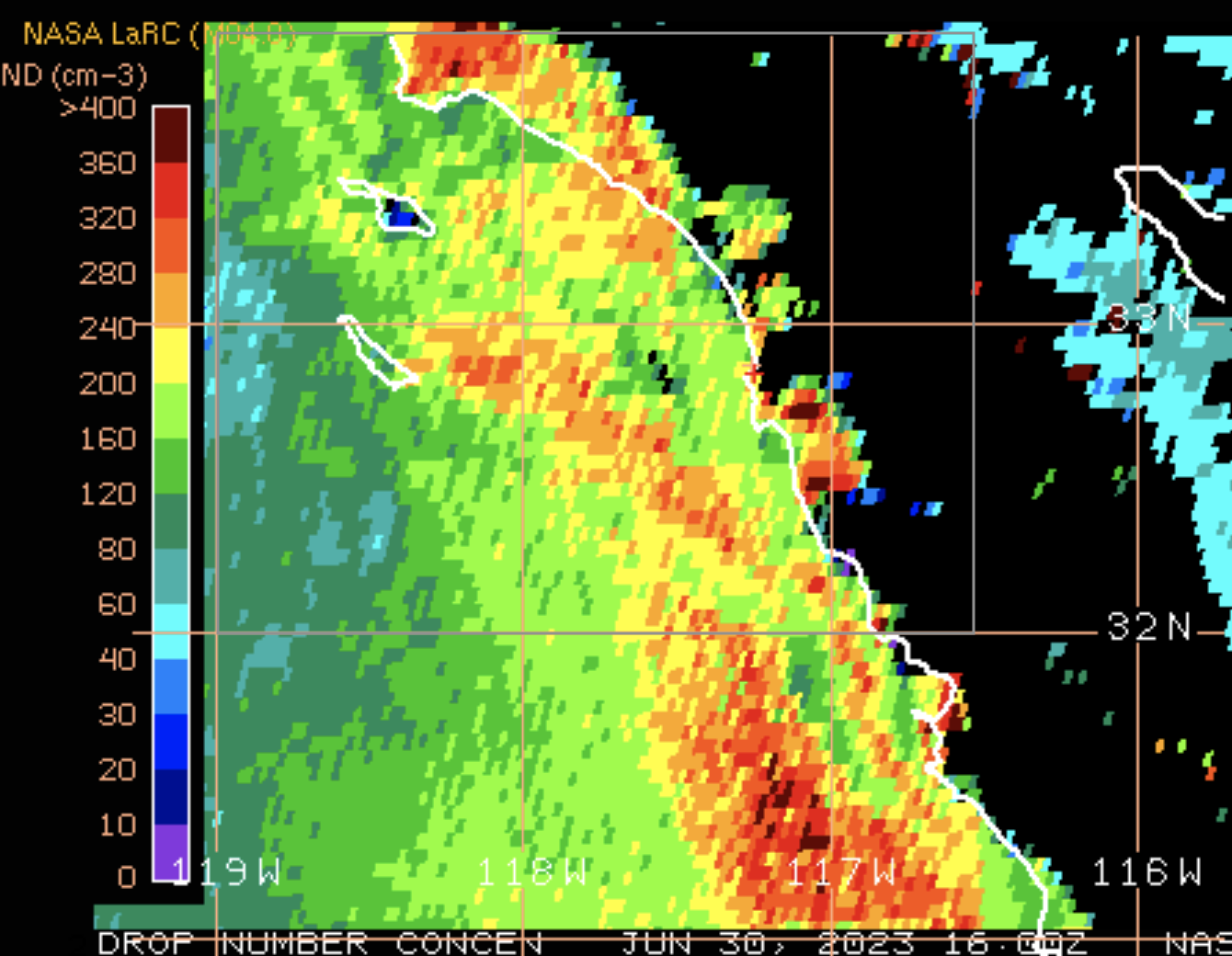
 - Indicates paper has been withdrawn from meeting
 - Indicates an Award Winner