
Tuesday, 14 January 2025
Hall C (New Orleans Ernest N. Morial Convention Center)
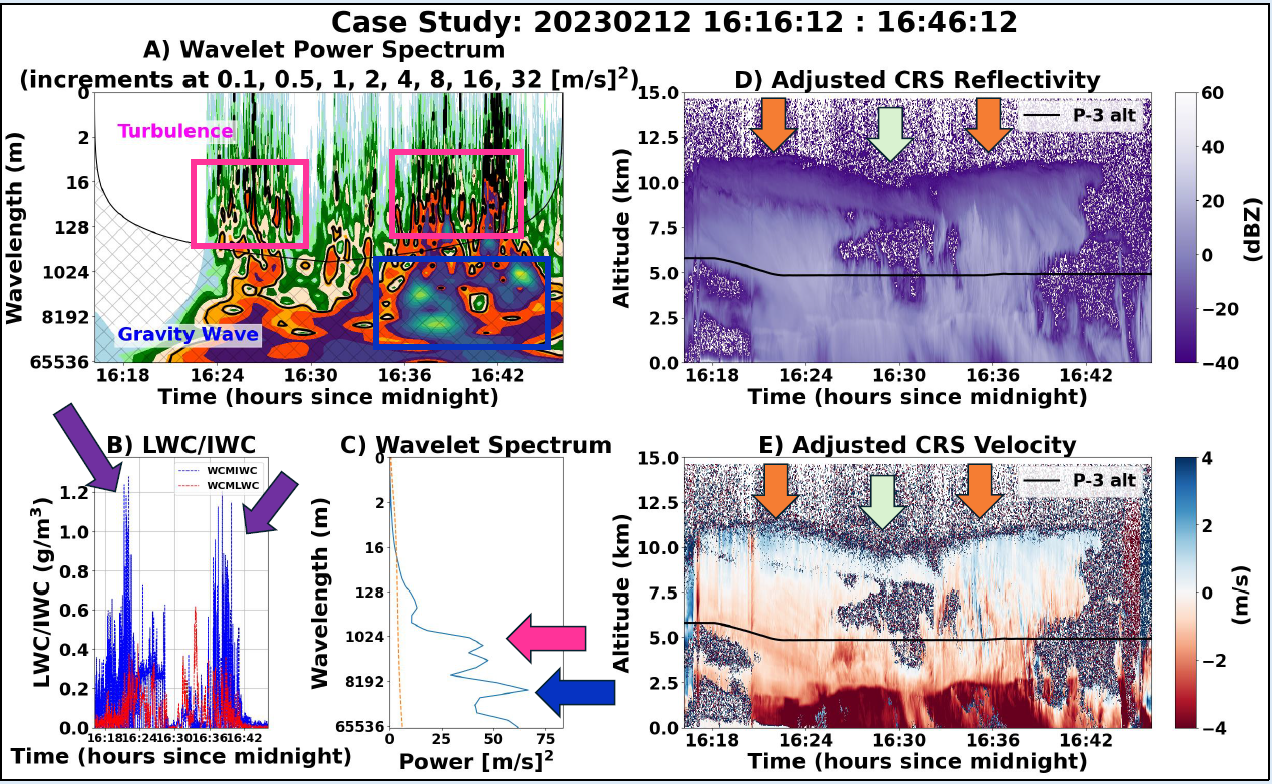
Gravity waves and turbulence influence ice microphysical processes at altitudes with aviation traffic. These large-scale vertical gravity wave oscillations and small-scale turbulent motions have been associated with convective and stratiform cloud maintenance, as well as higher ice supersaturations. The Investigation of Microphysics and Precipitation for Atlantic Coast-Threatening Snowstorms (IMPACTS) campaigns in 2020, 2022, and 2023 observed high ice water content (IWC) conditions while sampling wintertime synoptic-scale storm systems, where IWC is measured greater than 1.5 g m-3, in midlatitude wintertime convective environments. Regions of high IWC pose risks to aviation, promoting the need to determine the relationship between these oscillations and high IWC regions. Both gravity wave activity and turbulence were present in 39 of the 56 in-cloud, level flight legs in high IWC conditions over all three campaigns. An adapted Morlet wavelet technique is applied to in-situ measurements taken by the Turbulent Air Motion Measurement System (TAMMS) probe of vertical velocity and remote-sensing retrievals by the Cloud Radar System (CRS) of identified in-cloud regions of statistically significant turbulence and gravity wave activity, which were used to assess how IWC varies with dynamical activity. Regions of both statistically significant turbulence and gravity wave activity were especially common during penetrations of embedded convective eddies, where frequent sub-10 km wavelength waves in both the radar and wavelet analyzed in-situ data confirmed rapid updrafts/downdrafts and localized spikes in IWC. Gravity waves and turbulence were present in 100% of cases where maximum IWC exceeded 2.5 g m-3. Maximum values of IWC were often 2 to 3 times larger than the in-cloud mean IWC. 23% of case studies examined from IMPACTS had maximum IWC exceeding 1 g m-3 demonstrating the frequency of high IWC events in midlatitude synoptic-scale systems. Results show that high and localized spikes in IWC observations occurred in the presence of both turbulence and gravity wave conditions, consistent with top-of-cloud and convective eddy sampling that was conducted where we would expect more turbulent conditions.
 - Indicates paper has been withdrawn from meeting
 - Indicates an Award Winner