
Handout (1.8 MB)
Three different datasets were compiled to serve the machine learning model. The first comprised the twenty ensemble members of GEFS (https://ftp.nhc.noaa.gov/atcf/archive/) from 2008 to 2022, with six-hour increments from 0-5 days. A similar approach was used for the ensemble members of ECMWF (https://rda.ucar.edu/datasets/d330003/), although twelve-hour increments were adopted instead. In total, GEFS ensemble members were collected for 83755 forecasts, compared to only 5114 forecasts for ECMWF due to missing data. Since ECMWF has fifty ensembles, two cases were tested: one leveraged all available ensembles, while the other only examined the initial twenty. This allowed for the analysis of machine learning’s utility between GEFS and ECMWF. It also opened discussion of whether or not more ensembles resulted in a noticeable increase in the accuracy of the forecasted track of the tropical cyclone, if any. A Convolutional Neural Network (CNN) was trained on each dataset to learn to output a forecast as close to the best track of the tropical cyclone as possible.
The CNN offered an advantage over the GEFS mean for later forecast lead times (tau>18 hours), with a decrease in track error of 11%-79% at tau values from 24 hours to 120 hours. The CNN outperformed the two ECMWF means for all lead times tested. When all fifty ensembles were used, the CNN saw a decrease in track error of 72%-86% at each tau value. On the other hand, the twenty-ensembles case resulted in a reduction of track error of 55%-77%. The average track error of the CNN applied to fifty ensembles was also approximately 40% less than for twenty ensembles, indicating that a greater number of input ensembles increased the accuracy of the CNN. Sample tracks from the CNN for GEFS and ECMWF will be shown. These results can be used to improve tropical cyclone track forecasts and facilitate evacuation and relief efforts. They also suggest great promise for further studies applying machine learning to ensemble modeling. This work was supported by a grant from the Simons Foundation.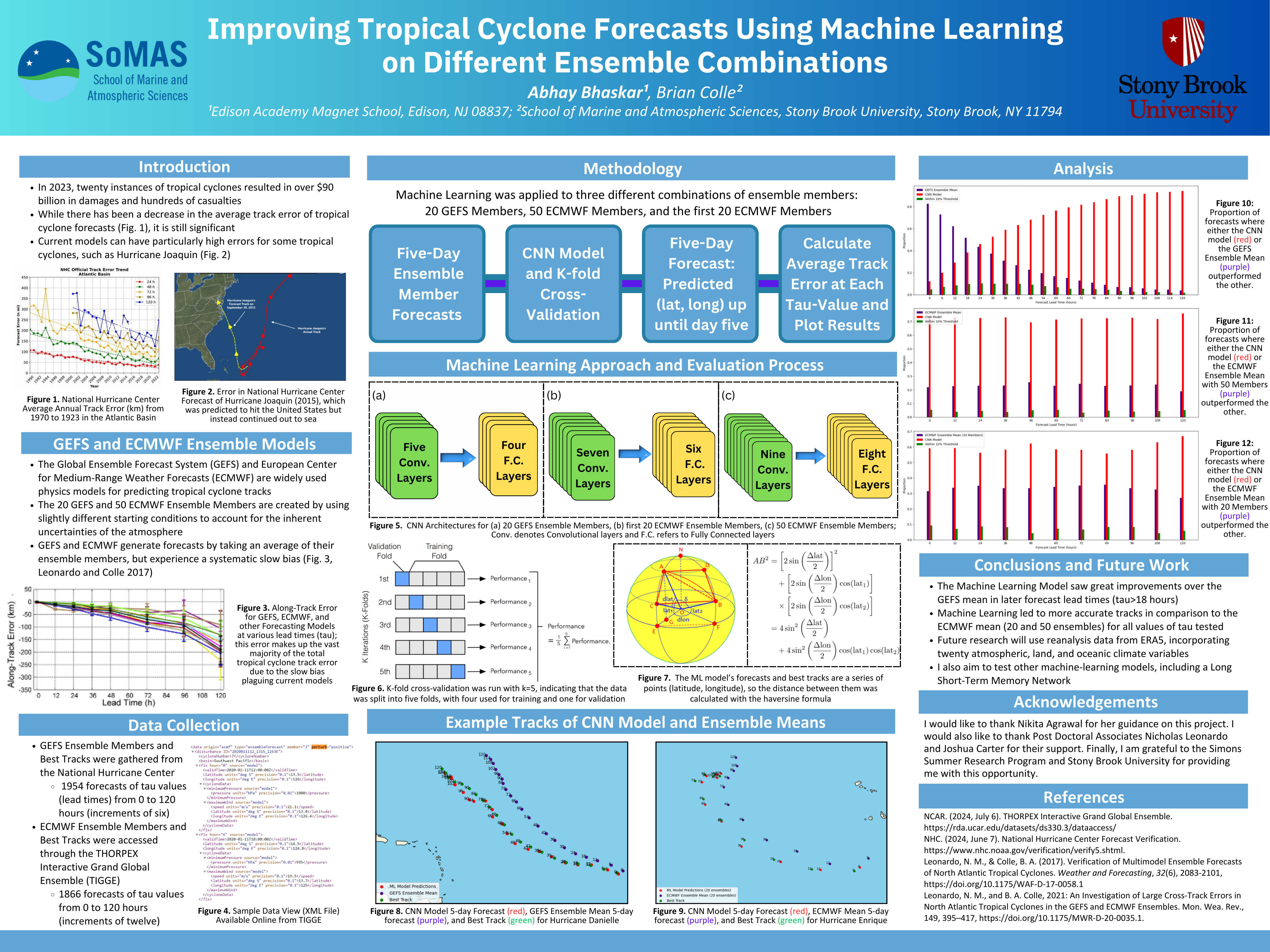
 - Indicates paper has been withdrawn from meeting
 - Indicates an Award Winner