
Monday, 13 January 2025
Hall C (New Orleans Ernest N. Morial Convention Center)
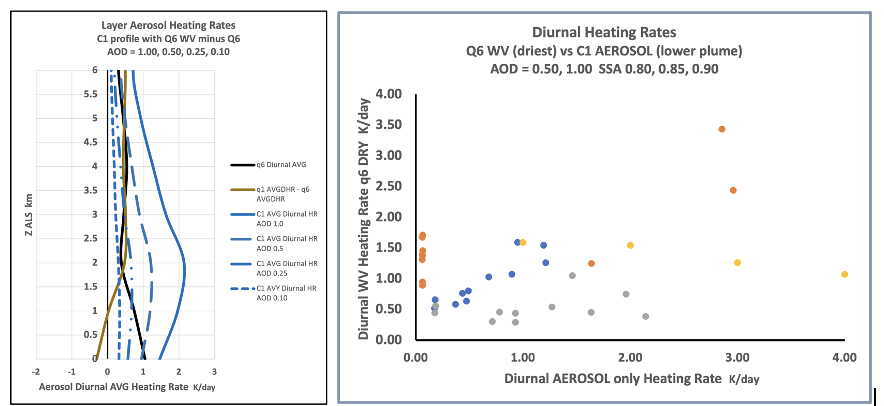
Understanding the vertical structure of atmospheric aerosol is important for solar radiometric study across broad spectra. We focus on studies relevant to the Southeast Atlantic (SEA) region where the stratocumulus cloud regime is prevalent and seasonal biomass burning in the Africa sub-Sahel contributes to smoke aerosol loading. We used the European Centre for Medium-Range Weather Forecasts (ECMWF) reanalysis ERA5 data at 18 atmospheric levels from the 1000 hPa pressure level to the 400 hPa pressure level to collect the appropriate seasonal data (August, September, October - ASO) for the years 2014 through 2019. We then performed a k-means clustering on the principal data components to form canonical groups. Lastly, we rendered vertical profiles of the grouped values as canonical water vapor (WV) profiles expressed as mass mixing ratios in kg per kg. Similarly, we employ the European Centre for Medium-Range Weather Forecasts (ECMWF) reanalysis of Copernicus Atmosphere Monitoring Service (CAMS) Carbon Monoxide (CO) data to construct canonical vertical CO profiles (characteristic "shape" curves) from records in the historic Sub-Sahel burn season window, and within the geographic rectangular boundaries of interest. These canonical CO curves then proxy for aerosol optical depth (AOD) curves, constrained to be distributed vertically such that their integrated sum matches to specific Bulk Columnar AOD (BCA) values of relevance to measured observations. The layer CO values are normalized to fractional coefficients of the columnar CO total for each canonical profile. These coefficients then are distributed as AOD layer coefficients of the bulk columnar AOD; thus, preserving the canonical profile shapes. This results in vertically resolved AOD profiles for specific geo-regions which can be fed into a Radiative Transfer Model (RTM) to result in Total Layered Heating Rates (TLHR) combining enhanced water vapor and enhanced aerosol loads, along with Aerosol Layered Heating Rates (ALHR) expressed in Kelvins per day (K/day). The radiative transfer model (RTM) is employed, firstly baselining clear-sky (no cloud) water vapor only effects, then combining variations on the canonical profile WV and AOD as inputs. The model outputs are expressed as instantaneous and diurnally averaged values of atmospheric heating rates in Kelvins per day (K/day). We present methodology, developments, and some cases of these studies. We present model results depicting the rather complicated interplay of enhanced column water vapor with enhanced aerosol loads. We attempt the quantification of the magnitudes of individual effects of each of these factors for the extreme value cases versus seasonal norms.
 - Indicates paper has been withdrawn from meeting
 - Indicates an Award Winner