
Climate change acts as a threat multiplier, intensifying extreme weather, rendering ecosystems more vulnerable and deepening socioeconomic impacts within human communities. Recognizing the interconnectedness of climate and health is essential for developing and enhancing health resilience in the face of these changes. While we can track vector-borne diseases (VBDs) using electronic health record (EHR) data, there is a gap in integrating EHR data with climatic and VBD surveillance data, both from a public health and clinical perspective. We therefore need to begin developing technical approaches that integrate data and processes into comprehensive VBD surveillance systems.
Methods
We assembled an interdisciplinary team of seven scientists in a novel collaboration to address this goal. The represented disciplines included biomedical informatics (TS), healthcare and clinical care delivery (SA and TS), public health (SA, KE), infectious disease epidemiology (KE, DL), vector-based infectious disease (LC, DL, KE), and earth sciences (GF, DJ). The group was charged with developing a concept for designing and developing a comprehensive VBD surveillance system that integrates data about climate change, vectors, and public and individual patient health. The group developed the concept described here in multiple discussions during the summer of 2024.
Results
The concept of developing a comprehensive VBD surveillance system includes the three phases described below.
Phase 1: Assess the feasibility of connecting climate change, vector surveillance and EHR data
The purpose of the first phase will be to integrate climatic, vector surveillance, and EHR data, enabling both regional and local health projections1. We will compile information about environmental and other databases that capture conditions that impact vectors, and evaluate how they can be used to document and predict the prevalence of vectors2 at a geographic scale consistent with individual EHR data. For EHR data, we will focus on the Observational Medical Outcomes Partnership (OMOP) data model, which is the dominant data model for representing EHR data for research. We will proceed in four steps:
- Evaluate data compatibility: We will first thoroughly assess the format, content, standards, and structures of selected vector surveillance databases, both by reviewing data sets and their metadata, as well as how they have been used in research and practical applications.
- Identify integration methods: In this step, we will explore various technical approaches for data integration, including interoperability frameworks and data mapping techniques.
- Assess privacy and security concerns: In parallel with the technical analysis and design work, we will assess privacy and security concerns that might be associated with use of vector and/or EHR data. Due to US- and other country-specific regulations, we anticipate that data governance and usage concerns will be much more substantive for EHR data than vector data.
- Engage stakeholders: Finally, we will interview key stakeholders from the climate science, vector ecology and healthcare information technology fields who need to be involved in successful large-scale data integration efforts.
Phase 2: Define requirements for a data resource that integrates these diverse datasets, enhancing VBD prediction and management among various stakeholders
The goal of the second phase is to define requirements for research and applied questions for an integrated data resource through user-centered design3. There are two primary audiences for our integrated data resource: (1) public health personnel and policymakers at the local, regional, and federal levels in the US and other countries, who would use the resource to support strategic, tactical and operational public health decisions regarding VBDs, and (2) researchers and developers who are focused on developing novel insights based on the integrated data set, and on advancing methodological and applied research in tracking and predicting VBDs.
In this phase, we plan to conduct individual interviews with representative stakeholders. These interviews will explore what information needs interviewees have regarding tracking and predicting VBDs; what information sources and strategies they currently use to meet those needs; what barriers and facilitators exist regarding fulfillment of these needs; and how an integrated data resource could improve information acquisition and decision support.
Phase 3: Develop and evaluate a prototype for integrating climate, vector and EHR data, and conduct a formative evaluation of its usefulness and usability
The third phase plans to develop and evaluate a prototype integration using the Indiana Network for Patient Care (INPC), and Indiana vector surveillance and climate data. The INPC, one of America's largest and most comprehensive health information exchanges, collects extensive data from routine clinical care across more than 100 hospitals and other health facilities, covering 66.7% of the state's population4. We will integrate INPC data with data from the Indiana Department of Health (IDOH) Medical Entomology program, which conducts routine mosquito surveillance for multiple mosquito-borne viruses of public health significance, most notably West Nile Virus (WNV).
Additionally, climate data from reanalysis products, such as MERRA-2 and ERA5, and remotely sensed data from MODIS, Sentinel II and Landsat 8 and 9 will be integrated as raster files. These datasets will aid in predicting where vectors carrying pathogens, like WNV, could be found at specific Indiana locales. The Figure illustrates the type of temporal data integration we envision. It shows the Minimum Infection Rate among mosquitoes sampled in IN for WNV compared to the number of human cases for periods of mosquito activity in 2023 and 2024. We will extend this visualization by adding the geospatial dimension for Indiana counties and possibly smaller units, similar to previous projects5.
Discussion and conclusion
This project is a first step in developing a concept for a comprehensive VBD surveillance system that integrates data about climate change, vectors, and public and individual patient health. Future directions in which this work will evolve include considering how this approach could work in regional, national and even worldwide contexts; which informatics and data analytics methods would be particularly appropriate; and how to connect more and different types of data sets to improve monitoring and prediction.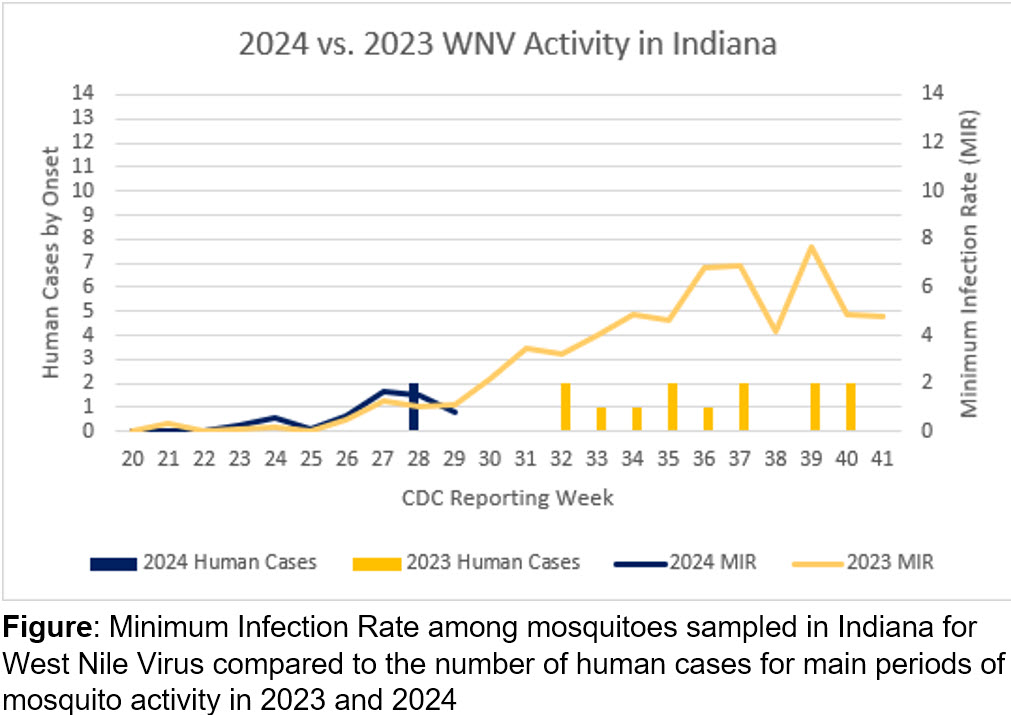
 - Indicates paper has been withdrawn from meeting
 - Indicates an Award Winner