
Wednesday, 15 January 2025: 8:45 AM
221 (New Orleans Ernest N. Morial Convention Center)
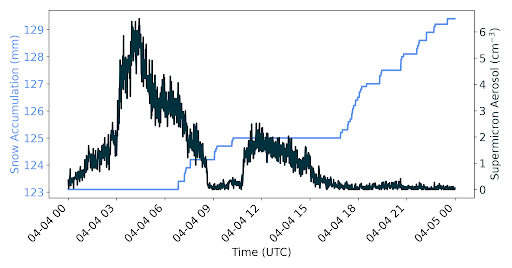
Transport of dust in the atmosphere and its subsequent deposition to the Earth’s surface has a very strong influence on snow albedo worldwide, especially during the spring snow-melt season in the Upper Colorado River Basin (UCRB). Dust can be deposited on snow through dry and wet deposition events, with the latter involving aerosol-cloud interactions and snow precipitation scavenging processes during deposition. Using the Colorado Dust-on-Snow (CODOS) definition of wet deposition, we explore wet deposition occurrence and implications with data from the Surface Atmosphere Integrated Field Laboratory (SAIL) field campaign which took place from September 2021 to June 2023 near Crested Butte, Colorado. We find that more than half of the deposition of dust on snow events that occurred during SAIL were the result of wet deposition. Immediately after these events, the snow albedo measured by the SAIL's Multi-Filter Radiometer (MFR) increased, but we show that the dust that was scavenged by falling snow and deposited in the snowpack reappeared in observations often within a week as the snow aged and compacted. The lowest observed 415nm-albedo that we can directly attribute to a wet deposition was 0.6. These findings show that wet deposition of dust is a significant process for snowmelt, but it also produces delayed impacts on snow albedo. Therefore, there are inherent challenges in connecting dust deposition events to snow albedo changes that require multiple, simultaneous observations of precipitation, aerosols, and the snowpack to determine the full extent to which dust is impacting snow albedo.
 - Indicates paper has been withdrawn from meeting
 - Indicates an Award Winner