
Monday, 13 January 2025
Hall C (New Orleans Ernest N. Morial Convention Center)
Numerical models are powerful tools for understanding atmospheric flow because they can numerically solve or parameterize several motion scales. The large-scale motion that is solved depends on the domain size, while the smaller scale is related to the grid spacing. Scale motions or phenomena even smaller than grid size must be parameterized. The main goal of this study is to compare simulations employing the Weather and Research Forecasting (WRF) Model - version 4.3.3 - with different turbulence closure schemes: Mellor-Yamada-Nakanishy-Nino 2.5 (MYNN) and Yonsei University Scheme (YSU). This study investigates the role of these schemes in a land-sea breeze situation in the Brazilian southeast. To accomplish this, a single domain with dimensions of 400 x 300 points and a nominal horizontal grid spacing of 3 km was employed. The vertical grid used was a hybrid sigma-pressure coordinate, discretized in 63 full levels, with the first full level set at 40 meters above the ground layer. The following-terrain vertical coordinate was used up to 0.2 sigma level above which, the vertical coordinate becomes isobaric. The simulation results were compared with observational data obtained near the shore in Linhares, ES - Brazil. The observational system consisted of a 140-meter micrometeorological tower with 10 measurement levels (2, 5, 9, 20, 37, 56, 75, 94, 113, and 132 meters) equipped with sonic anemometers sampling at 10 Hz. The period from 00 UTC on January 18, 2017 to 00 UTC on January 21, 2017 (Standard Local Time is UTC-3) was chosen for the simulation. In this period, there was a lack of transient synoptic disturbances in the simulation area, which is majorly influenced by the South Atlantic Subtropical Anticyclone (SASA). This semipermanent system drives easterly and northeasterly winds (which impose a landward component) in the absence of transient disturbances in the Linhares region. Thus, the breeze formation is related to synoptic (large-scale) and land-sea thermal-induced (local) gradient pressure superposition. During the daytime, both gradients drove winds landward, and both simulations were capable of reproducing the sea-land breeze. Besides that, experimental data from Linhares tower showed a Thermal Internal Boundary Layer formation related to the marine boundary layer advected over the land. Despite both simulations representing this feature, the MYNN run got a better performance. During the nighttime, large-scale and local forcings are opposite and the land-sea breeze occurrence depends on a stronger local forcing. In general, the large-scale forcing is dominant. However, when very stable conditions prevail, the upper boundary layer decouples from the surface and the large-scale forcing loses importance, allowing the local forcing to drive land-sea breeze. For the Linhares region, this pattern was only reproduced by the MYNN scheme. The simulation using YSU did not solve the land-sea breeze because it did not reproduce the very stable boundary layer that is commonly observed at Linhares.
Acknowledgments: This work was carried out with the support of the Coordenação de Aperfeiçoamento de Pessoal de Nível Superior - Brazil (CAPES), within the scope of the Capes-PrInt Program - Financing Code 001; The authors especially thank National Center for Atmospheric Research (NCAR) for computation support. Supported in part by Conselho Nacional de Desenvolvimento Científico e Tecnológico (CNPq) (Grant FSP - 311464/2021-1; Grant OCA - 305814/2021-4; Grant FDC - 312929/2022-6)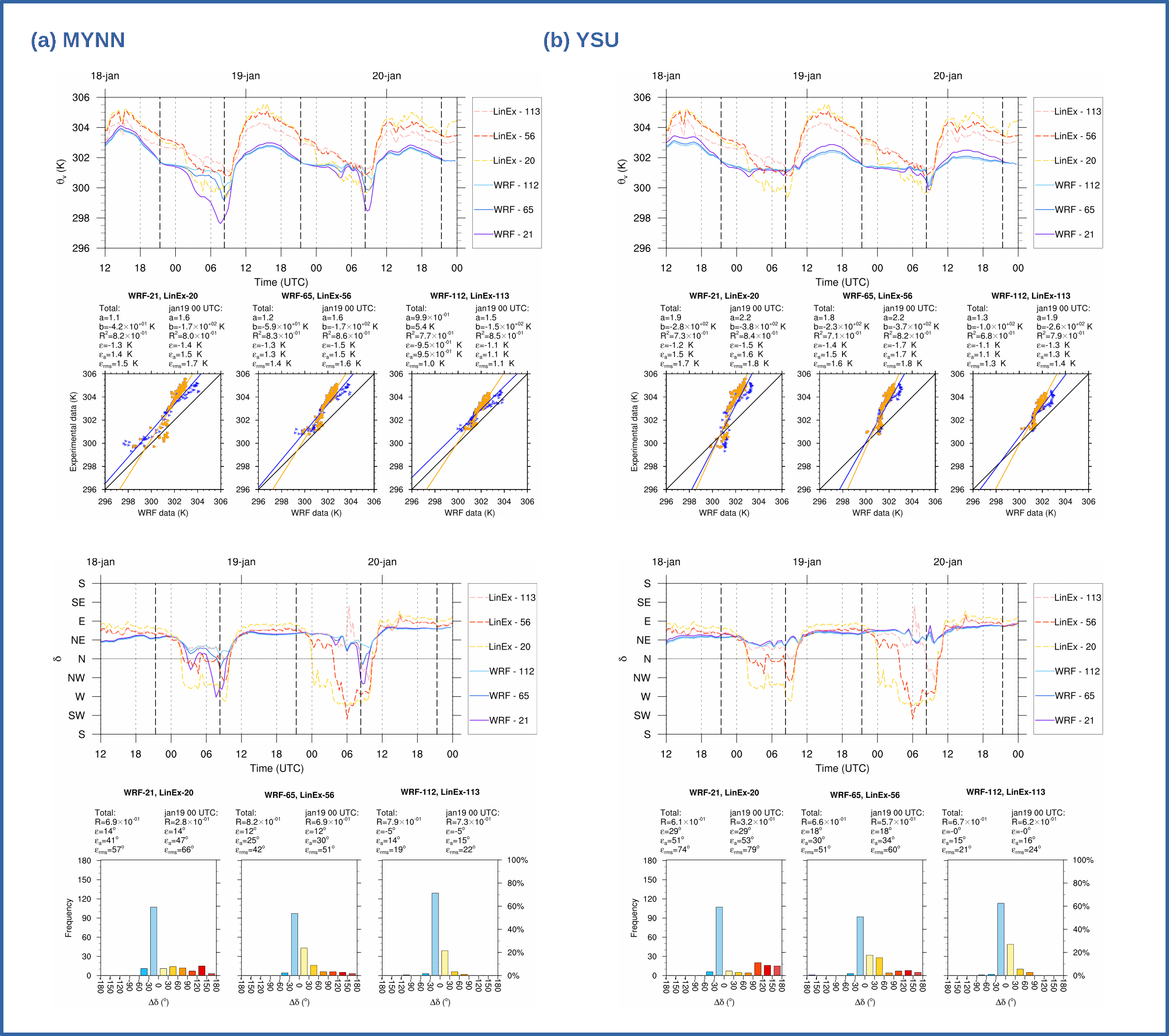
 - Indicates paper has been withdrawn from meeting
 - Indicates an Award Winner