
As part of the National Aeronautics and Space Administration’s (NASA) Nationwide Eclipse Ballooning Project (NEBP), the University at Albany (UAlbany), State University of New York deployed a team of undergraduate and graduate students, mentored by three faculty members and a post-doctoral scholar, to a site within the path of totality at Fort Drum, NY. Commencing 24 hrs before totality (which occurred at 1522 LT on 8 April), and continuing for 6 hrs after (through 1900 LT), the student-led team launched 32 balloons, mostly on the hour, coordinating launches with a NASA team operating instrumented profiling drones 200 m northeast of the UAlbany group.
Although high level clouds moved over the site (and the western half of New York State) about 30 min before totality, the effects of totality on surface-atmosphere exchange processes were still significant. In addition to the decrease in local surface temperatures (and concomitant increase in humidity), profiles from the balloon launches show rapid changes in the thermodynamic structure of the atmospheric boundary layer (Figure 2) responding to the accelerating loss of available surface energy driving convection. Here, we present local and regional analyses of how “turning off the sun” for a few minutes essentially squeezed the typical 24 hr diurnal cycle—that is the evolution and response of temperature, moisture and surface exchange processes—into less than 3 hrs. For example, the rapid decrease of available energy observed at a nearby flux site (Belleville) led to radiative cooling at the surface and a rapid decay of turbulence in the atmospheric boundary layer (ABL; e.g., potential temperature profile, see Figure 2 (left)). This resulted in moisture flux convergence at the surface (hence the increase in surface dew points) and a redistribution of heat and moisture in the residual ABL (Figure 2). With the increase in radiative fluxes following totality (Figure 2), the ABL began to at least partially recover, although given the time of day (late afternoon) the boundary layer was never able to fully mix out.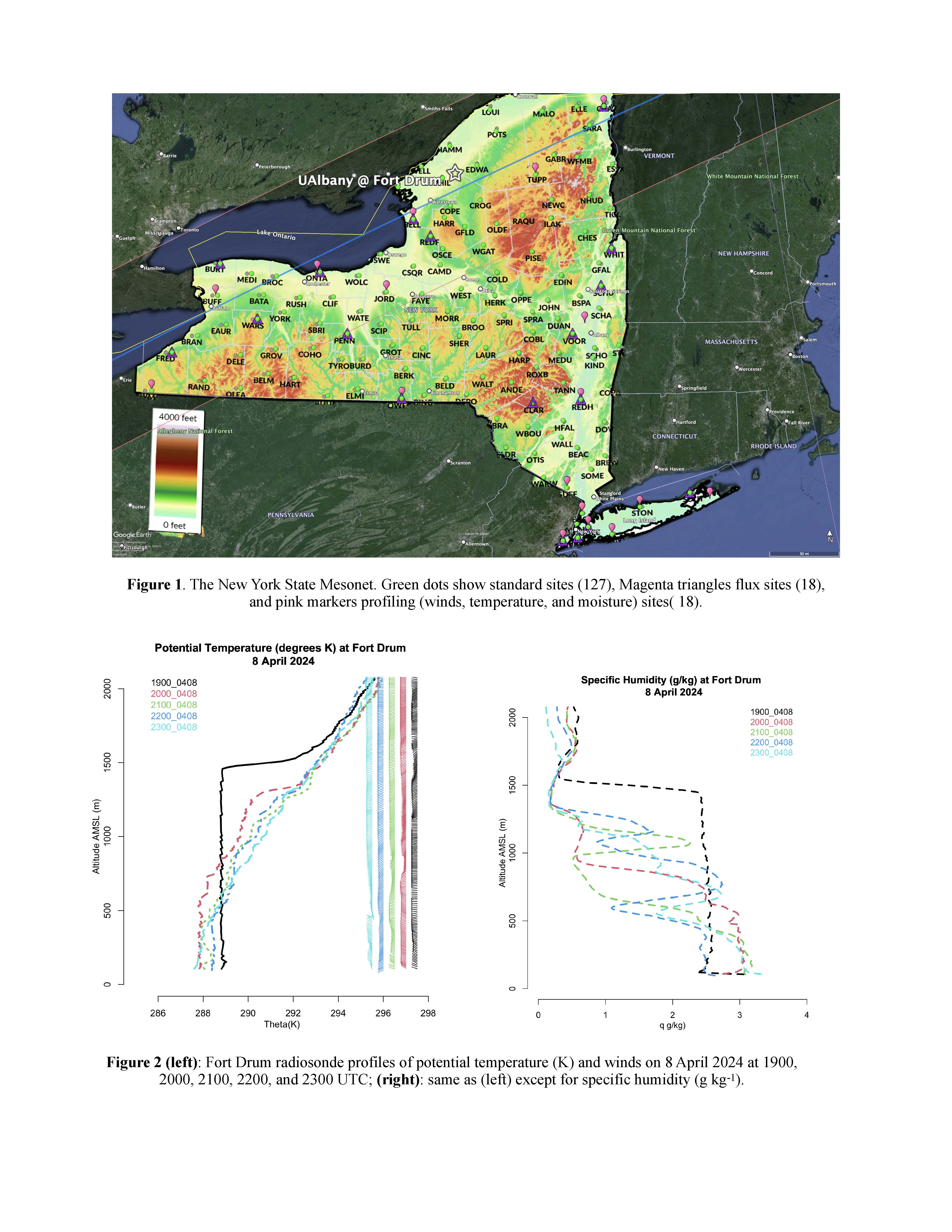
 - Indicates paper has been withdrawn from meeting
 - Indicates an Award Winner