
Tuesday, 14 January 2025
Hall C (New Orleans Ernest N. Morial Convention Center)
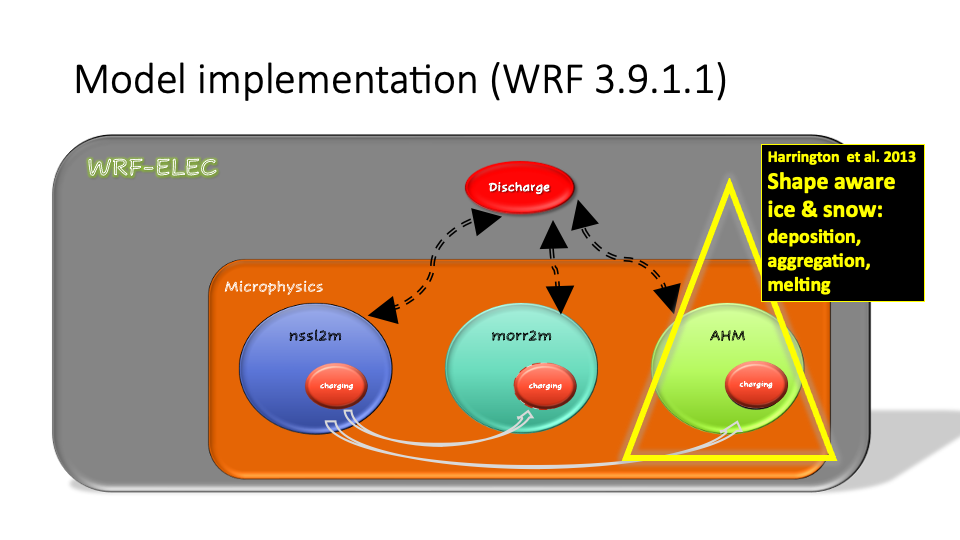
Explicit modeling of cloud electrification is challenging, requiring combined understanding of many aspects of the atmosphere and its outer reaches. This talk presents a subset of efforts done on cloud ice particle interactions. As a major category of hydrometeors involved in non-inductive charging, ice crystals are able evolve their habits adapted to the growing environment in the novel Adaptive Habit Model (AHM) microphysics scheme. Snow particles are subsequently shape aware as well, with related processes (e.g., aggregations, melting, deposition and sublimation) coded to consider the particle aspect ratio. The charging scheme embedded in the National Severe Storm Lab (NSSL) scheme was implemented in AHM and the Morrison Two Moment scheme in WRF. Case studies were conducted on deep (late spring great plain squall line) and shallow (wintertime lake effect snow storm) convections. Results show that: 1) Graupel parameterization remains dominantly important in electrification calculation. 2) snow self aggregation is an important process to generate sufficient charge separation. 3) All schemes have trouble capturing observed lightning in the winter storm.
 - Indicates paper has been withdrawn from meeting
 - Indicates an Award Winner