
Handout (2.6 MB)
There are similarities and differences between clouds in a convection chamber and clouds in the atmosphere in terms of the processes that determine the droplet size distribution (DSD). The most obvious similarity is the role of cloud droplet number concentration in controlling the mean radius of the droplet size distribution (DSD). Another similarity is the role of injected or entrained CCN. In addition to the differences in the supersaturation production processes, differences include the degree of variability in droplet residence time. All of these processes combine to determine the mean and width of the DSD and the onset of collision-coalescence in a convection cloud chamber and in nature.
We will explain and discuss how we can study processes that are important in natural clouds in a laboratory convection cloud chamber. For example, in natural clouds, entrainment and mixing leads to supersaturation variability among droplet histories, thereby broadening the DSD and favoring the onset of collision-coalescence. However, in a convection cloud chamber, DSD broadening occurs as a consequence of the large range of droplet residence times due to turbulent mixing, and to supersaturation variability due to temperature and water vapor fluxes from the bottom, top, and side walls, which have different temperatures and mixing ratios. These fluxes are analogous to entrainment fluxes in natural clouds. In a cloud chamber, unlike in natural clouds, the DSD width can be precisely controlled (via the CCN injection rate, the temperature difference between lower and upper surfaces, and the side wall temperature and degree of saturation) which allows detailed studies of the conditions favorable for the onset of collision-coalescence.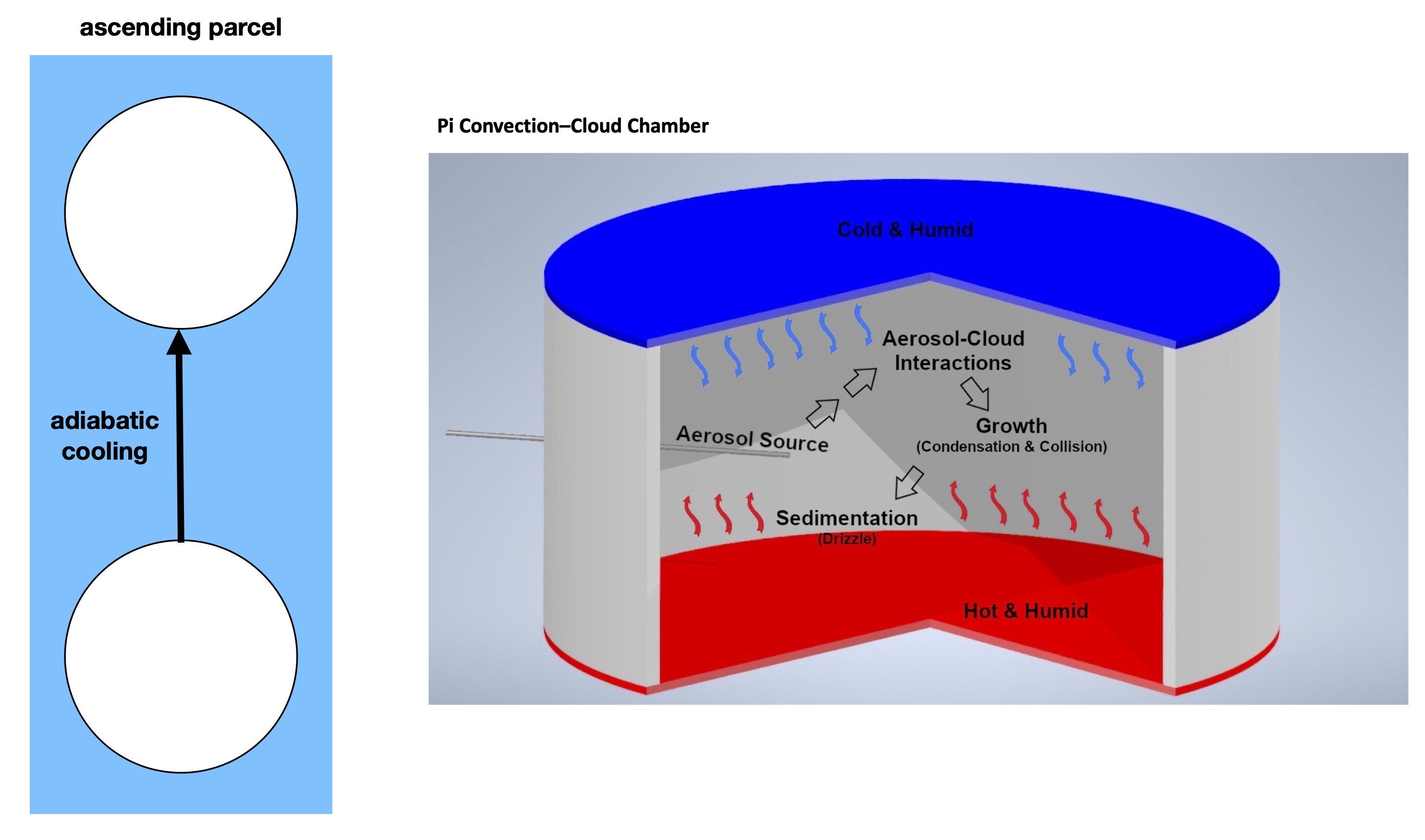
 - Indicates paper has been withdrawn from meeting
 - Indicates an Award Winner