
Measurements of water vapor in the Pi Chamber have been made by using an infrared hygrometer. Anderson et al. (2021, 2024) combined these with temperature measured by a sonic temperature sensor to calculate supersaturation. This approach provides estimates of both mean and fluctuating supersaturation. However, Anderson et al. (2024) noted limitations in their ability to measure the absolute magnitude of the supersaturation, which has motivated us to investigate methods of inferring the chamber mean supersaturation using additional or alternative measurements.
One such approach relies on the measured particle size distribution (PSD). PSDs are measured in the Pi Chamber using the WELAS2000 Digital Optical Particle Counter. We derived an equation to estimate the mean supersaturation from the measured PSD and the injected CCN properties. The equation is valid if the chamber is well-mixed. We are in the process of testing this method using particle-resolving simulations of the Pi Chamber. We are using the One-Dimensional Turbulence (ODT) model, and two direct numerical simulation (DNS) models (from NSF NCAR and University of Notre Dame). The results are accurate when the mean supersaturation is positive (as shown in the graphic), but not so when the mean supersaturation is negative. We suspect that the inaccurate results occur when the well-mixed assumption is violated.
We are currently investigating a version of the PSD method that is more general, as well as another method that relies on comparisons of measured and theoretical ratios of moments of the PDF in conjunction with the measured supersaturation variance (which should be more reliable than the measured mean supersaturation).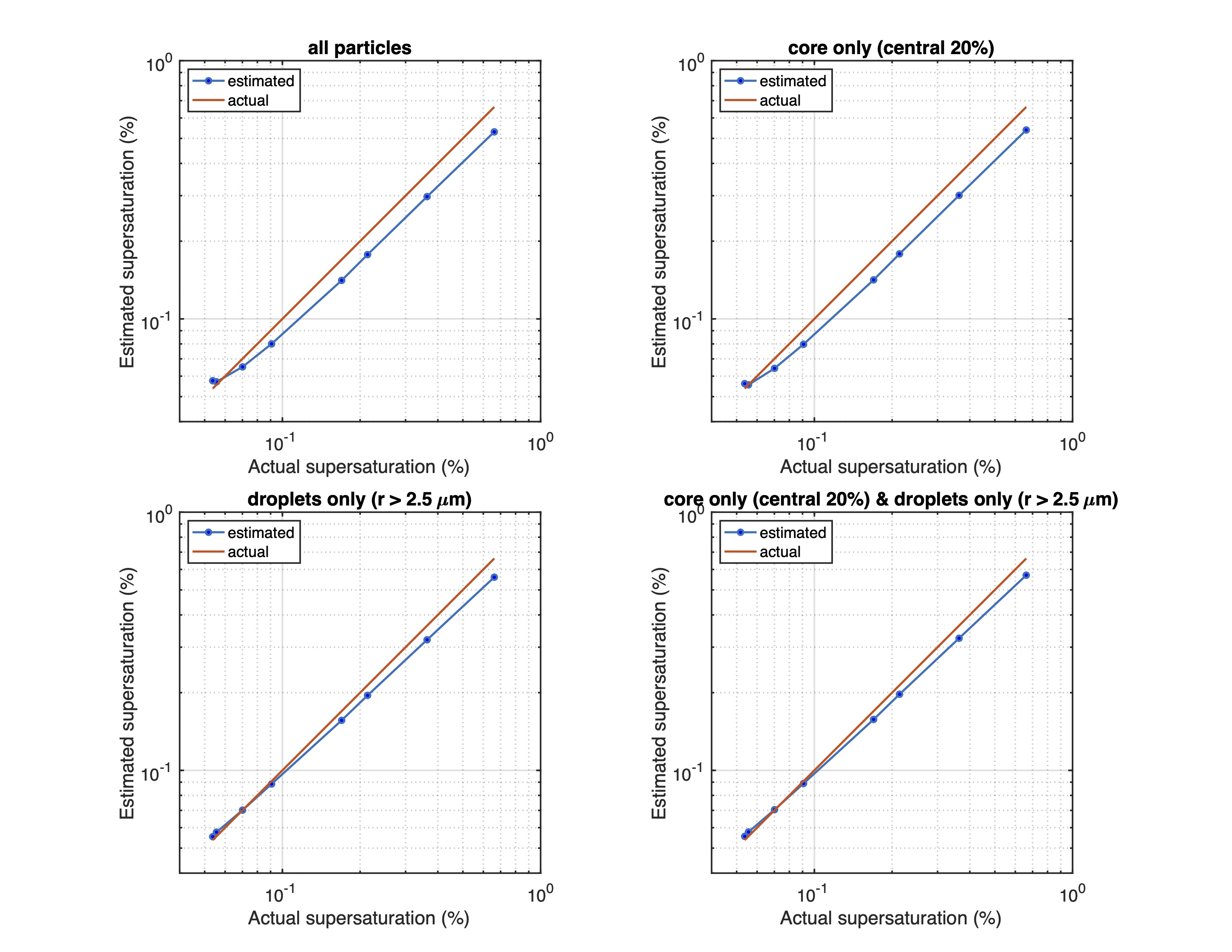
 - Indicates paper has been withdrawn from meeting
 - Indicates an Award Winner