
Executive Summary
The Maintenance Decision Support System (MDSS) Pooled Fund Study is a multi-state collaborative effort to develop and enhance a decision support tool for winter road maintenance operations. Led by the South Dakota Department of Transportation, this ongoing project aims to improve the efficiency and effectiveness of winter maintenance activities through advanced weather forecasting, road condition modeling, and maintenance treatment recommendations. The study began in 2002 with four founding member states and has continued to advance the technology of winter maintenance decision support services with new research tasks and operational enhancements to meet the changing needs of state transportation agencies. Key focus areas include improving the subjective and objective assessment of winter maintenance treatment recommendations, integrating new data sources including road weather friction measurements, enhancing liquid deicer decision support capabilities, and developing comprehensive training programs to improve acceptance of the technology in daily operations. The MDSS has demonstrated significant potential for optimizing resource allocation and improving road safety during winter weather events along with reducing costs to ensure agencies meet their level of service within budgetary constraints.
Introduction
Winter road maintenance is a critical and resource-intensive operation for transportation agencies across the United States. The MDSS Pooled Fund Study, initiated in 2002, brings together multiple state departments of transportation to collaboratively develop and refine a sophisticated decision support system for winter maintenance operations. The South Dakota Department of Transportation has been the program sponsor and DTN has been the primary contractor leading this effort, which combines advanced weather forecasting, road condition modeling, and maintenance practice optimization. The MDSS integrates various data sources, including road weather information systems (RWIS), automatic vehicle location/mobile data collection (AVL/MDC) data from maintenance vehicles, and high-resolution weather forecasts. It provides maintenance personnel with route-specific treatment recommendations, helping to optimize the use of materials and equipment while striving to maintain desired levels of service on roadways. Throughout its 22 years, the MDSS PFS project has followed an iterative process of research, development, field testing, and operational deployment. Key components of the methodology include:
- Continuous improvement of pavement condition forecasting modeling
- Integration of real-time data from various sources (RWIS, AVL/MDC, mobile sensors)
- Development and refinement of treatment recommendation algorithms
- User interface enhancements for both web and mobile platforms
- Extensive field testing and validation with participating state agencies
- Regular feedback and direction from the project Technical Panel
Current Research
The current research within the MDSS PFS project includes:
- Assessment of Recommendations
- Integration of Friction Data
- Level of Service Analysis
- Improved Forecast Verification Tools
- Improved Liquid Deicer Recommendations
- Enhanced Training Methods
- Potential integration of Probe/OEM and Crowd-Sourced Data
Initial results from the Assessment of Recommendations task indicate that approximately 80% of MDSS recommendations are accepted by users. The primary reasons for declined recommendations include inaccurate current road condition assessments and rapidly changing weather conditions. Further data collection is planned for the upcoming winter season to further validate current hypotheses around why certain weather and road conditions lead to greater MDSS treatment recommendation declines. The integration of friction data from mobile sensors has shown promise in improving road condition assessments, but challenges remain in standardizing data across different sensor types and manufacturers. Early work on the liquid deicer task has highlighted the need for better documentation of chemical properties and performance characteristics, particularly for proprietary blends. This information is crucial for accurate modeling and recommendation generation within MDSS. The development of objective analysis tools has significantly enhanced the ability to evaluate MDSS performance and troubleshoot issues reported by users. These tools have also proven valuable for training purposes and technical support.
Acceptance of MDSS in Operations
The MDSS has seen varying levels of acceptance and usability across different agencies and user groups. Key insights from user feedback include:
- Management Support and Champion Roles
- Strong management support is crucial for a successful MDSS implementation including finding MDSS champions who promote the technology to their peers. Each agency has approached these challenges differently but those that have found the most success have formed statewide teams with representatives from each district to solve problems and promote MDSS use.
- User Interfaces and Consumption Methods
- The MDSS project has recognized that multiple methods of capturing the MDSS information is critical for buy-in as each level of management uses the information differently.
- Decision Making and Treatment Recommendations
- In most cases, operators make the final decision on treatments, using MDSS as a tool to support their decision-making process. There is an emphasis on the importance of user input and not treating MDSS as a "set-it-and-forget-it" system.
- Ease of Use and Training
- Users generally find that the more exposure they have to MDSS, the easier it becomes to use. Simplicity is key: "The easier we can make it, the more it will be used." In-person training is preferred and considered more effective than remote training. Some agencies have created specific training videos and incorporated MDSS training into new employee onboarding processes.
- Challenges and Barriers to Adoption
- Connectivity issues with AVL/MDC systems can negatively impact user experience and trust. The complexity of MDSS and its steep learning curve can be a barrier to adoption, especially for new or less tech-savvy users. Staff turnover and retirement of experienced personnel pose challenges to widespread adoption.
- Benefits and Positive Outcomes
- MDSS provides a starting point for new employees who lack extensive winter maintenance experience. The system offers transparency and accountability, allowing agencies to analyze and discuss performance. Year-round use maintain familiarity and reduces the need for retraining each winter.
Conclusions
The MDSS Pooled Fund Study continues to drive innovation in winter maintenance operations through collaborative research and development. By combining advanced weather forecasting, road condition modeling, and maintenance best practices, the MDSS provides a powerful tool for transportation agencies to optimize their winter maintenance activities. The ongoing research tasks address critical areas for improvement, ensuring that the system remains at the forefront of winter maintenance technology. As the project advances, the potential for significant cost savings, improved road safety, and reduced environmental impact through optimized chemical use becomes increasingly apparent.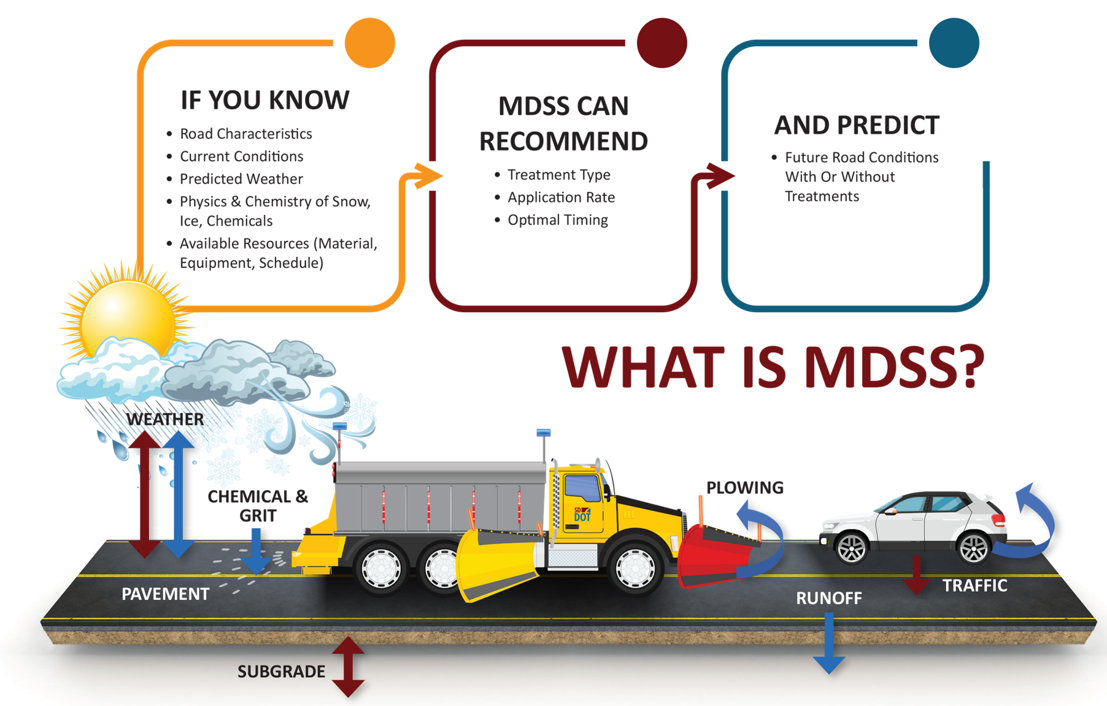
 - Indicates paper has been withdrawn from meeting
 - Indicates an Award Winner