
Handout (2.9 MB)
However, monitoring this process at short spatiotemporal scales is experimentally challenging. To address this, we employ molecular-scale simulations to study secondary nucleation behavior with high resolution over a wide range of cirrus temperatures and ambient pressures.
To examine our hypothesis, we investigate nucleation on flat, convex, and concave surfaces to understand the effect of surface roughness on ice nucleation. Since all types of roughness can be represented by combinations of convex and concave surfaces, this approach provides a comprehensive and generalized insight into the impact of surface roughness on nucleation. Beside, the ice nucleation on the convex surface provide us insight about nucleation on nanoparticles. Although limitations in computational resources may prevent us from modeling micro-sized ice-crystals with small curvatures, our simulations still provide qualitative insights into the impact of surface curvature on ice nucleation. Furthermore, we model ice nucleation of water vapor under confinement, exploring scenarios where water vapor trapped in small cracks or between ice crystals can lead to localized supersaturation, thereby promoting nucleation at these confined sites. Our preliminary results suggest that secondary ice nucleation exhibits different dynamics under varying levels of confinement.
By combining these approaches, our study offers a deeper understanding of the mechanisms driving secondary ice nucleation and the role of surface characteristics in this complex process.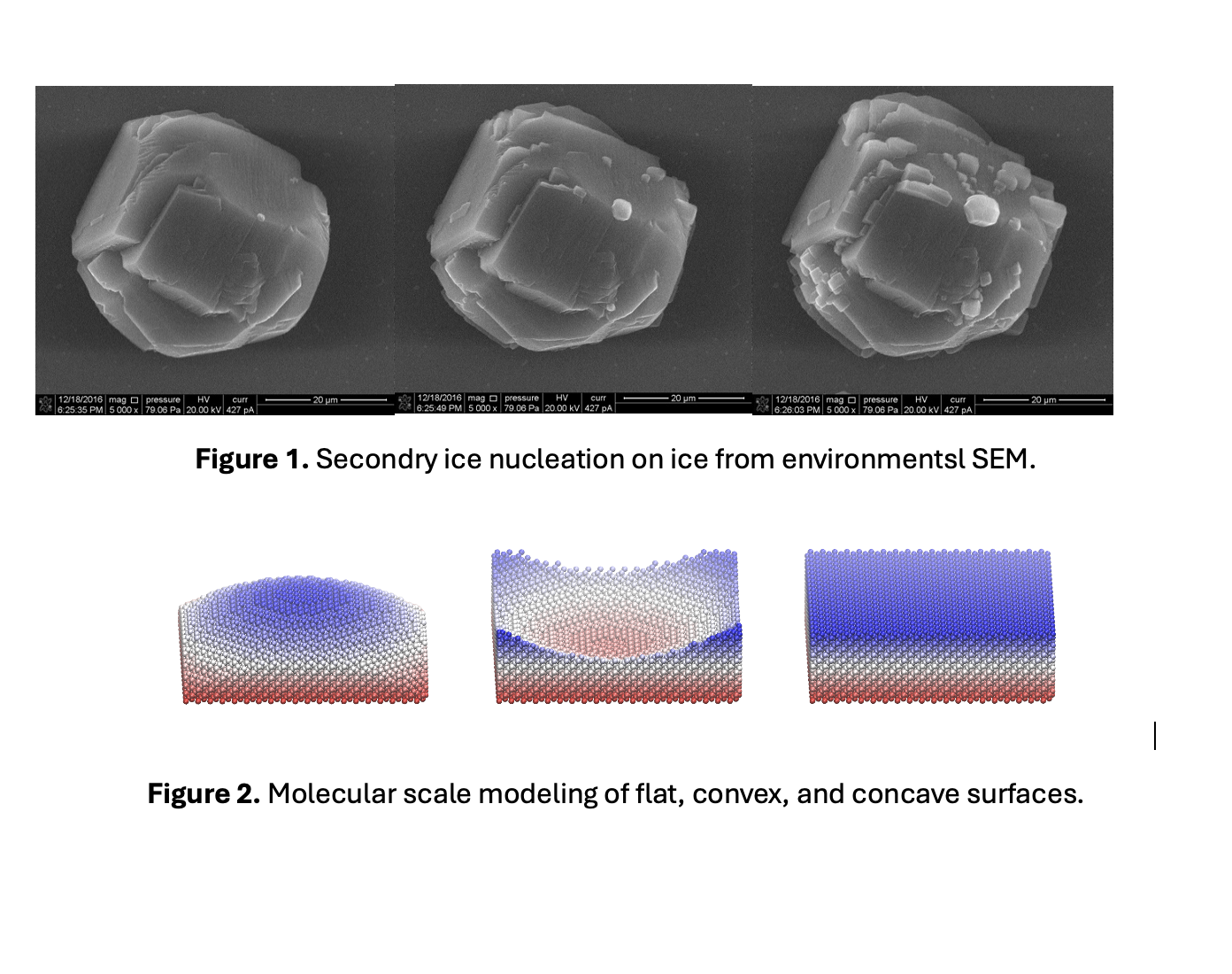
 - Indicates paper has been withdrawn from meeting
 - Indicates an Award Winner