
We identified activation, condensation, deactivation, evaporation, and sedimentation as the dominant microphysical processes driving these diverse dispersion effects. Threshold values for the first bin strength (0.3-0.4) and volume-mean diameter (10-14 μm) were established to classify the different dispersion regimes. Based on the observed ε-Dv correlations, we developed a non-monotonic parameterization of ε using the Nelder function.
The wide range of droplet sizes during fog events reflects complex fog dynamics, where multiple microphysical processes contribute to droplet formation. The presence of different droplet sizes during dissipation suggests that visibility can remain low even as fog dissipates due to the persistence of larger droplets.
This study provides new insights into the complex dispersion effects observed in polluted urban fog environments. By elucidating the roles of key microphysical processes, our findings contribute to reducing uncertainties in the simulation of aerosol-cloud interactions.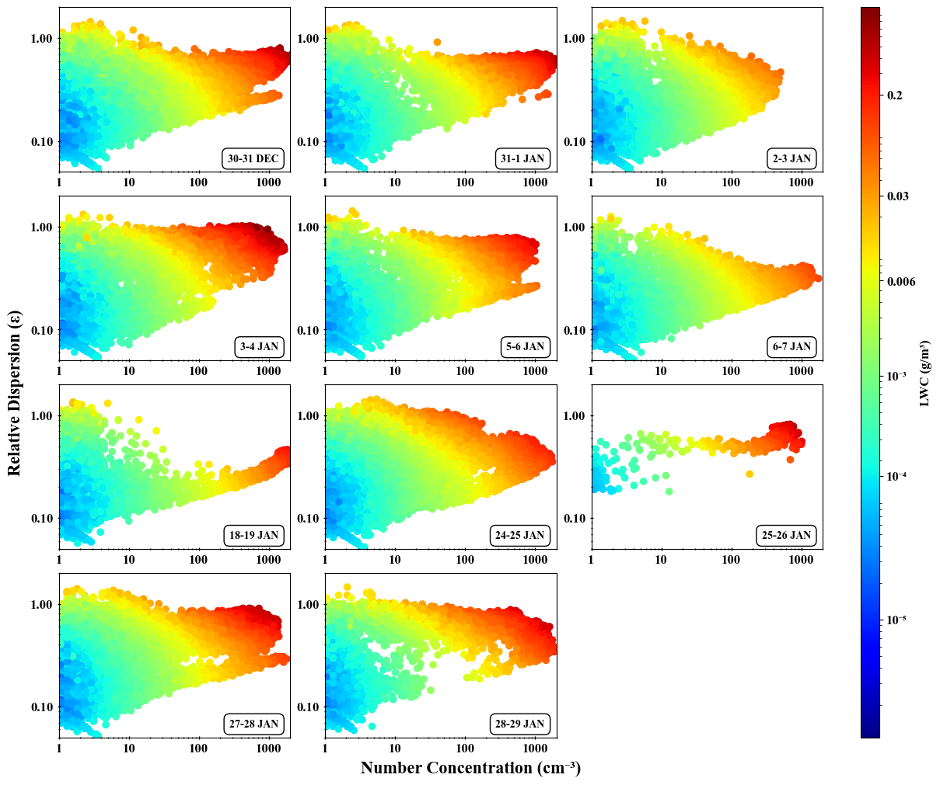
 - Indicates paper has been withdrawn from meeting
 - Indicates an Award Winner