
Handout (5.3 MB)
Figure 1 A hybrid analog-digital beamforming (ADBF) architecture of AESA system. The 56 digital channels provide the capability of the DBF process in the azimuth of a fixed fixed-range weather model.
A radar emulator ingests simulated source weather radar data observation and generates a pseudo real-time, multi-channel digital, radar time-series IQ data stream which is powered by a heterogeneous structure HPC with CPUs to process beam scheduling and data loading flow, GPUs to generate IQ data accordingly and following by FPGAs to emulate the receiver process of demodulation of the multi-channel signals [1].
The pseudo-real-time simulator generates a resembling time series echo response based on the observed ground truth reference echo data that is set up and processed by the HPC with tremendous computational power and immense processing time. The emulating weather data is generated in series by a rigorously electromagnetic backscattering simulation of weather models with fixed time step granularity which contains the temporal-varying response of weather models in range, velocity, angle, and amplitude with polarimetric diversity respected to the observative radar site.
In RSP simulation, however, the data reception period is varied based on the system configuration in pulse repetitive interval (PRI), scanning rate (SR), and numbers and angles of beamforming designated to the waveform configurations.
To access these emulated datasets efficiently in radar signal processing (RSP) simulation, an efficient event-driven simulation framework is introduced to associate the Physics-based precalculated weather model responses with the radar processing event accordingly without redoing the emulator to resolve the computational complexity and retain the fidelity of the echo data in RSP.
The weather model response is modified as the following form associated to the hydrometeors spectrum calculated by the emulator.
f(x)= 1/√(2πσ^2 ) e^(-〖(x-υ)〗^2/〖2σ〗^2 )
The υ is the radial velocity, the σ is the spectrum width of the hydrometeor’s samples in this observation cell.
The emulating weather data is generated in series by a rigorously electromagnetic backscattering simulation of weather models with fixed time step granularity which contains the temporal-varying response of weather models in range, velocity, angle, and amplitude with polarimetric diversity respected to the observative radar site.
In RSP simulation, however, the data reception period is varied based on the system configuration in pulse repetitive interval (PRI), scanning rate (SR), and numbers and angles of beamforming designated to the waveform configurations. An event-driven simulation structure processes the echo data based on the waveform configuration design. The time granularity will not be in fixed increments but rather invoked by the associated PRI, SR, and the aspect angle between the weather model and the designated beams. The designated simulation events vs. the overall emulator simulation time stamps wasare shown in Figure 1. This RSP in discrete event simulation (DES) architecture utilizes the physics-based weather emulation model and. It processes the data on the event invoked by the radar configuration settings regardless of the irrelevant dataset which is not matched to this specific radar configuration [2].
Figure 2 An even-driven simulation architecture process the emulator data based on the arithmetic event schedule of radar configurations rather than a fixed time step increment.
The DES RSP performs high-fidelity results based on the genuine weather emulator as well as keeps the simulation efficiency and accuracy by invoking only the dataset happening at the time and perspective angle that is associated with the radar configuration.
With the DBF architecture of AESA radar system, the 56 row-wise beamformers provide the degree of freedom (DF) of the special signal process to enhance desired resource direction and suppress potential distortion sources within the radar searching field of view (FOV). A DBF DBF-based STAP denoise example was is shown in Figure 1. With the DFs in special and time domains, more efficient denoise processes can be introduced into RSP. A Doppler distortionless waveform design [3] and advanced STAP [4] enhance RSP performance in atmospheric observation applications. This DES framework provides a high high-fidelity and efficient platform for RSP simulation to carry on.
Figure 3 A space-time adaptive process (STAP) example is process under a DBF structure. In (a), a desired signal was under interference by a time-varying chirping noise (red square) and a signal tone jamming signal (red circle). In (b) showed these two interferences were removed after STAP.
* Corresponding author address: Yuan-Pin Cheng, Earth Observing Laboratory, National Center for Atmospheric Research (NCAR), Boulder, CO 80307-3000; e-mail: yuanpinc@ucar.edu
References
[1] Karboski, Adam, et al. "Airborne Polarimetric Doppler Phased Array Weather Radar: Digital Twin of the Active Electronically Scanned Array." 2022 IEEE International Symposium on Phased Array Systems & Technology (PAST). IEEE, 2022.
[2] Cheng, YuanPin, et al. "Hybrid High-Fidelity Modeling of Radar Scenarios using Atemporal, Discrete Event, and Time-Step Simulation." Proceedings of the World Congress on Engineering and Computer Science. Vol. 2. 2016.
[3] Nieh, Jo-Yen, and Yuan-Pin Cheng. "Innovative multi-target estimating with clutter-suppression technique for pulsed radar systems." Sensors 20.9 (2020): 2446.
[4] Mahafza, Bassem R. Radar systems analysis and design using MATLAB. Chapman and Hall/CRC, Ch.16, 2005.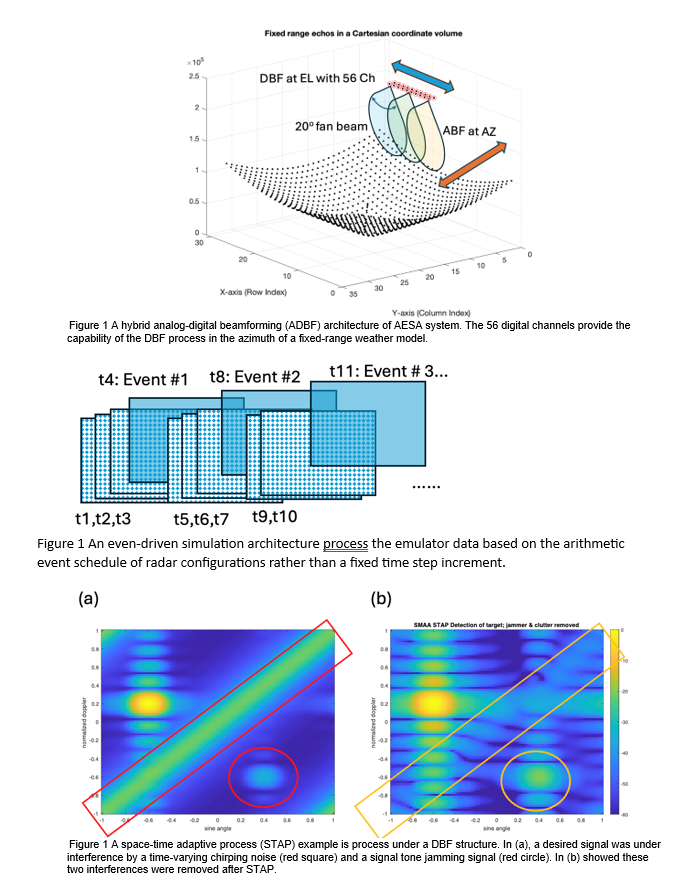
 - Indicates paper has been withdrawn from meeting
 - Indicates an Award Winner