
However, here it is shown that, for short-durations post eruption, ensembles of simulations of the Mt. Pinatubo eruption can reliably identify a signal in the maximum daily surface temperatures at spatially-local regions. This is aided by the use of tagged tracers, which separate the evolution of sulfate aerosols due to the eruption from other atmospheric aerosols. These tracers enable clear spatio-temporal tracking of the aerosol plume, and isolated assessment of their effect on the maximum surface temperature approximately one week after the eruption.
For this analysis, historical simulations of the Mt. Pinatubo eruption were performed using the Department of Energy funded Energy Exascale Earth System Model version 2 (E3SMv2) [1], modified with a stratospheric prognostic aerosol capability that enables evolving SO2 gas from the eruption into sulfate aerosols [2]. In addition to simulating the actual Mt. Pintubo eruption with an injection mass of 10 Tg of SO2, a counterfactual simulation with no eruption, and higher and lower injection masses (ranging from 15 Tg to 1 Tg) are also considered, similar to the variable mass approach of Marshall et al. [3].
At each injection mass, up to 13 ensemble members generated by perturbing the initial conditions were simulated and analyzed. The numbers of ensemble members required to identify the signal in the maximum daily surface temperature are compared for various mass injections. The short-term reduction in maximum surface temperature in the days post eruption is contrasted with warming in the stratosphere, which occurs months post eruption after the plume is dispersed around the globe.
References
[1] Golaz, J.-C., Van Roekel, L. P., Zheng, X., Roberts, A. F., Wolfe, J. D., Lin, W., et al. (2022). The DOE E3SM Model version 2: Overview of the physical model and initial model evaluation. Journal of Advances in Modeling Earth Systems, 14, e2022MS003156. https://doi.org/10.1029/2022MS003156
[2] Brown, Wagman, Bull, Peterson, Hillman, Liu, Ke, Lin, Validating a microphysical prognostic stratospheric aerosol implementation in E3SMv2 using observations after the Mount Pinatubo eruption, Geoscientific Model Development, 10.5194/gmd-17-5087-2024, 17, 13, (5087-5121), (2024).
[3] Marshall, L., Johnson, J. S., Mann, G. W., Lee, L., Dhomse, S. S., Regayre, L., et al. (2019). Exploring how eruption source parameters affect volcanic radiative forcing using statistical emulation. Journal of Geophysical Research: Atmospheres, 124, 964–985. https://doi.org/10.1029/2018JD028675
This work was funded by Sandia National Laboratories Laboratory Directed Research and Development (LDRD) funds through CLDERA Grand Challenge project.
This research used resources of the National Energy Research Scientific Computing Center (NERSC), a Department of Energy Office of Science User Facility using NERSC award BER-ERCAP0026535.
Sandia National Laboratories is a multimission laboratory managed and operated by National Technology & Engineering Solutions of Sandia, LLC, a wholly owned subsidiary of Honeywell International Inc., for the U.S. Department of Energy's National Nuclear Security Administration under contract DE-NA0003525. The views expressed in the article do not necessarily represent the views of the U.S. Department of Energy or the United States Government.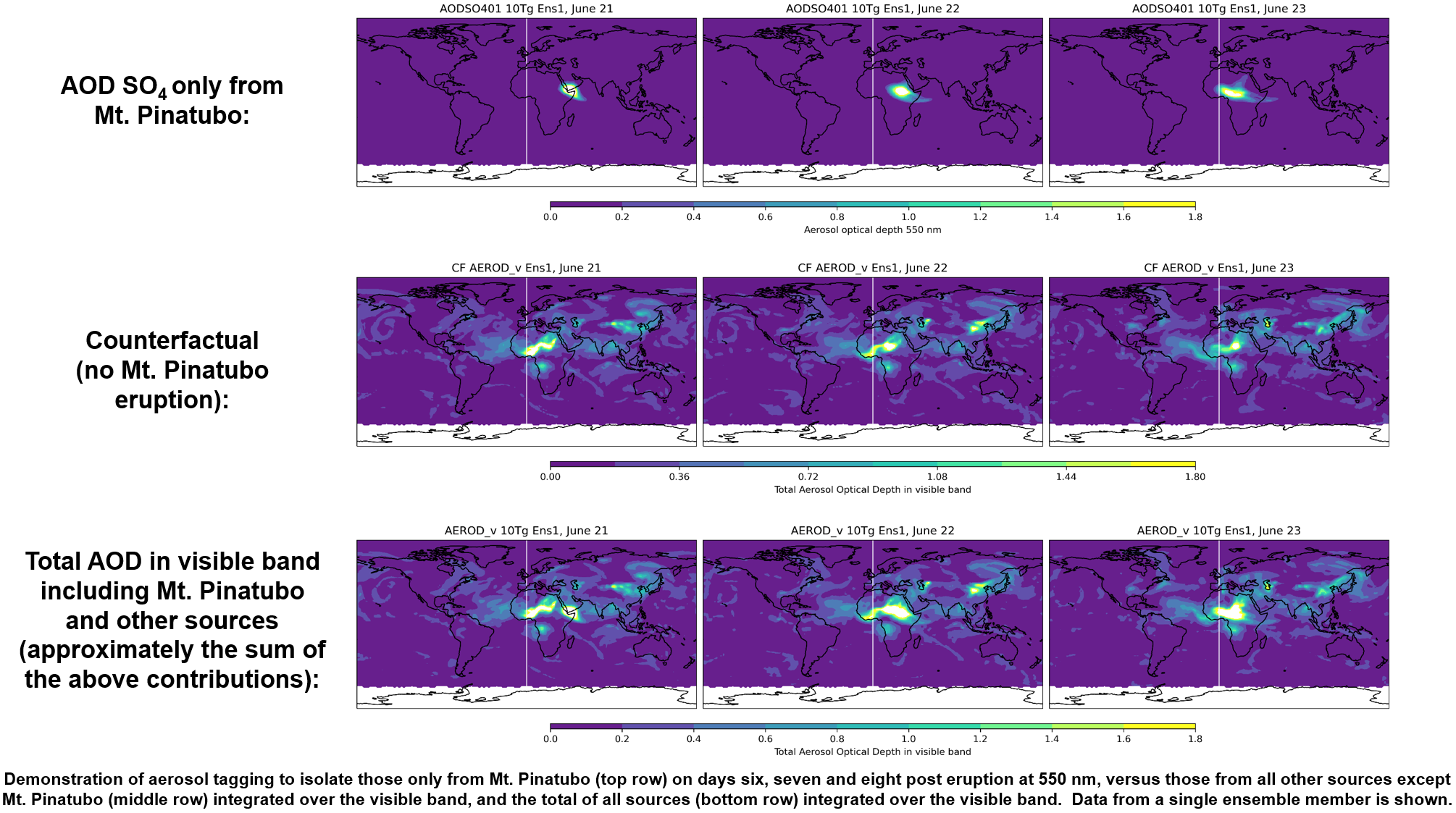
 - Indicates paper has been withdrawn from meeting
 - Indicates an Award Winner