
Monday, 13 January 2025: 9:30 AM
245 (New Orleans Ernest N. Morial Convention Center)
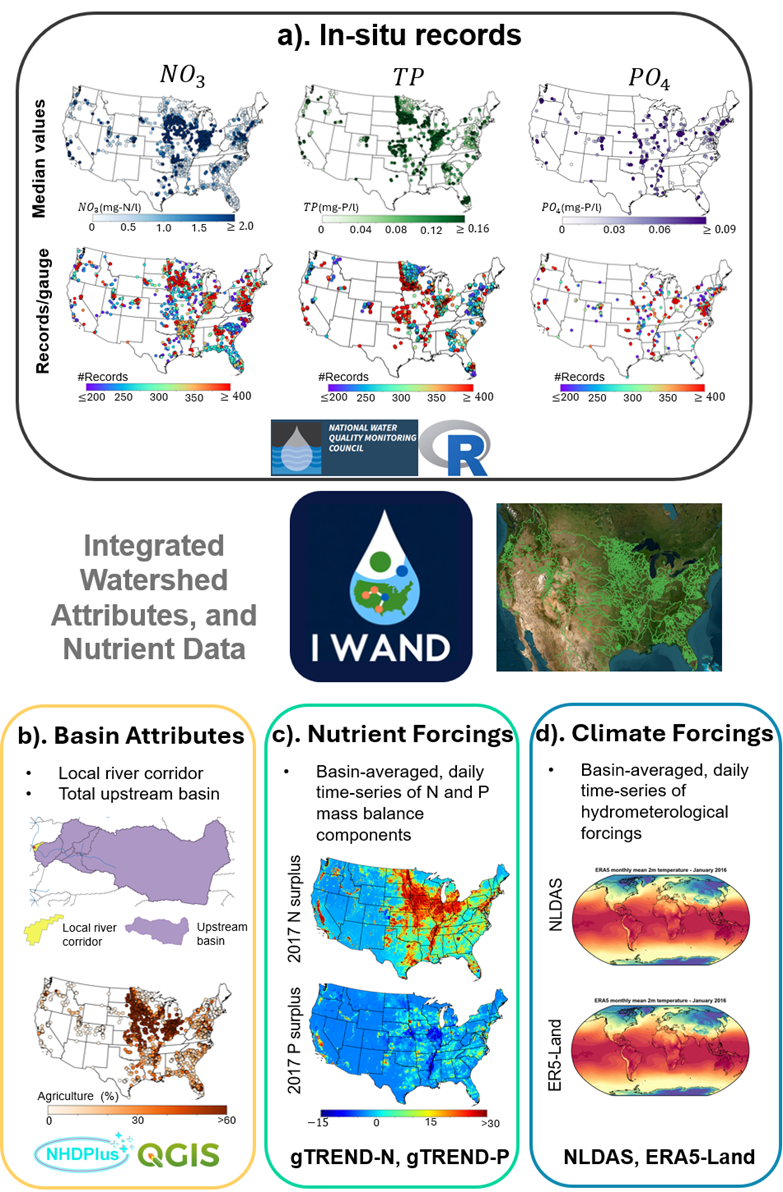
Water quantity predictions have gained tremendous progress from model development to theoretical derivation by Large-sample hydrology (LSH), going beyond single case studies and individual catchments. The backbone behind such progress is the CAMELS (Catchment Attributes and Meteorology for Large-sample Studies) dataset. However, large-scale water quality predictions, particularly for nitrogen (N) and phosphorus (P) lag behind due to the scarcity of ready-to-use datasets. We identify three primary limitations in existing water quality datasets: (1) limited spatial and temporal coverage, (2) a focus on watersheds with minimal human impact, and (3) a lack of detailed nutrient input forcing information. To address these gaps, we developed the Integrated Watershed Attributes and Nutrient Data (IWAND) dataset, building upon the state-of-the-art CAMELS-Chem dataset for the CONUS. The IWAND dataset includes over 1.2 million in-situ nutrient records (NO3, TP, and PO4) from 2453 different catchments, each with at least 200 measurements since 1980. This dataset pairs 40 watershed attributes for both the total upstream area and local corridor, 8 time-series nitrogen input forcings, 7 phosphorus input forcings, and 13 climate forcings. Our vision for IWAND is to serve as a nutrient data benchmark for the water quality community, facilitating better modeling and deeper physical understanding. To demonstrate its potential, we showcase the development of a multi-objective Long Short-Term Memory (LSTM) nutrient model based on the freshly-minted IWAND to simulate daily N and P in ungauged basins at a continental scale.
 - Indicates paper has been withdrawn from meeting
 - Indicates an Award Winner