
Safe flight of Advanced Air Mobility (AAM) systems in the US national airspace system, including unmanned aircraft systems (UAS) and urban air mobility (UAM), will require a high level of integration with weather awareness leading to autonomous navigation in wind and severe weather. New eVTOL autonomous aircraft must dynamically respond to varying weather conditions such as high winds, gust, and icing, including the rapidly changing conditions in urban environments. NASA’s efforts in UTM and AAM traffic management development must have real-time weather forecasting coupled with autonomous path planning in order to accommodate safe operation.
In addition to the challenges of traffic congestion and obstacles, critical technology gaps exist for modeling, detecting, and accommodating the dynamic local weather environment and for precision navigation through uncertain weather conditions. The WINDMAP program, a NASA University Leadership Initiative, is composed of a highly interdisciplinary team involving expertise from engineering (aerospace, computer, mechanical, and robotics), sensors, atmospheric physics, aviation weather, and numerical modeling to directly address these technical challenges. This talk will summarize the efforts including results from the Tulsa field campaign held in September 2024 focused on urban weather observaitons and predictions.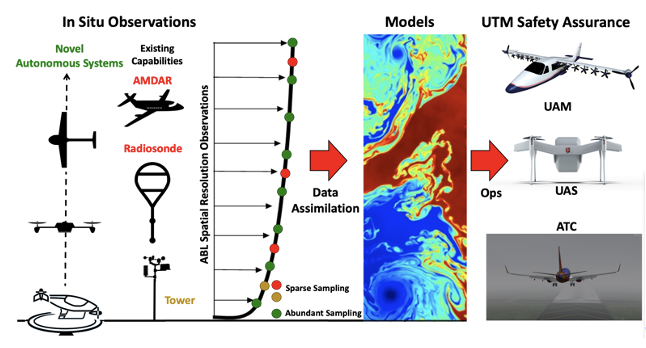
 - Indicates paper has been withdrawn from meeting
 - Indicates an Award Winner