
Monday, 13 January 2025
Hall C (New Orleans Ernest N. Morial Convention Center)
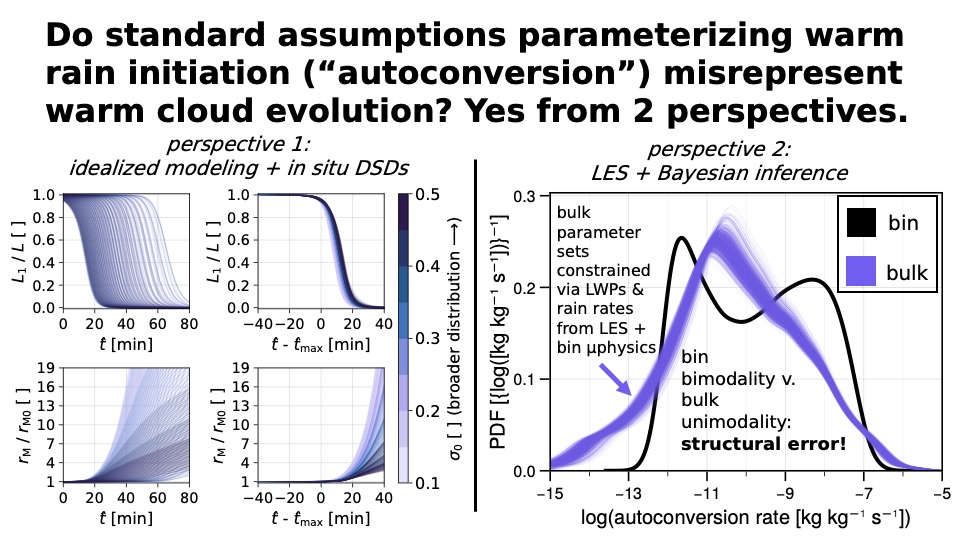
Liquid drop growth via collision-coalescence drives warm rain and modulates low cloud lifetimes and radiative properties. Despite this major role in Earth’s water cycle and radiation budget, fundamental questions exist about the capacity of standard bulk microphysics schemes (i.e., two category, one-two moment) to represent the initiation of significant collisional growth, commonly known as “autoconversion.” Here, we begin by highlighting that CMIP-class Earth System Models (ESMs) share fundamental structural assumptions in their parameterizations of autoconversion—structural assumptions with longstanding theoretical critiques. We present two approaches to assess these structural assumptions from a more applied perspective. First, we pair idealized modeling and in-situ drop size distribution observations to show evidence that the CMIP structural assumptions commonly break down in warm clouds. Second, we perform (machine learning-enabled) Bayesian inference using large eddy simulations with bin and bulk microphysics schemes to characterize the bulk scheme’s parametric error and distinguish it from structural error. We find evidence for structural error tied to autoconversion in the bulk scheme’s representation of emergent cloud and precipitation properties as well as process-level statistics supportive of the conclusions drawn from part 1. Taken together, these analyses suggest an urgent need to reformulate ESM autoconversion parameterizations. We discuss the implications of our work for future ESM parameterizations of collision-coalescence and the (potential) death of autoconversion.
 - Indicates paper has been withdrawn from meeting
 - Indicates an Award Winner