
The original goals were modified to the following list to take advantage of the presence of clouds that transitioned from an overcast of stratocumuli to broken convective clouds prior to the eclipse beginning:
- Acquire observations on rapid boundary layer transitions associated with cooling from eclipse-induced shading, and compare with a similar set of MAPNet observations around a similar time (1826 UTC) from the total solar eclipse on 21 August 2017.
- Examine the response of convective clouds during the boundary layer transitions from stabilization, followed by destabilization after resumption of solar heating, guided by the following physical chain of events for the initial stabilization: eclipse shading low-level cooling and stabilization reduction in BL turbulence and thermals decreased cloud vigor and coverage.
- Compare the vertical profile of cooling at the MAPNet sites in Texas, to a single profile site in NE Arkansas that experienced cooler, drier, and cloud-free conditions.
- Determine changes in AF behavior around the time of the eclipse, utilizing high-resolution MAX measurements (~30 km maximum range)
A triangular configuration was selected for the 2024 eclipse (as in the 2017 eclipse) to facilitate calculations of areally-averaged divergence, vertical vorticity, and horizontal advection (temperature and water vapor) over the network. The MAPNet consists of (a) three comprehensive profiling systems, two with radar wind profilers and one with a Doppler lidar; (b) similar microwave profilers, (c) lidar ceilometers at the two RWP sites, (d) radiosondes, (e) time-lapse photography, (f) surface instrumentation, and (g) solar radiation instruments.
Cloud observations from the lidars and ground-based photographic images were vital in this case due to the presence of Sc cloud cover (100%) in the early morning, which evolved to broken Sc and Cu med/con prior to the eclipse beginning. Variability in the surface temperature and 7-10 m wind response at the three sites was documented, and was more substantial at the MIPS site over the rough surface of the city of Whitney than over the wide open RaDAPS site. The temperature reduction was lower than expected at all three locations, in the range of 2-3 F. Another independent team equipped with Windsonde soundings and surface instrumentation deployed over the cooler and drier areas of NE Arkansas ~800 km NE of the MAPNet, where the skies were clear. Here, the temperature reduction was much larger at ~9 F.
As expected, both the areal coverage and vigor of the preexisting cloud field over the MAPNet domain decreased, and was commensurate with the near cessation of BL turbulent eddies as revealed in the t-z section of lidar backscatter and vertical velocity from the MoDLS Doppler lidar (attached Fig 1). The observed behavior as summarized above will be discussed in greater detail at the conference.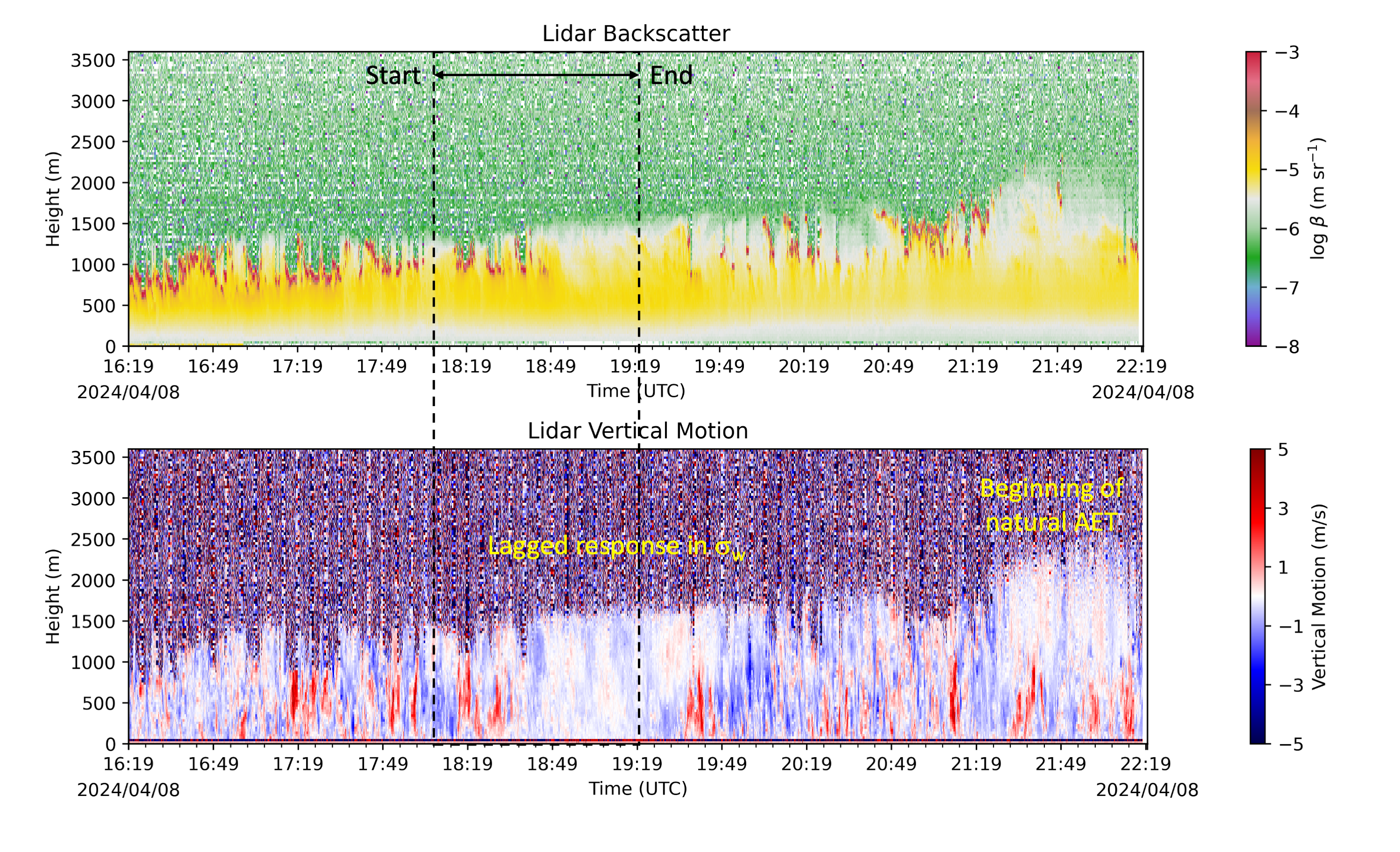
 - Indicates paper has been withdrawn from meeting
 - Indicates an Award Winner