Tuesday, 14 January 2025: 9:30 AM
224 (New Orleans Ernest N. Morial Convention Center)
Corey Bois, University of Utah, Salt Lake City, UT; and S. K. Krueger, T. J. Garrett, T. DeWitt, and K. Rees
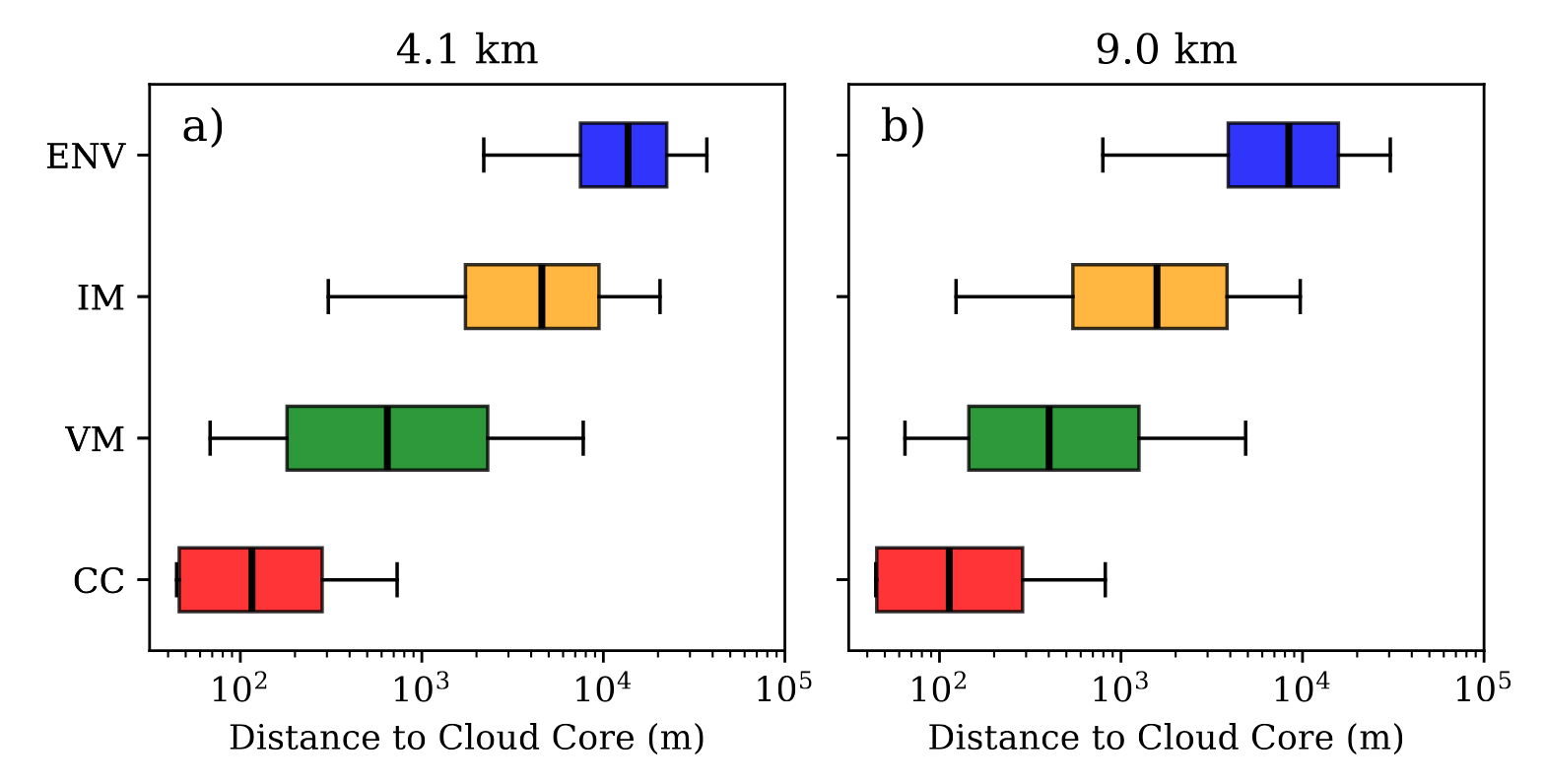
A long standing problem in cloud physics is defining where a cloud begins and ends, creating ambiguity in how exchanges of heat and water vapor occur between clouds and the broader environment. This problem is especially difficult in deep convection, where entrainment across the cloudy-clear interface has a significant impact on the intensity of the convection. The concept of a cloud-top entrainment "zone" in stratocumulus layers helped clarify their time-averaged properties. However, unlike stratiform clouds, the entrainment zone of deep convection consists of a complex 3-dimensional topology, and can be oriented parallel to the gravitational force. In order to better understand the physical properties of these zones, we investigate the near-cloud environment using a large eddy simulation (LES) of tropical deep convection. The LES was run with a horizontal grid spacing of 100 m and a horizontal domain spanning 204.8 km, consisting of over 1 billion gridpoints. Based on the partitioning scheme of Nair et al. (2021), we categorize each LES grid point into one of four groups: cloud core (CC), visible mixing (VM), invisible mixing (IM) and environment (ENV). These categories are based on cloud condensate, turbulent kinetic energy (TKE) and thermal buoyancy, with the intent to isolate convectively active regions with different dynamic properties. We then determine the horizontal distance of each grid point to the nearest cloud core in order to compare the relative location of each partition. The graphic shows the distributions of these distances for the four groups at two altitudes.
We find that the grid points that belong to the visible mixing partition (VM) are located closest to cloud cores, followed by invisible mixing (IM) and then the environment partition (ENV). Additionally, the visible mixing partition has a lesser net upward mass flux than cloud cores and the invisible mixing partition has a net downward mass flux. The profiles of mass flux are indicative of subsiding shells comprised of evaporatively cooled air located within 500 m of the cloud cores and extending to 7 or 8 km in altitude. This analysis highlights that convective clouds do not have a distinct "edge", but rather a zone of turbulently mixed air with a range of dynamic/thermodynamic properties. Furthermore, this study suggests that to accurately represent these cloudy-clear mixing regions in numerical models, a resolution of a few hundred meters or less is required.

- Indicates paper has been withdrawn from meeting

- Indicates an Award Winner
