
Ali Emre Koruk, Mustafa Kemal Cambazoglu
School of Ocean Science and Engineering, The University of Southern Mississippi, Stennis Space Center, MS
Understanding the impact of climate change on water resources is crucial for the planning and management of hydrometeorological systems, as well as for assessing the influence of riverine sources on estuaries, ecosystems, and fisheries. Conducting trend analysis of hydrometeorological data is an essential first step in this process. This study aims to perform a monthly-scale trend analysis using discharge data from United States Geological Surveys (USGS) gauge stations on the Mississippi River (MSR) and Pearl River (PR), United States. These rivers significantly affect water quality and salinity in the Mississippi Sound and Bight, which in turn influences the growth and sustainability of fisheries. Prior to analysis, the data undergoes three homogeneity tests: the Standard Normal Homogeneity Test, the Pettitt Test, and the Buishand Sequence Test. Only stations that are deemed homogeneous by at least two of these tests are included in the trend analysis. We employ innovative methodologies such as Innovative Trend Analysis (ITA) (Sen, 2012), Innovative Polygon Trend Analysis (IPTA) with the Star Concept (Şen et al., 2019; Şen, 2021), the Triangular Concept (Güçlü et al., 2020), and Improved Visualization for Innovative Trend Analysis (IV-ITA) (Güçlü, 2021), in addition to the widely used Mann-Kendall Test. The effects of climate change on the rivers will be determined, shedding light on the studies to be carried out in terms of flood protection and planning of river water resources such as the future operations of Bonnet Carré Spillway. For preliminary analysis, 2 stations (Baton Rouge and Belle Chasse) on the Mississippi River and 1 station (NR Monticello) on Pearl River were analyzed. The Mann-Kendall test detected trends in only 5 out of the 36 months analyzed, indicating that most of the data did not exhibit a significant trend over the analyzed period. However, Innovative methodologies’ results for river discharges reveal distinct patterns for the Mississippi and Pearl Rivers. We applied Innovative methodologies using monthly average river discharge data collected between 2006-2022. The ITA analysis demonstrates that the Mississippi River has a significant increasing trend (Figure 1 a-b) in monthly discharges, particularly for high values, while the Pearl River exhibits a notable decreasing trend (Figure 1c). The IPTA analysis allows us to obtain trends per month and highlights that Baton Rouge (MSR) has a significant increasing trend in river discharges from February to May, with climatological shifts between January-February and April-May (Figure 2a). Belle Chasse (MSR) also shows increasing trends from February to May. In contrast, Near Monticello (PR) displays an apparent decreasing trend, especially from February to June and December to January (Figure 2c). Whereas summer months have a slightly increasing trend with minimal month-to-month changes. Star concept graphs (Figure 2, b and d) show the changing trends between months such that at Mississippi River in Baton Rouge (Belle Chasse-not shown), Jun-Aug (Jun-Jul and Jul-Aug) have the highest decreasing trends, and Dec-Jan has the highest increasing trend. At Pearl River in Near Monticello, Dec-Jan has the highest increasing trend, and April-May has the highest decreasing trend. These findings underscore the contrasting hydrological behaviors of the two river systems over the analyzed period. We will also employ triangular methodologies of IPTA to detect sub-interval trends, and IV-ITA to quantify the intensity of decreasing or increasing trends. Once the preliminary analysis is completed, all Innovative methodologies will be used for extended time series analysis to discern trends attributable to climate change. This study aims to demonstrate the efficacy of these innovative trend detection approaches, thereby assisting natural resource managers and decision-makers in comprehending the impacts of climate change on major freshwater sources within the study area.
References:
Güçlü, Y. S., Şişman, E., & Dabanlı, İ. (2020). Innovative triangular trend analysis. Arabian Journal of Geosciences, 13(1), 27.
Güçlü, Y. S. (2020). Improved visualization for trend analysis by comparing with classical Mann-Kendall test and ITA. Journal of Hydrology, 584(February), 124674.
Şen, Zekai. (2012). Innovative trend analysis methodology. Journal of Hydrologic Engineering, 17(9), 1042–1046.
Şen, Zekâi, Şişman, E., & Dabanli, I. (2019). Innovative Polygon Trend Analysis (IPTA) and applications. Journal of Hydrology, 575(May), 202–210.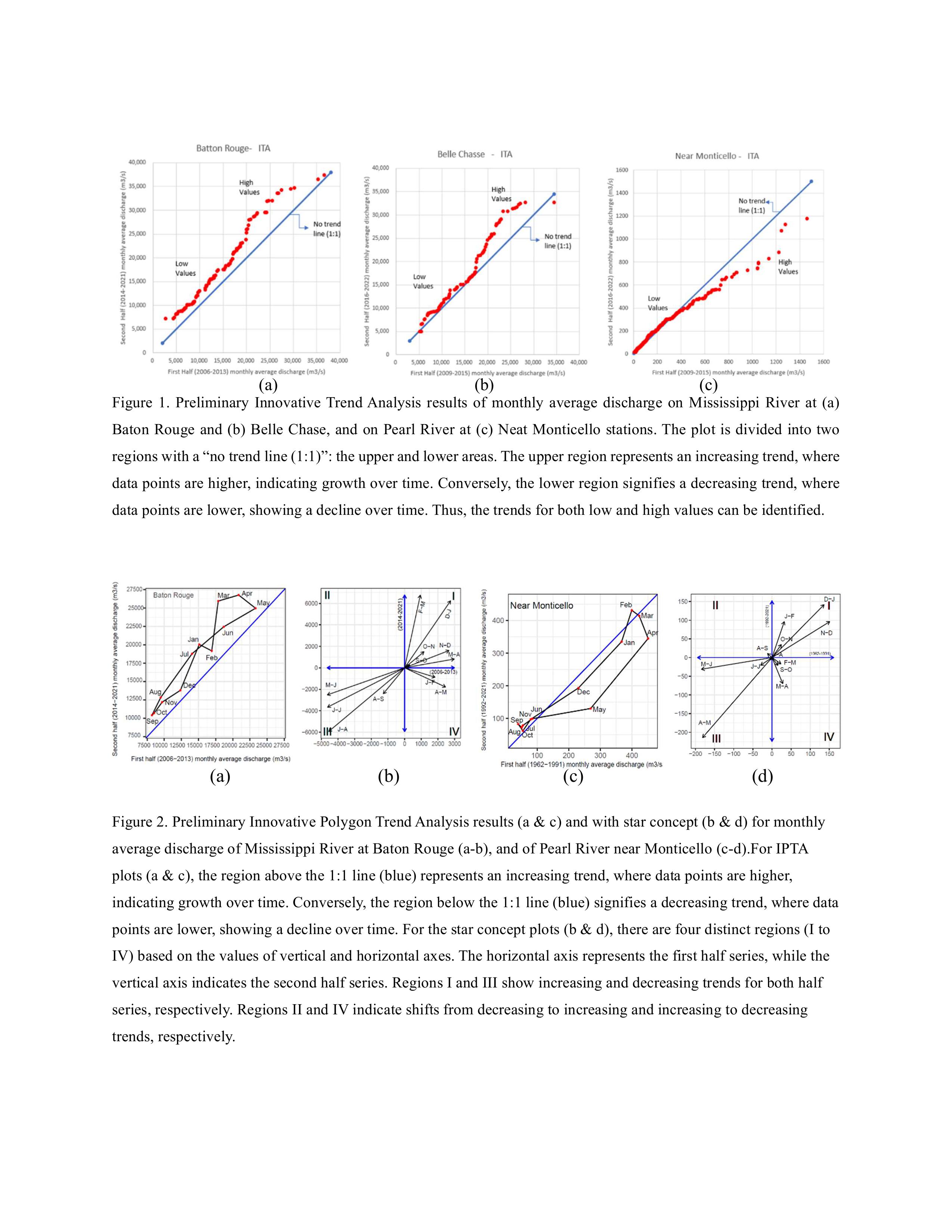
 - Indicates paper has been withdrawn from meeting
 - Indicates an Award Winner