
Monday, 13 January 2025
New Orleans Ernest N. Morial Convention Center
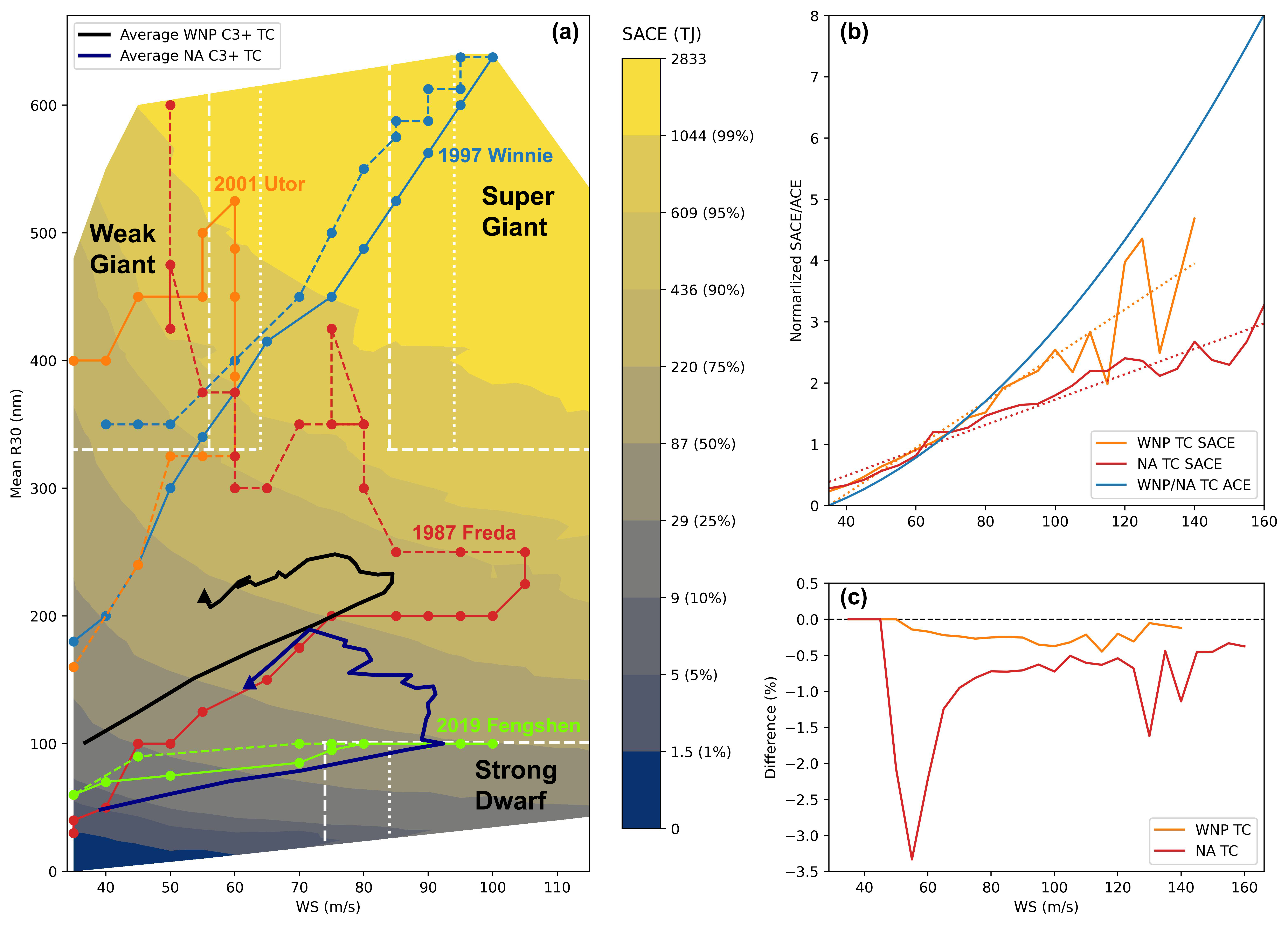
Accumulated Cyclone Energy (ACE) is a metric widely used to quantify tropical cyclone (TC) activity. However, it overlooks TC structure (i.e., size and asymmetry) because of its exclusive dependence on maximum wind speed, resulting in an inaccurate assessment of TC accumulated energy. To address this, we propose an improved metric, structural accumulated cyclone energy (SACE), using wind radii data from best track datasets (i.e., IBTrACS). SACE integrates an idealized wind profile azimuthally over the extent of TCs to account for TCs’ size and structure, which resembles an approximation to the integrated kinetic energy (IKE) of TCs based on observational data. We show that SACE reveals new aspects of tropical cyclone evolution, basin-wide activity, and temporal variability in the Western North Pacific (WNP) and North Atlantic (NA) basins. Compared to ACE, SACE shows relatively higher accumulated values at higher latitudes and lower values along parts of the coast, and it privileges weaker but larger TCs. SACE also shows stronger correlations with ENSO indices and environmental mid-level moisture compared to ACE in the WNP. Similarly, SACE can be computed for climate model evaluation purposes as it can be directly compared with observational SACE. Here, we evaluate TC simulation performance in the atmosphere-only historical simulations of ECMWF-LR-IFS and ECMWF-HR-IFS models. We track and detect WNP and NA TCs in the model outputs using an advanced tracking algorithm based on TempestExtremes (TE) and calculate their wind radii matching the data format of IBTrACS for model SACE computation. In addition to TC frequency and intensity, SACE reveals how well models simulate TC size and changes in TC size responding to environmental factors. We also show that SACE reduces the TC accumulated energy discrepancies between two different model resolutions.
 - Indicates paper has been withdrawn from meeting
 - Indicates an Award Winner